
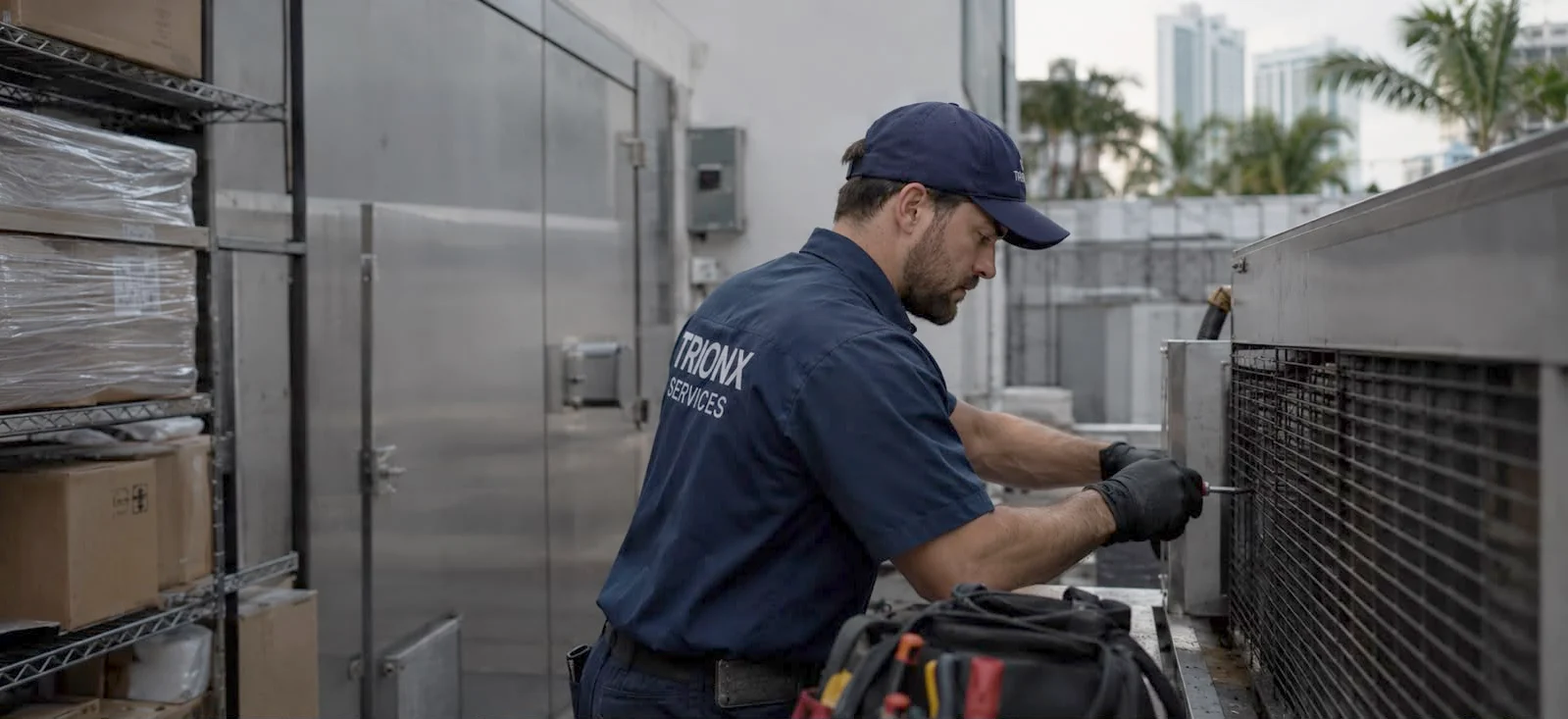
Refrigeration
Grocery and convenience: what actually keeps the doors open
A cabinet door that no longer seals costs more over a year than the repair ever would.
A grocery has one asset that decides whether it trades and a handful that decide whether it trades comfortably. The refrigeration is the first. Almost everything else on this list feeds into it.
The doors on the cold assets
Gaskets, hinges, closers, sweeps and strip curtains are hardware rather than refrigeration, and they are the most common reason a cabinet or a walk-in stops holding temperature.
A seal that has hardened, split or pulled out of its channel lets warm air in continuously. The system compensates by running longer, which costs energy every hour of every day and shortens the life of the plant doing it. None of that shows as a fault until the room actually drifts.
Run a hand around every door seal on a walk. Look for gaps at the corners, which go first, and for ice building at a threshold, which is a seal telling you it has already failed. Our article on a walk-in not holding temperature covers the door checks worth doing before a contractor is called, and the warning signs covers the predictive half.
Entrance doors, and the cycle count nobody estimates
A grocery entrance is operated more times in a week than most commercial doors manage in a year. Powered operators, sensors, seals and floor tracks all wear on a predictable schedule because the use is predictable.
That makes them scheduled items rather than reactive ones. A sensor that has drifted out of alignment, a track full of grit, or a safety device that somebody has bypassed to keep the door running are the three that turn up most, and the third is the one that matters. Our article on powered doors covers where the mechanical work ends and electrical begins.
Rear and delivery doors are the other half. They are propped during deliveries, which is the main pest route into a food premises, and the reason they get propped is usually that they no longer close properly on their own.
Floors, which are a liability rather than a finish
Spills, cart wheels and constant footfall work on a floor harder than anything else in the building. Tile debonds, grout fails along the lines traffic takes, and a raised edge in a public aisle becomes a trip claim.
Tap across a suspect area and listen for hollow. The debonded zone is nearly always larger than the tiles that have visibly failed, and knowing that before pricing decides whether it is a patch or a section. Our article on floor tile lifting covers it, and isolating a hazard the moment it is found matters more than the repair date.
Lighting sells the product and lights the parking lot
Aisle lighting fails one fixture at a time and nobody reports the third one, so a section dims gradually. On a chilled aisle it is also behind glass, which makes access a different job from a ceiling fixture.
The parking lot is the one that gets escalated, because it arrives as a safety concern from a customer rather than a maintenance fault. Our article on exterior lighting out covers walking it at night, because dark spots only show after dark.
What belongs on a schedule
Door seals and gaskets across every cold asset. Entrance door service. Floor inspection in the aisles. A night walk for exterior lighting. Temperature logs kept properly, which our article on temperature logs covers and which get asked for at inspection.
Power loss is a stock-loss clock
A grocery losing power is not the same event as an office losing power. Every cold asset starts a clock, and the temperature log across the outage is the record that gets asked for afterward.
Establish quickly whether it is the supply or the building, which is answered by looking at whether neighboring premises and the street lighting are also dark. Resist resetting a breaker that trips a second time. Our article on part of the building losing power covers both, and why the second trip matters.
Keep doors shut. Every opening on a cold asset during an outage costs recovery time the system may not have. Staff can change the outcome with this more than with anything else.
Before the season
A grocery has more to lose in a storm than most commercial property, because the loss is stock rather than fabric. Shutters tested rather than looked at, generator arrangements understood, and the temperature logging habit already in place before it is needed. Our article on testing hurricane shutters covers why a visual check finds nothing.
Who carries this out
Doors and hardware, cold room and cabinet door hardware, gaskets, sweeps, strip curtains, glass, flooring, ceiling, carpentry, painting and relamping are performed directly by our own technicians. TrionX carries general liability and workers' compensation on that work.
The sealed refrigeration system, electrical, plumbing and HVAC are carried out by licensed contractors, coordinated and documented by us, because Florida requires a license for those at any job size.
Common questions
Questions we get asked about this
Do you work on the refrigeration itself?
The sealed system is licensed work in Florida at any job size and goes through a licensed contractor, coordinated and documented by us. The doors, gaskets, closers, hinges, sweeps and strip curtains are hardware, and those are performed by our own technicians.
Why do gaskets matter so much?
Because a cabinet or walk-in that is not sealing runs continuously to hold temperature, which costs energy every hour and shortens the life of the plant. It is also the first thing to check when a room drifts warm, ahead of assuming the system has failed.
What fails on the entrance doors?
Cycle count. A grocery entrance is operated more than almost any door on commercial property, so operators, sensors, seals and floor tracks all wear on a schedule rather than at random. Treating them as scheduled items rather than waiting is materially cheaper.
What about the floors?
Spills, carts and constant traffic. Loose or lifting tile in a public aisle is a trip claim waiting to happen, and it is worth isolating the moment it is found rather than adding it to a list.
Keep reading
Related field notes



One company, whoever does the work
Our technicians handle the trades that need no state license, and licensed contractors handle the ones that do. Either way we scope it, book the visit and file the record. Tell us the property and the problem and we will come back with a window. Call out of hours and someone who works here answers.