
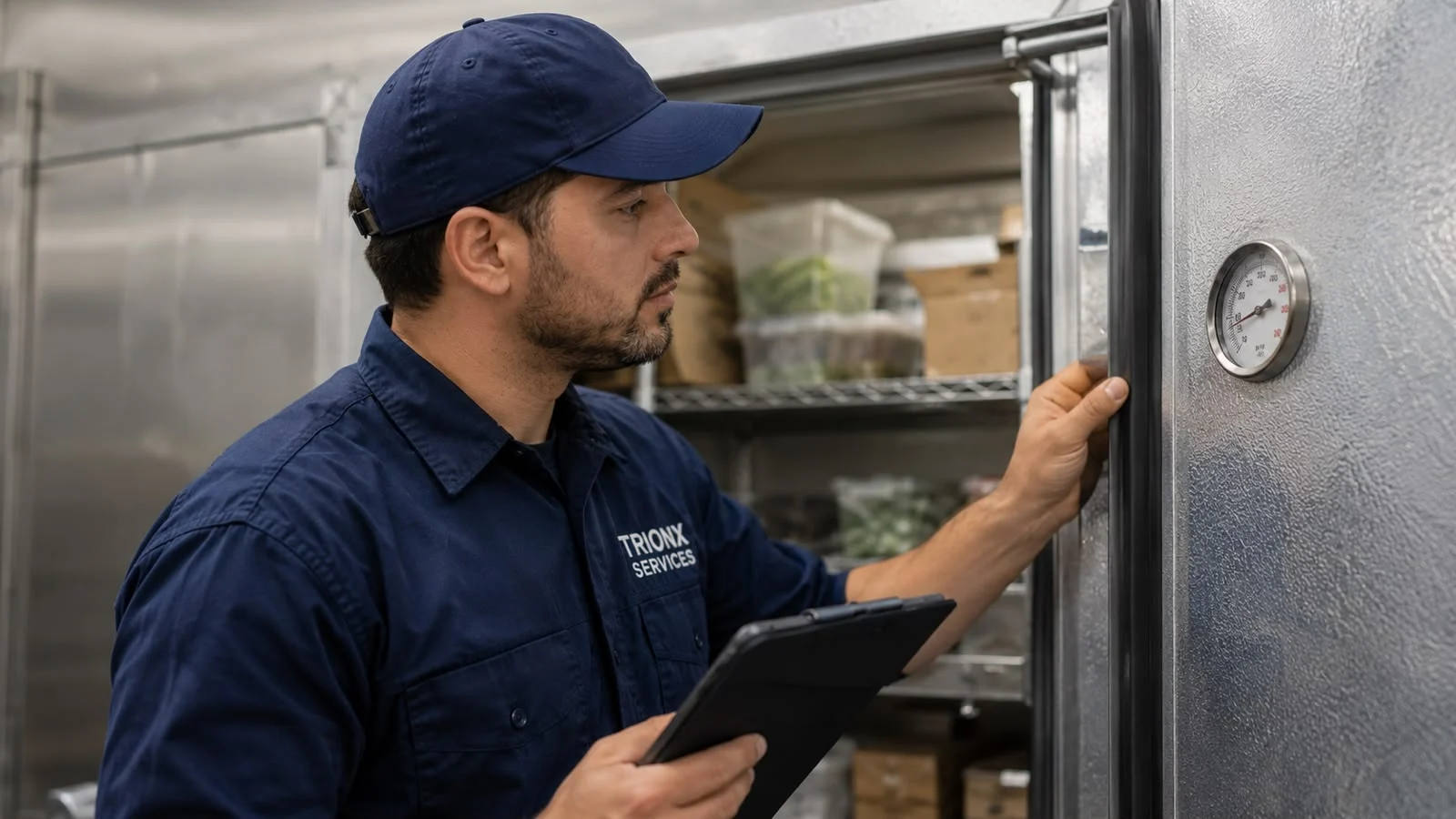
Refrigeration
Walk-in temperature logs: what to record, and what it tells you
Most kitchens keep a temperature log because somebody will ask to see it. Kept properly, it is also the earliest warning you will get that a compressor is in trouble.
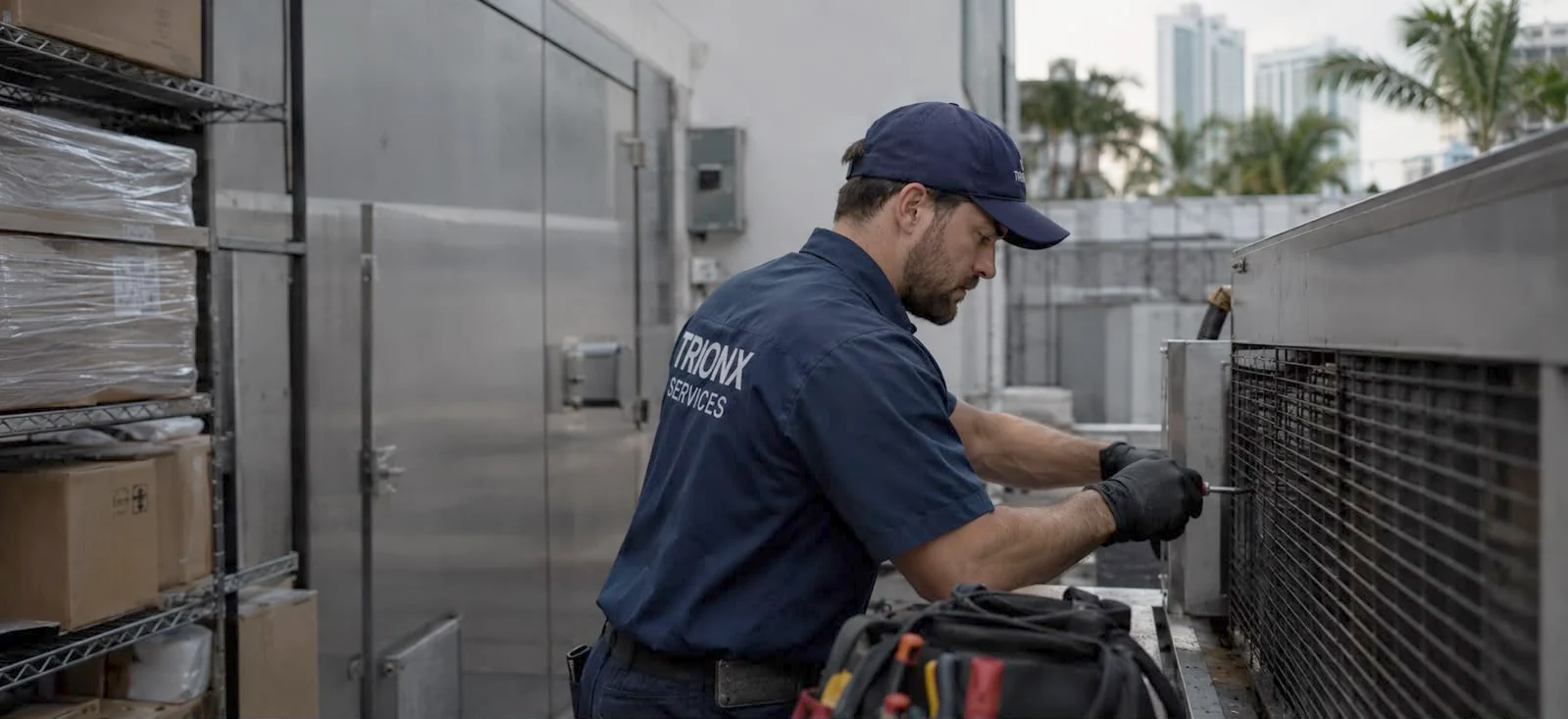
Every commercial kitchen in Miami-Dade keeps refrigeration temperature records, and most keep them for exactly one reason: an inspector will ask. That is a legitimate reason. It is also a waste of a genuinely useful document, because a log kept properly is the cheapest predictive maintenance tool available to a food business.
The difference between a log that satisfies an inspector and a log that saves you a walk-in full of product is not effort. It is what gets written down.
What the log is for, beyond the inspection
Refrigeration almost never fails suddenly. A system losing charge through a slow leak keeps running and keeps looking fine, holding temperature on a cool night and drifting a degree or two on a hot afternoon. A condenser gradually fouling with grease and dust does the same. In both cases the equipment is degrading for weeks before anything goes visibly wrong.
A single reading tells you nothing about that. A column of readings tells you everything, because the pattern that precedes a failure is a slow upward drift with recovery that takes longer each week. Somebody glancing at the numbers daily will not see it. Somebody looking down the column will.
What to record
For each refrigerated unit, at each check:
- Date and time. Time matters because a reading taken during a delivery, when the door has been open for ten minutes, is not comparable to one taken at eight in the morning.
- The unit. Name every box the same way every time. Walk-in cooler, walk-in freezer, prep line, bar under-counter, ice machine. Ambiguity ruins a log.
- The temperature. Both the reading on the controller and, where practice requires it, a product or thermometer reading. Controllers drift, and a controller insisting on 38 while a probe says 45 is itself a finding.
- Who took it. Not for blame. For the ability to ask what they saw.
Ambient conditions are worth a note in Miami. A reading taken during a July afternoon when the back door has been propped open sits in a different context from the same number in January, and a system that only struggles in the heat is telling you something specific about its condition.
How often
Twice a day is the common practice for cold holding equipment, typically once at opening and once during or after service. High-risk or high-value units justify more. The particular requirements that apply to your operation come from your local health authority and your own food safety plan, so treat the frequency as something to confirm rather than assume.
Consistency matters more than frequency. Readings taken at roughly the same times each day are comparable to each other. Readings taken whenever somebody remembers are a list of numbers rather than a trend.
Reading the trend rather than the number
Once every two weeks, look down the column rather than at the last entry. Three things are worth noticing:
A slow upward creep. A walk-in that read 36 in April and reads 39 in July, with nothing else changed, is not fine. It is losing capacity, and the usual causes are a fouled condenser, a failing door seal or a slow refrigerant leak. All three are cheap to address now and expensive to address after the compressor gives up.
Longer recovery. If the reading after a busy delivery period used to return to normal within an hour and now takes three, capacity is falling even though the resting temperature still looks correct.
Widening spread. A unit whose morning and evening readings used to sit within a degree of each other and now differ by five is struggling with load or ambient heat in a way it did not before.
What to write down when a reading is out of range
An excursion in the log is not itself a problem. An excursion with no note beside it is, because it leaves an inspector to assume the worst and leaves you with nothing to say. Record what you found, what you did about it, and what happened next.
A useful entry names the probable cause where it is known, such as a delivery door held open or a defrost cycle in progress, the corrective action taken, the product decision if any product was affected, and the follow-up reading with its time. Four short lines. If a technician attended, the service report should sit with the log rather than in a separate folder, because together they answer the question completely.
Our refrigeration reports record readings on arrival and on completion, and name the failed component and the corrective action rather than only listing parts. It is written for your file, not ours. There is more on how this plays out in high-volume production in our note on refrigeration in Hialeah.
Digital loggers versus a clipboard
Wireless temperature loggers record continuously, alarm on an excursion and remove the possibility of a missed check. For high-value stock they pay for themselves the first time somebody gets a phone alert at midnight instead of finding the problem at seven the next morning.
They are not a substitute for someone opening the door and looking. A logger will not notice a torn door gasket, ice forming on an evaporator, a drain backing up or a fan running slowly. The strongest arrangement is a logger for the continuous record and a person for the weekly walk-round, which is roughly how the better-run kitchens we work with already do it.
Common questions
Questions we get asked about this
What should a walk-in temperature log record?
The reading, the time, the date and who took it, at least twice a day. Adding the discharge air temperature and a note when a door was propped or a delivery landed turns a compliance record into something that predicts failure.
How often should walk-in temperatures be checked?
Twice daily is the practical minimum for a commercial kitchen, taken at roughly the same times each day so readings are comparable. Consistency of timing matters more than frequency, because the pattern is what shows drift.
What do I do when a temperature reading is out of range?
Record the reading rather than leaving a gap, note what you found and what you did, and check the door, the gasket and whether a delivery has just gone in. A gap in the log is what an inspector reads as a problem.
Keep reading
Related field notes
Building a preventive maintenance schedule that survives contact with reality
Dealership showrooms: glass, lighting and the service bay
Mounting to a commercial wall: what actually holds
Replacing ceiling tile without wrecking the rest of the grid
Trim and door frames: repairing rather than replacing
Painting a space that is still trading
One company, whoever does the work
Our technicians handle the trades that need no state license, and licensed contractors handle the ones that do. Either way we scope it, book the visit and file the record. Tell us the property and the problem and we will come back with a window. Call out of hours and someone who works here answers.