
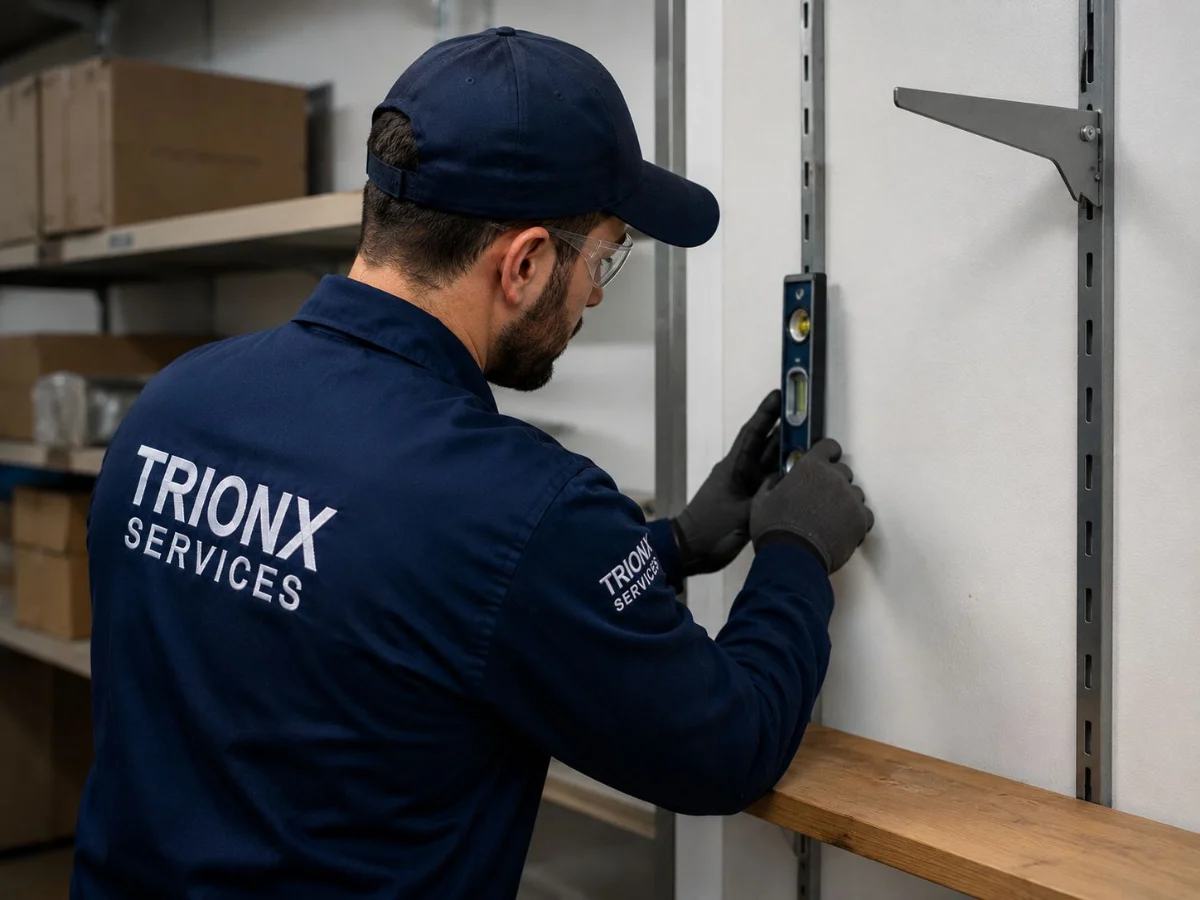
Carpentry
Mounting to a commercial wall: what actually holds
Almost everything that falls off a commercial wall was fixed to drywall and nothing else.
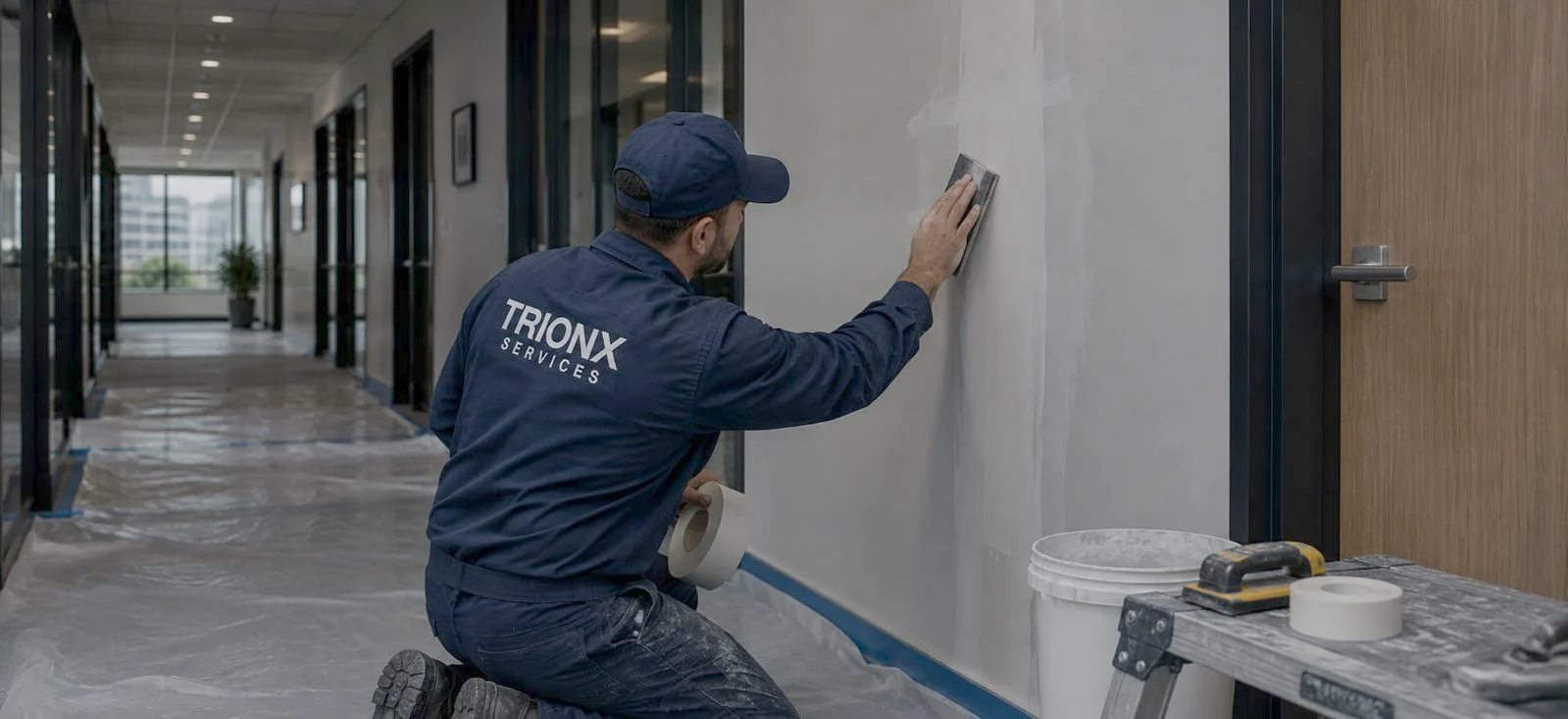
Something pulls out of a wall and the reaction is to fit a bigger screw. The screw was almost never the problem. What it went into was.
Find out what is behind the board first
Tap along the wall with a knuckle and listen. Hollow with solid points at a regular spacing means a framed wall with studs behind it. Solid everywhere means masonry or concrete, which is common in Miami commercial construction and calls for a completely different fixing.
Confirm with a detector rather than trusting the tap, and check for services before drilling anything. A stud detector that also flags live cable is worth the difference, and a cable or a pipe in a wall is the one mistake on this list that hurts somebody.
Worth knowing: stud spacing is regular until it is not. Around openings, corners and where a wall was altered, the pattern breaks, and people still hang things there.
What each substrate will take
Drywall on its own holds very little. Board anchors of every type work by spreading load across a thin sheet of gypsum, and they fail by tearing that sheet rather than by the fixing pulling out, which is why the hole left behind is always larger than the screw.
A stud is what you actually want. A screw into the center of a timber or steel stud holds a genuine load, and two fasteners into two studs hold considerably more than twice one.
Backing is better still. It is a timber or steel member fitted between studs specifically so something can be fixed to it later, and it turns a section of wall into solid material.
Masonry and concrete hold a great deal with the correct anchor, and very little with the wrong one. Solid block, hollow block and poured concrete each want a different anchor, and hollow block treated as solid is a frequent failure: the anchor expands into a void and grips nothing.
The loads people underestimate
Static weight is the easy part. Everything else is what catches fasteners out.
Leverage. A shelf projecting from a wall multiplies its load at the fixing, so a bracket holding a deep shelf pulls far harder than the weight on it suggests. The top fixing takes the worst of it in tension.
Dynamic load. A door on a wall-mounted track, a screen somebody adjusts daily, a bracket people grab to steady themselves. Anything that gets pulled, leaned on or knocked sees loads well beyond its own weight.
Accumulation. A shelf installed for files that now holds stock. Nobody re-checks the fixing when the use changes, and the wall is usually the last thing anybody suspects.
Where it goes wrong on commercial property
Build-outs that ran out of time, so screens and shelving went onto board with the intention of doing it properly later. Tenant changes, where the incoming fasteners go into holes the outgoing ones tore open. Walls that are not what they look like, particularly a stud partition skinned to look like masonry.
And repairs made by filling the hole rather than solving it: filler carries no load at all, so a fixing back into a filled hole is weaker than the one that failed.
Doing it so it stays up
Find the studs and use them, or fit backing. Spread the load across more fasteners rather than relying on a heavier one. Fix into the middle of a stud rather than its edge, where a screw can split timber or skate off steel. On masonry, match the anchor to the material rather than to the bolt diameter.
Where the wall genuinely will not take it, say so before fitting rather than after. A bracket that holds for a month is worse than a conversation about a different position.
Tile, glass and metal
Commercial build-outs put plenty of things on surfaces that are not board or masonry, and each one has its own answer.
Tile is drilled rather than hammered, slowly, with the right bit, and the fixing has to reach the substrate behind rather than relying on the tile. A fixing carried by the tile alone pulls the tile off the wall, and takes the neighboring ones with it.
Glass partitions and metal stud walls without backing take nothing meaningful at all. Where something has to go on one, it is mounted to the structure around it or to a purpose-made fitting, and that is a design decision rather than a fixing choice.
Where an old fixing has torn a hole, the repair comes before the new fixing. Filler carries no load, so putting a screw back into a filled hole is weaker than the fixing that failed, and the new position needs to be genuinely new rather than a few millimeters along.
Who carries this out
Shelving, brackets, screens, signage mounting, backing, wall repair and the making good afterward are performed directly by our own technicians. None of it requires a Florida contractor license, and TrionX carries general liability and workers' compensation on that work.
Mounting a fixture with no wiring involved is ours. Anything that needs a connection made is electrical, and Florida requires a licensed contractor for that at any job size. Where a wall turns out to be structural and the fixing is significant, that is coordinated rather than judged on site.
Common questions
Questions we get asked about this
How do I know what is behind the board?
Tap along the wall and listen for the change from hollow to solid, then confirm with a detector. Solid spots at a regular spacing are studs. A wall that sounds solid everywhere is masonry or concrete, which is a different fixing entirely and common in Miami construction.
Are drywall anchors ever enough?
For light items at low level, yes. For anything carrying weight, anything at head height, or anything people will pull on, the fixing needs to reach a stud or a proper backing. Board anchors fail by tearing the board rather than by the screw letting go, which is why the hole is always bigger than the fixing.
What is backing and when should it go in?
A timber or steel member fixed between studs behind the board, giving something solid to screw into. It is put in while the wall is open, which is why a build-out is the cheap moment to decide where a screen or a shelf will eventually go.
Can you fix into a concrete or block wall?
Yes, with the right anchor for the material and the load. Concrete, hollow block and solid block all behave differently, and a hollow block wall fixed as though it were solid is a common failure here. Getting the substrate right matters more than the size of the bolt.
Keep reading
Related field notes
Tenant turnover punch lists: what to fix between tenants
A crack has appeared in a wall
Trim and door frames: repairing rather than replacing
Grocery and convenience: what actually keeps the doors open
Dealership showrooms: glass, lighting and the service bay
Commercial signage: what fails and who fixes it
One company, whoever does the work
Our technicians handle the trades that need no state license, and licensed contractors handle the ones that do. Either way we scope it, book the visit and file the record. Tell us the property and the problem and we will come back with a window. Call out of hours and someone who works here answers.