
Carpentry
Why a drywall patch shows, and how to stop it
Most visible patches are not badly filled. They are finished to a lower standard than the wall around them.
A repair that vanishes when you stand in front of it and reappears from the doorway is almost never a filling failure. It is a texture difference, and light is what finds it.
Why raking light is the test
Light hitting a wall square on lands evenly and hides small variations. Light arriving at a shallow angle across the surface throws a shadow off anything proud or hollow, and a patch a fraction of a millimeter different from the wall becomes obvious.
So the useful check is not standing in front of the repair under the ceiling light. It is looking along the wall from one side, with a flashlight held flat against the surface, which is the same thing a window or a wall washer will do to it later.
This is also why a repair can pass at handover and fail the first sunny afternoon.
What the finish levels describe
The industry uses a scale of finish levels describing how much work a surface has had. At the low end, joints are taped and no more, which is right for a mechanical room or above a ceiling where nothing is seen.
The middle levels add coats over the tape and the fasteners, sanded progressively flatter, and are where most painted commercial walls sit.
The high end is a skim across the whole surface so there is no difference at all between board and joint. It is what you want under a gloss finish, under critical lighting, or on a feature wall.
The rule that matters for repairs: the patch has to match the level of the wall it is in. A middle-level patch in a fully skimmed wall shows, and so does the reverse.
Where repairs actually go wrong
Too narrow. Each coat should extend well beyond the one before it, so the build-up tapers away to nothing and the eye cannot find where it ends. A patch finished to the edge of the damage has a hard boundary, and a hard boundary is exactly what raking light looks for.
Too thick in one pass. Compound shrinks as it dries, so a single heavy fill sinks in the middle and leaves a dish. Thin coats, dried properly between, end up flatter than one thick one ever will.
Sanded through. Over-sanding cuts back into the paper face of the board around the repair, which then raises a fuzzy texture as soon as it is painted.
And the one specific to this climate: filled before the wall was dry. Our article on drywall repair after a leak covers why a repair over damp board comes back, and it comes back looking exactly like a finish fault.
Texture is its own problem
Where a wall has a sprayed or applied texture, the repair has to reproduce it, and matching an existing texture is a genuine skill rather than a step. Orange peel, knockdown and skip trowel all behave differently and all look wrong if the pattern scale is off.
Where a match cannot be made convincingly, taking the repair to a corner or a natural break usually looks deliberate where a patch in the middle of a wall never will.
External corners take most of the damage
Corners are where commercial walls get hit, and the corner bead under the finish decides how the repair goes. A metal bead dents and stays dented, so the damage telegraphs through any amount of compound put over it. It has to be cut out and a new section let in rather than filled.
Paper-faced and vinyl beads behave differently again, and a repair that uses the wrong type next to the existing one leaves a visible change in the corner profile down the length of the wall.
Where a corner takes repeated impact from carts or traffic, repairing it is treating the symptom. A corner guard costs less over two years than the same repair done three times, and it is worth raising rather than quietly refinishing it again.
What to ask for
Say what the wall is going to live under. A corridor with overhead light is a different specification from a reception with a window down one side, and the second one needs a flatter finish to survive its own lighting.
Then look at the repair with a flashlight held flat to the wall before anybody paints. Before paint it is cheap to fix. After paint it is not.
Our article on matching paint over a repair covers the half that comes next, because a perfect finish under the wrong sheen still shows.
Who carries this out
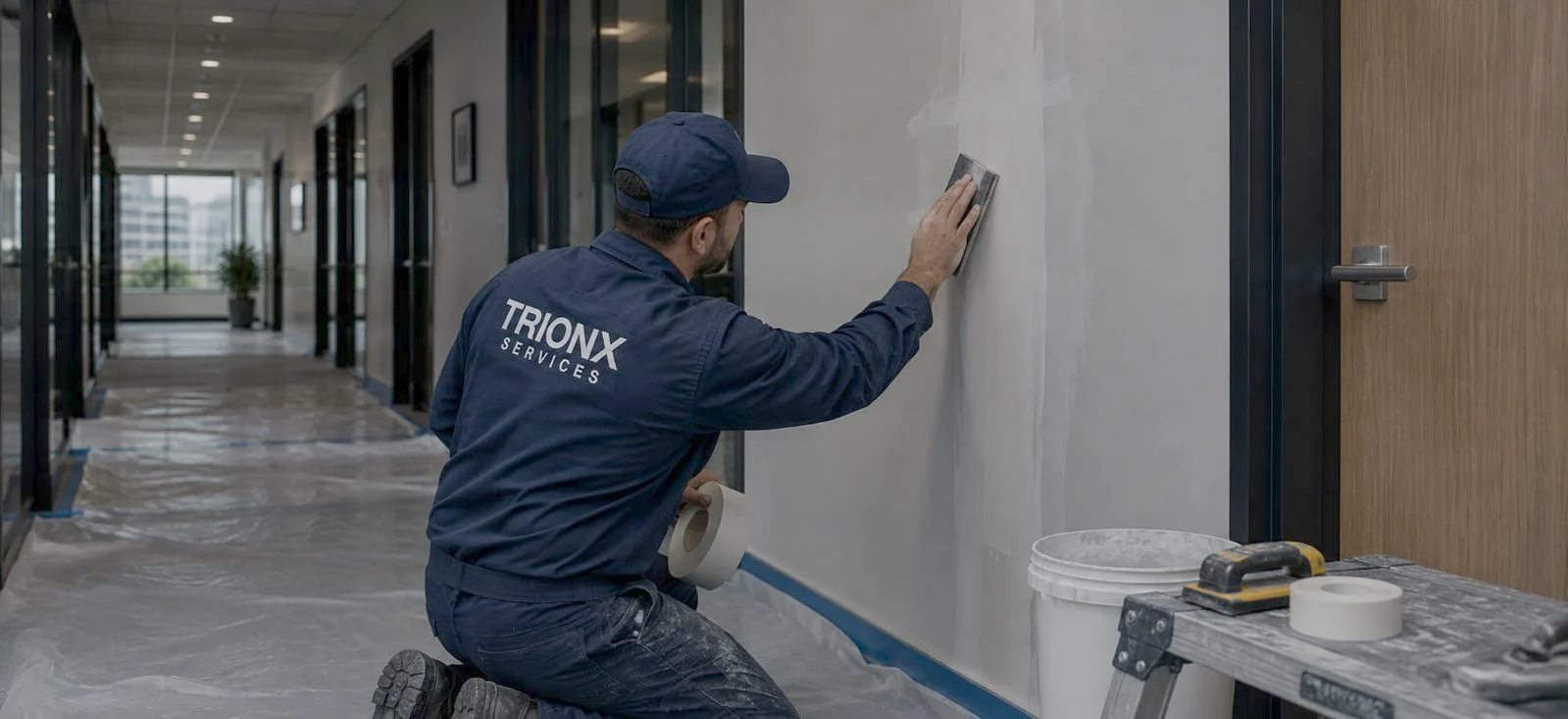
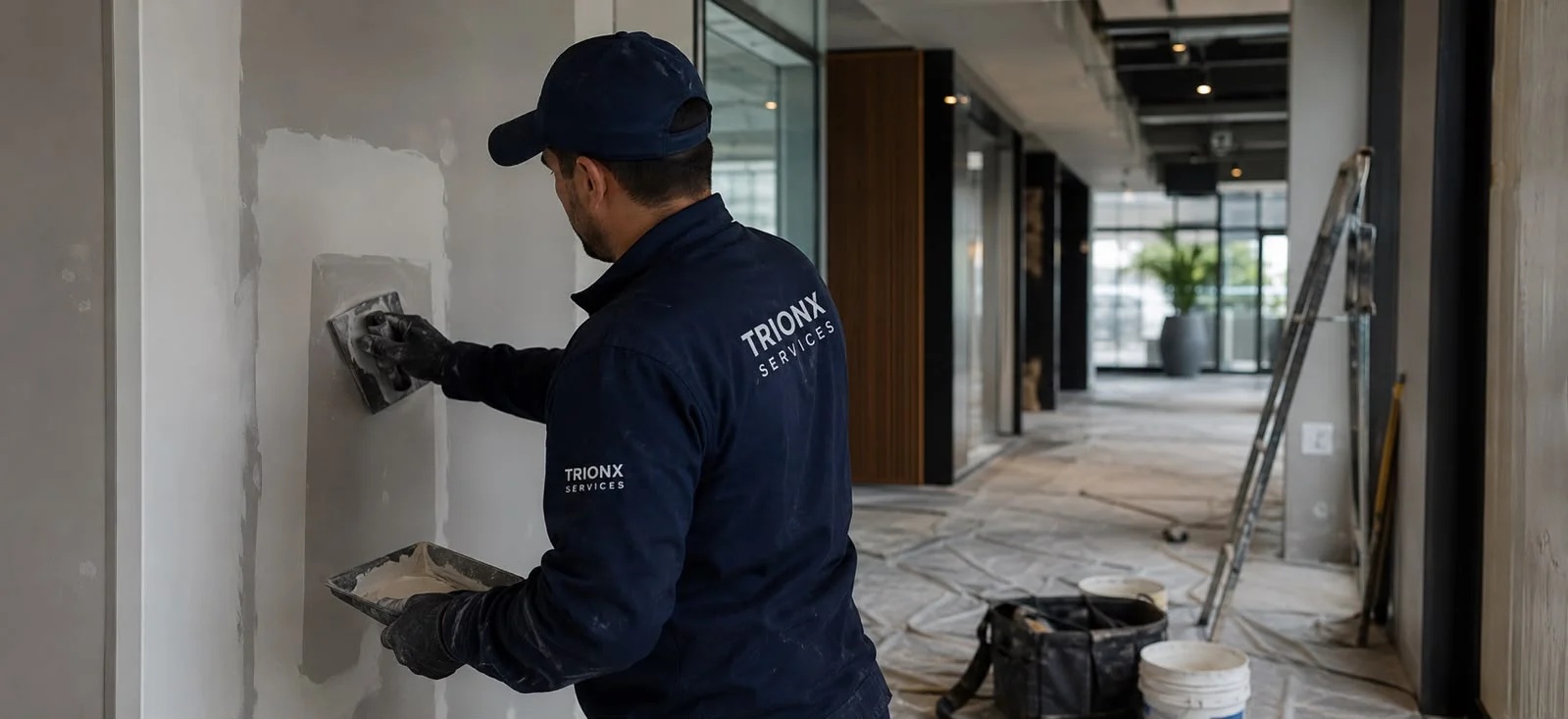
Drywall repair, taping, jointing, skimming, texture matching and the painting that follows are performed directly by our own technicians. None of it requires a Florida contractor license, and TrionX carries general liability and workers' compensation on that work.
Where the damage came from water, the source gets fixed and the wall gets dried before any of this starts. Patching a wet wall is money spent twice.
Common questions
Questions we get asked about this
Why does the patch only show in certain light?
Because the fault is texture rather than color. Light raking across a wall at a shallow angle exaggerates any difference in surface, so a patch invisible under overhead light appears as soon as sun comes through a window or a wall light throws a beam down it.
What are drywall finish levels?
An industry scale describing how much finishing a surface has had, from taped joints only through to a fully skimmed surface. Higher levels mean more coats, more sanding and a flatter surface. A repair finished lower than the surrounding wall shows, however well it was filled.
Does the paint hide it?
Paint reveals it. A flatter sheen disguises more than a satin or gloss, but no coating fills a texture difference, and a higher sheen makes it worse. The finish has to be right before anything is painted.
How wide should a patch be feathered?
Wider than most people expect. Each coat extends beyond the last so the transition is gradual enough that the eye cannot find an edge, which on a final coat means a long way past the original damage. A patch the size of the hole is a patch you will see.
One company, whoever does the work
Our technicians handle the trades that need no state license, and licensed contractors handle the ones that do. Either way we scope it, book the visit and file the record. Tell us the property and the problem and we will come back with a window. Call out of hours and someone who works here answers.