
Lighting
A light is out and the bulb is not the problem
When a new lamp does not bring a light back, the fault is in one of four places, and the first two cost nothing to rule out.
Someone who works here answers, out of hours included. (786) 628-9227
Check the lamp first, then the holder, then whether anything else on the same switch is working. A light that stays dark after a new lamp has a fault in the lamp type, the holder, the ballast or driver, or the supply to the fixture, and the order of those checks is the order of cost and risk.
Most reports end at the first or second check. The rest need a licensed electrician, and it is worth knowing which category you are in before anyone climbs anything.
Is it the right lamp
Lamps look interchangeable and are not. A fixture is built for a particular base, wattage range and technology, and a lamp that fits the socket can still be wrong for the circuit behind it.
Fluorescent tubes come in several diameters and lengths, and an electronic ballast will not start a tube made for a magnetic one. LED replacement tubes come in at least three wiring types: some run on the existing ballast, some need the ballast bypassed, and some are fed from one end only. Fit the wrong one and the light stays dark or fails within weeks. Metal halide and high pressure sodium lamps in high bays are matched to their ballast by type and wattage, and a mismatch means no light at all.
Read the markings on the old lamp and on the fixture label and compare them with what was bought. If the lamp is correct and fully seated, move on.
The holder
The lamp holder is the socket the lamp sits in. In a hot or humid space it corrodes, the contacts lose their spring, and the plastic cracks. A fluorescent holder that has turned slightly in its mount makes poor contact on one pin and the tube never starts.
Signs are scorch marks, brittle or discolored plastic, a lamp that seems loose however it is seated, or a light that works when the lamp is pressed and fails when released. Replacing a holder means disconnecting and reconnecting conductors inside the fixture. That is wiring, and it is electrical work.
Ballast or driver
If the lamp is right and the holder looks sound, the usual cause is the ballast in a fluorescent or discharge fixture or the driver in an LED one. Both convert and regulate the supply, and both fail with age and heat.
A failed ballast tends to show as a tube that glows at the ends and never lights, a hum, a light that comes on late, or a burning smell. A failed driver usually gives a light that is entirely dead or flickers. Two fixtures of the same age in the same space often fail within months of each other, so expect to find a second one.
This is where a repair stops being a swap. Replacing a ballast or driver is wiring, and wiring needs a licensed electrician. It is also the point to ask whether repairing an old fixture is worth doing, which is covered in our article on relamping versus retrofit.
The switch and the circuit
If several fixtures on one switch are dark, the fixtures are probably fine. Look for a tripped breaker, a failed switch, a faulty occupancy sensor or a timer that has lost its setting. Sensors are a common one in corridors and stairwells, where a light that is out in the daytime turns out to be waiting for motion that never arrives.
Resetting a breaker once is reasonable. A breaker that trips again right away is telling you there is a fault, and resetting it repeatedly is how a small problem becomes a fire. Our article on an outlet or circuit that has stopped working covers what is safe to check yourself.
If a light flickers, buzzes or comes on and goes out, that points to a different set of causes, covered in our article on lights flickering in a commercial building.
Reaching a high fixture
On a high ceiling the difficulty is usually reaching the fixture. A step ladder is for fixtures you can reach standing on a low step with the ladder fully open on a level floor. Above that, work needs a scaffold tower or a lift, a second person and a clear floor beneath.
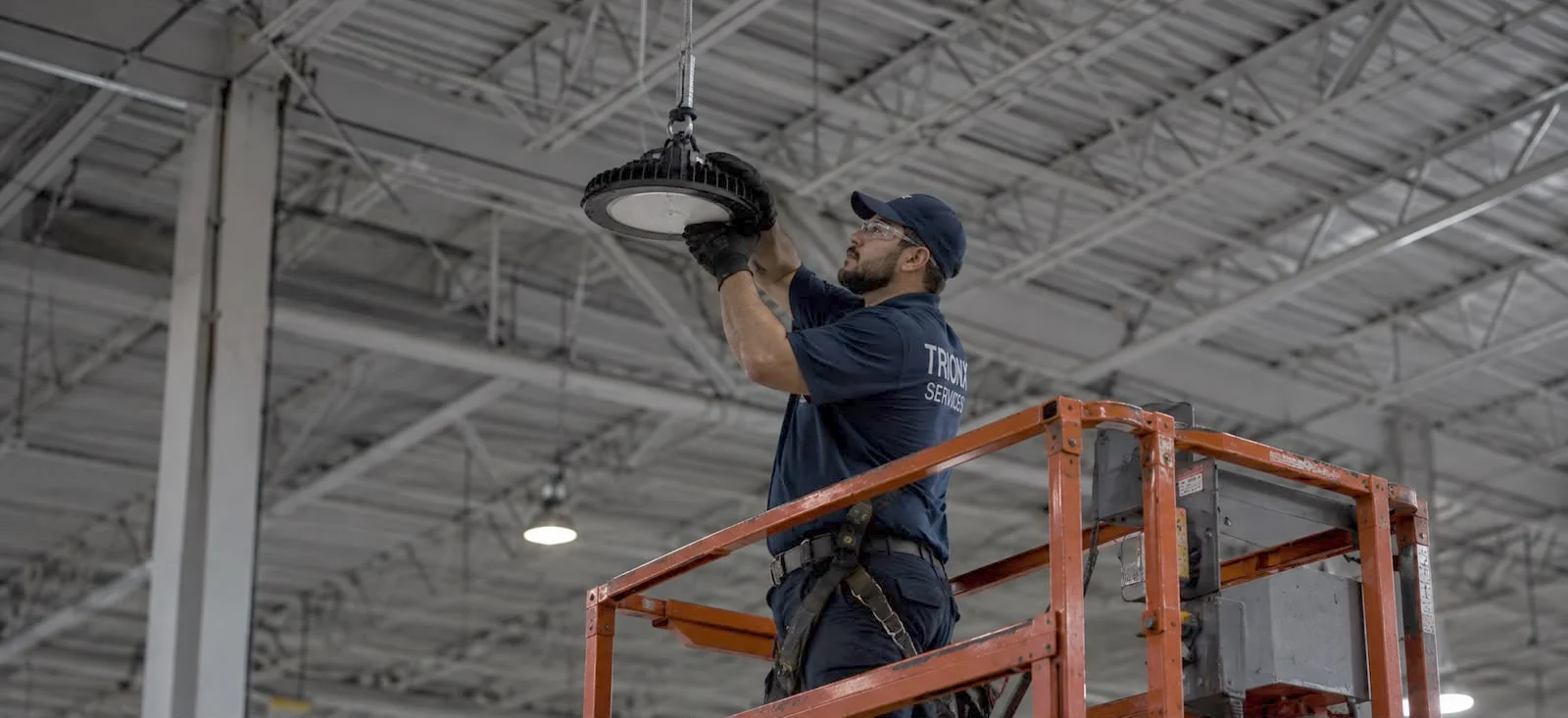
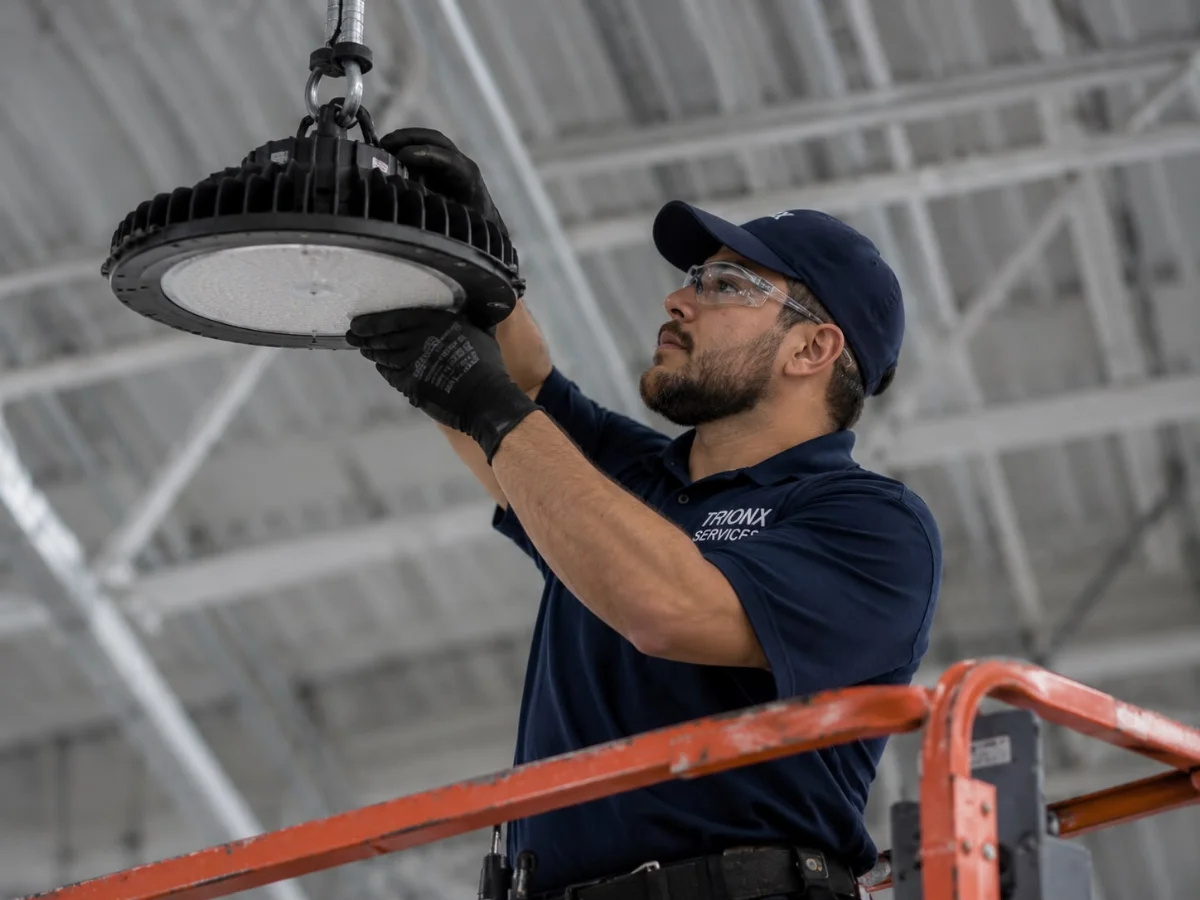
In a warehouse, gym or lobby, access equipment is often what the job costs time on. Our own technicians relamp and mount fixtures at height with the equipment the ceiling calls for, and photograph the fixture before and after so you have a record of what was found. Keeping a note of fixture type and height per room makes the next visit shorter.
Do not lean a ladder against a fixture or a ceiling grid, and do not work above a public floor without closing it off.
Where our technicians stop
Relamping and mounting a fixture are direct work. Our technicians replace lamps, fit new fixtures where no wiring is involved, and refit ones that have come loose.
Ballasts, drivers, holders, switches, sensors and any wiring are electrical, and Florida requires a licensed contractor for them at any job size. A single ballast is licensed work exactly as a whole floor of lighting is. Licensed, insured electrical contractors carry it out, and TrionX coordinates the visit and documents what was found and fixed. Our page on when you need a licensed electrician in Florida sets out where that line sits.
You can reach us through commercial lighting maintenance for relamping and fixtures, and electrical services where the fault is in the wiring. Describing what you have already tried saves the first visit.
When it cannot wait
Immediately where the dark area is an exit route, a stairwell or a parking lot, or where a fixture is buzzing, hot to the touch or smells of burning. Switch the circuit off at the breaker and keep people clear.
Within the day where a work area, entrance or customer space is too dark to use safely.
A single dark fixture in a space with plenty of light can be scheduled, ideally together with the others that are about to follow it.
Common questions
Questions we get asked about this
I put in a new bulb and the light is still out. What should I check first?
Check that the new lamp is the right type for the fixture, that it is seated fully, and that the same switch controls other lights that are working. Those three checks take a few minutes and settle whether the fault is the lamp, the holder or something further back.
Can I swap an LED lamp into a fluorescent fixture?
Only if the lamp is made for that fixture. Some LED tubes run on the existing ballast and some need it removed and the fixture rewired. The second kind is electrical work, so check the lamp packaging before buying a box of them.
Is it safe to work on a fixture myself?
Changing a lamp in a fixture you can reach from the floor or a stable step ladder is ordinary maintenance. Anything past the lamp, including the ballast, driver, holder wiring or switch, involves live conductors and needs a licensed electrician.
Who does the work on a high ceiling?
Our own technicians relamp and mount fixtures, using the access equipment the height calls for. Ballasts, drivers, wiring and switches are carried out by licensed, insured contractors, coordinated and documented by TrionX.
Keep reading
Related field notes
Relamping against retrofit: what a technician can and cannot touch
Parking lot or sign lighting is out

An outlet or a circuit has stopped working
Working out LED retrofit payback on Florida commercial property

Closing checklist for a retail storefront: locks, glass and lighting

Warehouse dock doors, gate access and the loading yard
One company, whoever does the work
Our technicians handle the trades that need no state license, and licensed contractors handle the ones that do. Either way we scope it, book the visit and file the record. Tell us the property and the problem and we will come back with a window. Call out of hours and someone who works here answers.