
Electrical
Lights are flickering in part of the building
How much of the building flickers, and when, is the difference between a lamp at the end of its life and a connection that is heating up.
Someone who works here answers, out of hours included. (786) 628-9227
Establish how much of the building is affected before anything else. One fixture, one room, one circuit, or lights across several areas dimming together. That answer separates a routine lamp replacement from something that needs attention today.
Then note when it happens, because the timing is the other half of the diagnosis.
One fixture on its own
Almost always the lamp or the fixture itself. A fluorescent tube at the end of its life flickers and often darkens at one end. An LED panel that has started strobing usually has a failing driver rather than a failing chip.
Relamping the fixture is the first move and it is work our own technicians perform, because a lamp change involves no wiring. If a new lamp behaves the same way, you have learned something useful: the fault is in the fixture or beyond it.
A whole area, or several areas at once
This is the case worth acting on. Lights across a circuit flickering together, or dimming noticeably when a motor, compressor or air conditioner starts, points at the supply rather than at any fixture.
The usual causes are a loose connection at a terminal, a breaker or a neutral, an overloaded circuit, or a supply problem upstream of the building. A loose connection is the one that matters, because a poor connection carrying current generates heat, and heat in a concealed junction is how electrical fires start.
Treat area-wide flickering as a fault to be investigated rather than a nuisance to be lived with, particularly if it has recently got worse.
What the timing tells you
Flicker that coincides with a large load starting, such as a compressor, an elevator or an air handler, suggests the circuit is heavily loaded or the supply is weak. Note exactly what starts at that moment, because it shortens the diagnosis considerably.
Flicker that comes and goes with no pattern, or that got worse over weeks, is more consistent with a connection degrading.
Flicker only on a dimmed circuit is usually a compatibility problem between an LED driver and an older dimmer, which is a design mismatch rather than a fault.
Flicker across the whole building including neighboring premises is a utility matter, and stepping outside to look at the street is the quickest way to establish it.
What to write down before calling
Which fixtures, which rooms, and which ones are unaffected. What is running when it happens. Whether anything has changed recently, including a build-out, a new piece of equipment, or work done by another tenant. Whether a lamp has already been swapped and what that did.
Also note anything else on the same circuit misbehaving. Flickering lights alongside an outlet that has stopped working, or a breaker that has tripped once, are the same fault reported twice.
What not to do
Do not open a fixture, a junction box or a distribution panel. Do not keep resetting a breaker that trips. Do not treat a warm switch plate, a warm outlet or any smell of hot plastic as part of the flickering problem, because that combination is urgent on its own.
Who is allowed to work on it
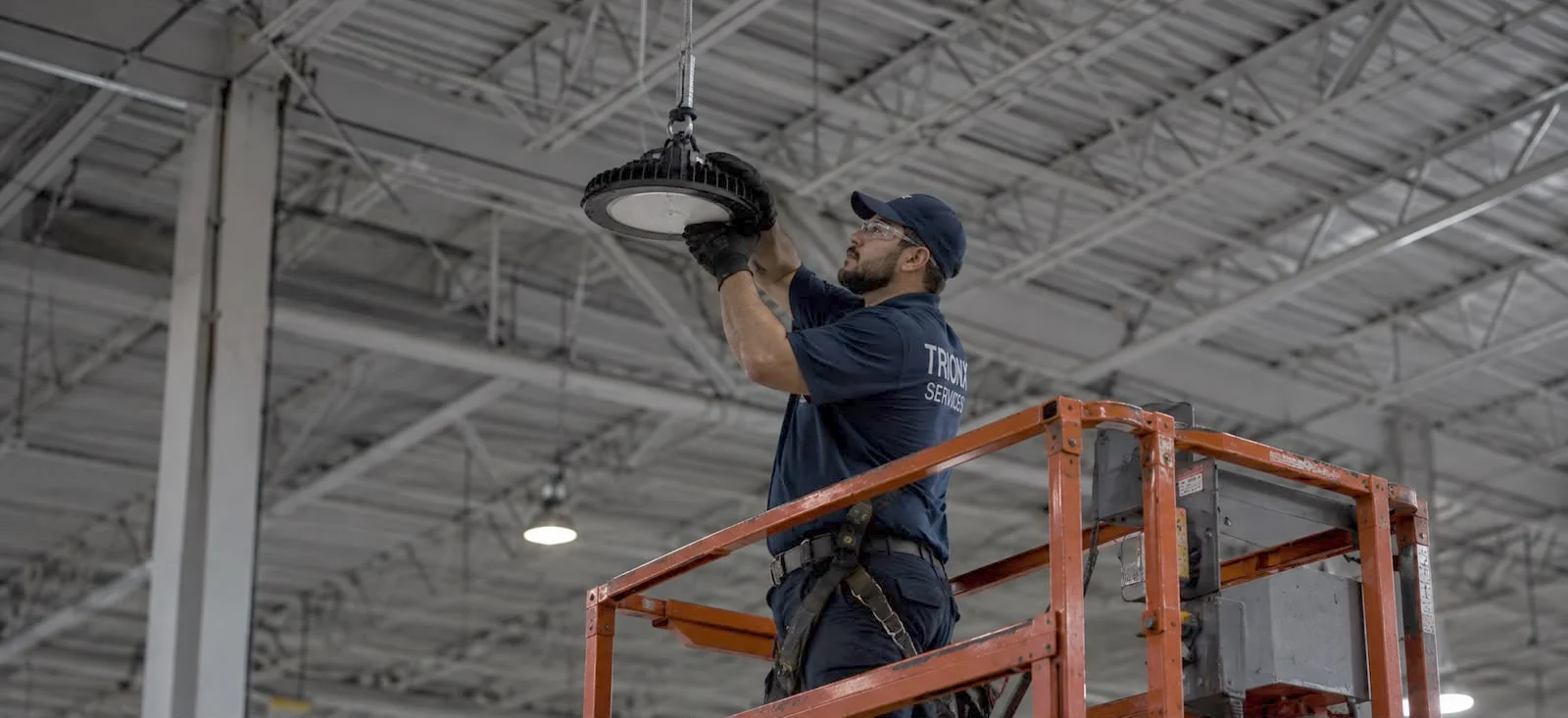
Relamping a fixture and mounting a fixture where no wiring is involved are performed directly by our own technicians. That covers the single-fixture case, which is the most common one.
Everything else is electrical work, and Florida requires a licensed electrical contractor for it at any job size. Drivers, ballasts, fixtures, dimmers, terminations, circuits and distribution panels all sit there, and the rule does not soften because the job is small. Our article on what legally needs a licensed electrician covers the boundary, and relamping against retrofit covers where a lamp change stops being a lamp change.
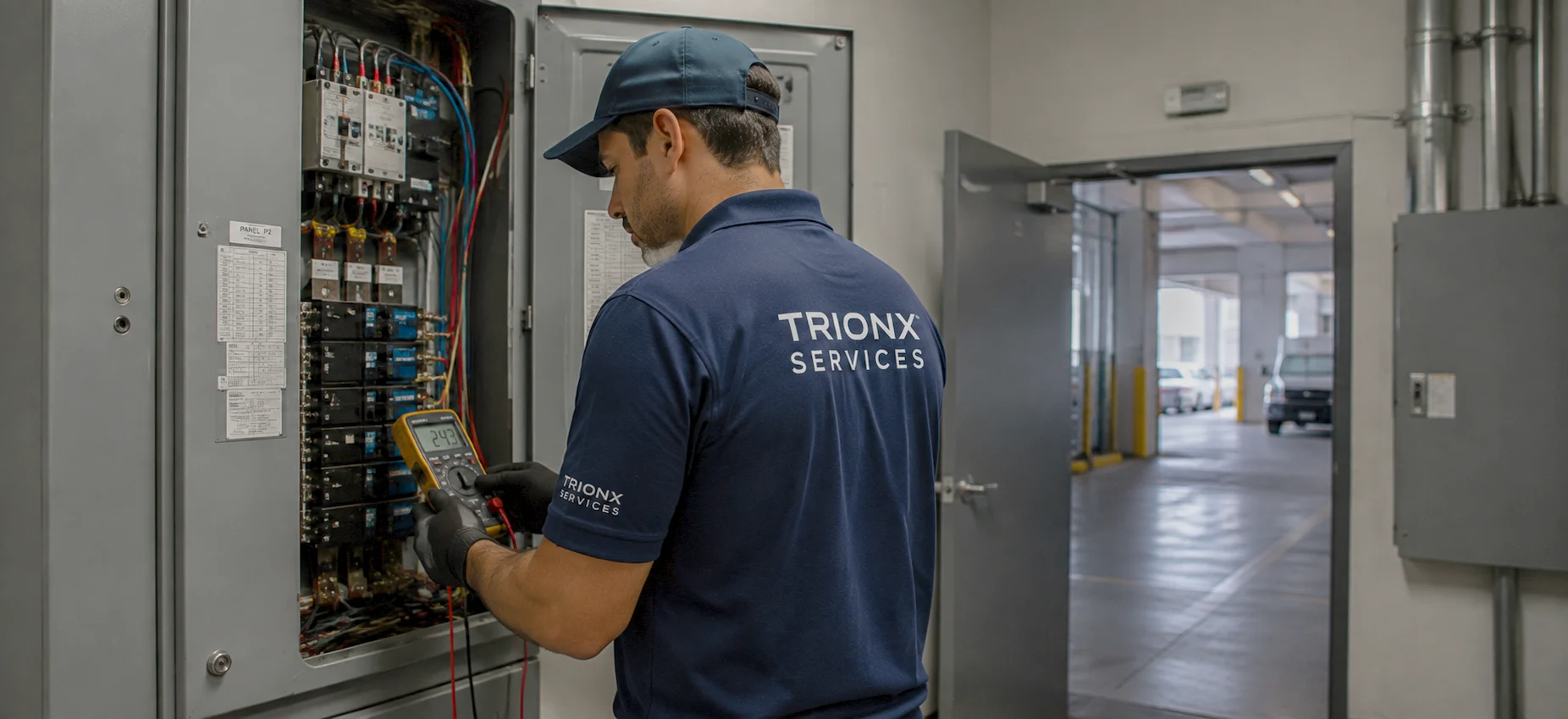
TrionX coordinates the licensed contractor, attends, and documents the work, so the flickering and the relamp come back as one record rather than two vendors' paperwork.
When it cannot wait
Call today if an area flickers together, if lights dim when equipment starts, if anything is warm to the touch at a switch, outlet or panel, or if there is any smell of hot plastic. Those are not lighting problems.
A single fixture flickering in a lit space can be scheduled, and it is a good candidate for batching with other work. Worth knowing that where several fixtures of the same age start going within months of each other, replacing the group is normally cheaper than paying for repeated attendance.
Common questions
Questions we get asked about this
Is a flickering light dangerous or just annoying?
One fixture flickering is usually a lamp or a driver at the end of its life. Several fixtures across an area flickering together, or lights dimming when equipment starts, points at the supply or a connection, and a loose connection generates heat. The second case is not a cosmetic problem.
We changed the lamp and it still flickers. What now?
That result is useful. It rules out the lamp and points at the fixture, its driver or ballast, or the circuit. All three are electrical work, and Florida requires a licensed electrical contractor for them at any job size.
Our LED lights started flickering after a dimmer was fitted.
Common, and it is usually a compatibility problem rather than a fault. Many LED drivers do not work with older dimmers designed for incandescent lamps. It gets solved by matching the dimmer to the driver, which is electrical work.
Can TrionX fix this?
We can relamp a fixture, which resolves it where a lamp is the cause. Anything on the fixture, the driver, the ballast or the circuit is electrical and goes through a licensed contractor, coordinated and documented by us.
Keep reading
Related field notes
One company, whoever does the work
Our technicians handle the trades that need no state license, and licensed contractors handle the ones that do. Either way we scope it, book the visit and file the record. Tell us the property and the problem and we will come back with a window. Call out of hours and someone who works here answers.