
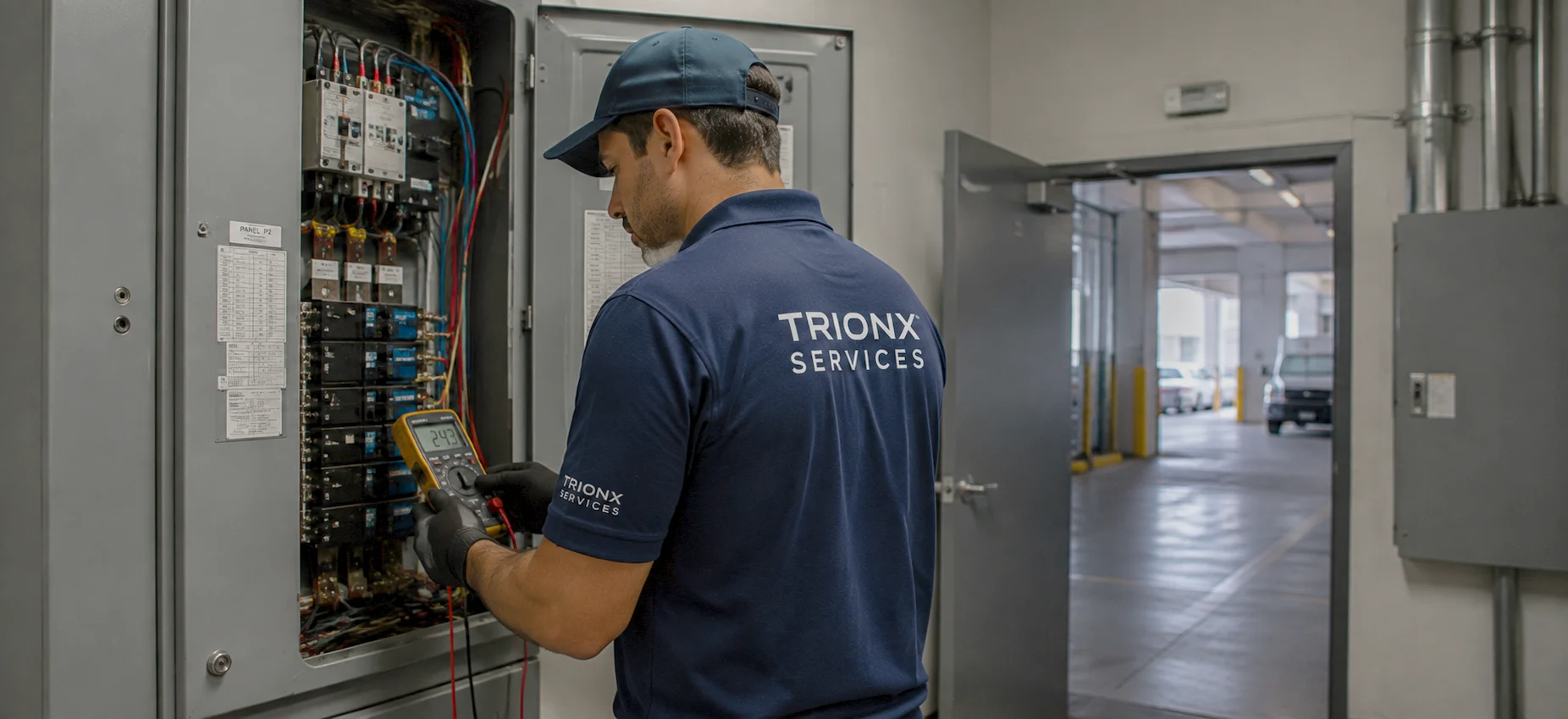
Electrical
There is a burning smell and nothing visible
A smell of hot plastic with no visible source is the one building complaint that should never be filed for the morning.
Treat this one as urgent from the first sentence. A smell of hot plastic, burning insulation or scorching with no visible source means something is getting hot where you cannot see it, and the smell reliably arrives before anything stops working.
Follow your own fire procedure first. Everything below assumes the building is safe to remain in and somebody competent has made that call.
Switch off what you safely can
Turn off and unplug equipment in the affected area at the outlet, starting with anything with a motor, a heating element or a power supply. Portable heaters, fans, kettles, chargers, printers and older appliances are the usual candidates.
If the smell reduces after something is unplugged, you have found it. Leave that item unplugged, label it, and take it out of use rather than trying it again later to check.
Do not start switching circuits at the distribution panel unless somebody qualified is doing it. Isolating a circuit is electrical work.
Where to look, without touching anything
Use the back of a hand held near, rather than on, a surface, and look before you feel.
Outlets and switch plates for discoloration, browning around the pins, scorch marks or distortion. Light fixtures, especially older ones and anything recessed into a ceiling. Extension leads and multi-way adaptors, particularly where several are chained together or one is under a carpet or behind furniture. Motors in fans, pumps, air handlers and refrigeration equipment, where a failing bearing or winding produces a distinctive hot smell.
Check whether the smell is stronger near a ceiling void, a riser, a cupboard holding equipment, or the distribution panel itself. Note where it is strongest and where it is absent, because that map is the most useful thing you can hand a contractor.
The things that are not electrical
Worth eliminating quickly, because they are common and harmless. A new heater or a fixture running for the first time in months burning off dust, which fades within an hour and does not come back. Food or packaging against a heat source. A drive belt slipping on a fan or an air handler, which smells of hot rubber rather than hot plastic. Work happening nearby, including a neighboring unit.
Eliminate these by checking them, not by assuming them. A smell that persists after an hour, returns, or gets stronger is not dust.
Extension leads and multi-way adaptors deserve a specific mention, because they are the most common source of this in offices and the least likely to be thought of as electrical equipment. A lead coiled tightly, run under a carpet, pushed behind furniture or feeding a heater is carrying current it was never designed for, and the heat has nowhere to go. In a building that has grown into its space over a few years, this accumulates quietly and nobody owns it.
What not to do
Do not open a distribution panel, a panel cover or a junction box. Do not remove a light fixture to look inside it. Do not spray water or a general purpose extinguisher at suspected electrical equipment.
Do not reset a breaker that has tripped in an area where something smells hot, and do not restore power to equipment that was isolated because of the smell. Do not decide it has gone away because it faded, since a connection that has been heating up does not repair itself.
Why this is licensed work, without exception
Finding an overheating connection means opening and testing the electrical installation. Florida requires a licensed electrical contractor for electrical work at any job size, and this is the clearest case on the whole site for why that rule exists rather than the most tempting one to work around.
TrionX coordinates a licensed contractor and treats this as an emergency call rather than a scheduled one. Our own technicians will isolate equipment, secure the area and document what was found. Our article on what legally needs a licensed electrician covers the boundary in full.
What to have ready when you call
Where the smell is strongest and where it cannot be detected. When it started and whether it has changed. What was running at the time. What you have already unplugged and whether that made a difference. Whether anything is warm, discolored or scorched. Whether any circuit has tripped recently, and whether the lights in that area have been flickering.
That last one comes up often. Flickering lights and a hot smell in the same area are usually the same loose connection reported twice, and saying both on the same call is what gets it found quickly.
Common questions
Questions we get asked about this
Should we evacuate?
That judgment belongs to you and your fire procedure, not to a maintenance article. We would say plainly that a persistent burning smell with no identified source is treated as a fire risk until somebody qualified has found the cause, and the fire service would rather attend and find nothing.
It smells like burning but everything works. Is it still urgent?
Yes. An overheating connection can smell long before anything stops working, and equipment continuing to run is not evidence that it is safe. The absence of a fault indication is not the absence of a fault.
What does a hot plastic smell usually turn out to be?
Most often an overheating connection at an outlet, a switch, a light fixture or a terminal, or a motor that is failing in a fan, a pump or an air handler. Both generate heat at a point nobody can see, which is why the smell arrives before anything visible does.
Can our maintenance technician find it?
They can look for the obvious and safe things and isolate equipment. Finding an overheating connection means working on the electrical installation, which in Florida requires a licensed electrical contractor at any job size. We coordinate that and we treat it as an emergency call.
Keep reading
Related field notes
One company, whoever does the work
Our technicians handle the trades that need no state license, and licensed contractors handle the ones that do. Either way we scope it, book the visit and file the record. Tell us the property and the problem and we will come back with a window. Call out of hours and someone who works here answers.