
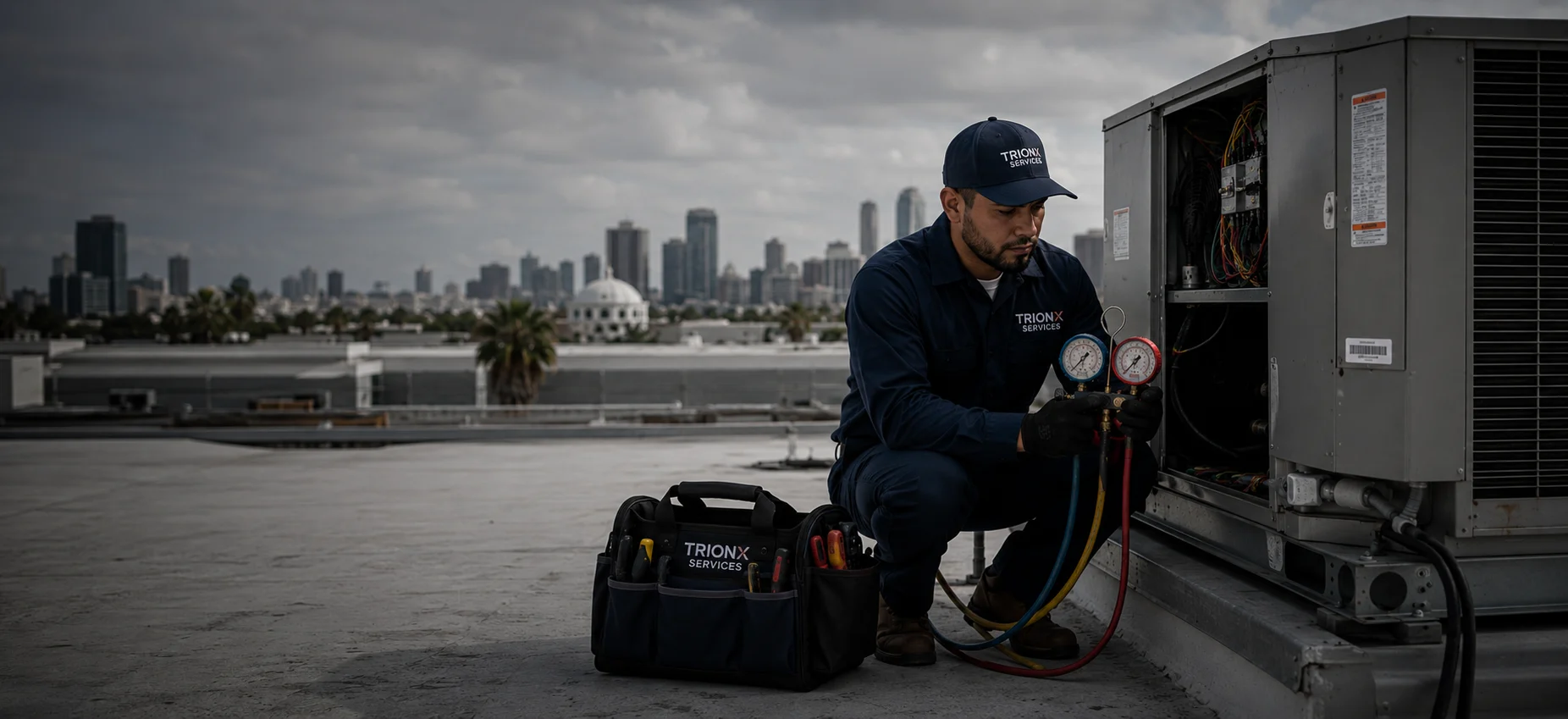
HVAC
The air conditioning is leaking water inside
An air conditioner dripping indoors is usually removing humidity correctly and failing to get rid of it.
Turn it off at the thermostat and move whatever is underneath. Water dripping from an air conditioner is condensate that the unit is producing correctly and failing to drain, so leaving it running keeps making more.
Then look at where the water actually is, because that narrows it quickly.
Almost always the drain
An air conditioner in Miami removes a large volume of water from the air every day. All of it collects in a pan under the coil and leaves through a condensate line, and any restriction in that path puts the water on your floor or your ceiling instead.
The line blocks with algae and slime, which grows readily in a warm wet pipe and is the single most common cause. It also comes apart at a joint, gets crushed, loses its fall after somebody works nearby, or blocks at the trap. Some units have a secondary pan with its own drain and a float switch, and where that float switch has failed the first sign is water rather than a unit that has shut itself down.
A pan that has rusted or cracked through leaks regardless of whether the line is clear, and that is a replacement rather than a clean.
The filter connection people miss
Check when the filter was last changed, because a restricted filter causes leaks by a route that is not obvious.
Starve the coil of airflow and its surface temperature drops below freezing. Ice forms on the coil, and while it is frozen the unit produces very little condensate, so nothing looks wrong. When it cycles off, the ice melts all at once and the pan cannot take it. The result is a leak that appears in bursts rather than steadily, often overnight or at the end of the day.
A frozen coil also shows as poor cooling, so a unit that is both leaking and not cooling well is usually telling you one story rather than two. Our article on air conditioning that is not cooling covers that side of it.
Where the water is tells you which unit
Water directly under an indoor unit or air handler is that unit's pan or drain.
Water at a ceiling some distance from any unit is a condensate line running through the void, and the leak is anywhere along it. This is the case that gets reported as a roof leak and is not one. Our article on water coming through a ceiling covers finding a source when you do not yet know it is the air conditioning.
Water outside at a wall is normally a secondary or overflow drain doing exactly its job, which means the primary is blocked. It is working as designed and it is still telling you to act.
The timing is diagnostic
Continuous dripping while the unit runs points at the pan or the line. Water appearing after the unit shuts off points at a coil that had frozen. Water only on the hottest, most humid days points at a line that is partly restricted and only fails at full output. Water that started after work was done nearby points at a line that was knocked, crushed or disconnected.
Say which of those it is on the call, because it changes what a contractor brings.
What not to do
Do not put a bucket under it and leave it running for a week. Condensate is not clean water, it soaks into whatever it lands on, and a ceiling void that stays wet produces a much larger problem than the leak.
Do not pour bleach down a condensate line as a habit. It damages some pan materials and some line fittings, and it treats the symptom rather than the restriction.
Do not ignore a unit that has shut itself down and stopped leaking. A float switch has done its job, and nothing about the blockage has changed.
Who is allowed to work on it
The unit, the coil, the pan, the condensate line and the controls are HVAC, and Florida requires a licensed contractor for HVAC work at any job size. There is no exception for clearing a drain line. TrionX coordinates that contractor, attends and documents the visit.
Everything the water damaged on its way out is ours: ceiling tile, grid, drywall, painting, flooring and general making good, performed directly by our own technicians once the source is fixed and the void has dried. Patching a ceiling that is still damp puts the same stain back within weeks, which our article on reading a stained ceiling tile covers.
When it cannot wait
Immediately if water is reaching lighting, electrical equipment or a distribution panel, if a ceiling is sagging, or if it is landing on stock, records or equipment. Water and lighting circuits together is the part of this that genuinely hurts somebody.
Immediately in a food operation, where condensate over a preparation area is a health inspection finding as well as a maintenance one.
It can be scheduled where the unit is off, the water is contained, nothing electrical is involved and the space can operate without it. Clearing a condensate line is a routine visit, and it is a great deal cheaper than the ceiling repair that follows leaving it.
Common questions
Questions we get asked about this
Should I turn the unit off?
Yes, at the thermostat, and move anything underneath. The water is condensate the unit cannot drain, so running it produces more. Turning it off stops the source while you find out why it is not draining.
Why does this happen so much in Miami?
Because humidity is what an air conditioner mostly removes here. A unit in this climate pulls a great deal of water out of the air every day, and any restriction in the drain has somewhere obvious to show itself.
Can a dirty filter really cause a leak?
Yes, and it is the most commonly missed cause. A restricted filter starves the coil of airflow, the coil drops below freezing, ice builds, and when the unit cycles off the ice melts faster than the pan can drain.
Is this licensed work?
The unit, the coil, the drain line and the pan are HVAC and Florida requires a licensed contractor at any job size. The ceiling, drywall, tile and painting afterward are performed directly by our own technicians.
Keep reading
Related field notes
Water is coming through the ceiling: what to do first
A ceiling tile is stained or sagging: what it is telling you
Getting commercial HVAC through a Miami hurricane season
Commercial signage: what fails and who fixes it

There is a burning smell and nothing visible
A toilet is running, or the water bill has jumped
One company, whoever does the work
Our technicians handle the trades that need no state license, and licensed contractors handle the ones that do. Either way we scope it, book the visit and file the record. Tell us the property and the problem and we will come back with a window. Call out of hours and someone who works here answers.