
Doors
A sliding door is hard to slide or off its track
A sliding door that has started to drag is running on rollers that have already failed, and every use from here is grinding the track.
Someone who works here answers, out of hours included. (786) 628-9227
Stop forcing it. A sliding door that needs shoving is riding on something that has failed, and each pass is damaging the track underneath it, which is the expensive part to replace.
Then clear the channel out and see whether that alone changes anything, because a surprising number of these are debris rather than hardware.
Clean the track before diagnosing anything
Commercial sliding tracks collect grit, sand, packaging strapping, staples, screws and in Miami a remarkable amount of wind-blown debris. That material sits in the channel, the rollers ride over it, and the door gets progressively harder and noisier.
Vacuum the channel along its full length, including under the leaf at both extremes of travel. Run a thin blade or a stiff brush along the corners of the channel where the vacuum will not reach.
Do not grease it afterward. Oil and grease hold grit against the track and turn it into a grinding compound, which is how a track goes from worn to unusable. A dry lubricant is acceptable and cleaning is what actually matters.
What the rollers are doing
If cleaning did not fix it, the rollers have almost certainly gone. They fail in three ways and all three feel similar from the handle.
The wheel flattens on one side, so the door moves in a series of small jolts rather than smoothly. The bearing seizes, so the wheel drags rather than rolls and the effort rises sharply. Or the roller assembly collapses entirely, dropping that corner of the leaf onto the track, which is when the door starts scraping and the gap at the top opens up.
Look at the gap along the top of the door across its width. A gap that is even means the leaf is sitting level. A gap that widens toward one end means that end has dropped, and the roller under it is the one that has gone.
The track itself
Run a finger along the top surface of the track where the rollers travel. A track that is grooved, burred, dented or has a raised lip has been run on with failed rollers and it will chew new rollers as well.
On aluminum tracks a dent from a cart, a pallet or a dropped delivery is a common single cause. Some tracks accept a stainless capping to restore the running surface, and some have to be replaced with the frame, which is a far larger job and is worth knowing early.
Why a leaf that jumps out is different
A door that has come off the track completely is a hazard rather than a maintenance issue. A commercial glazed leaf is heavy, and one leaning in a frame with nothing carrying it can fall.
Keep people away from it and do not attempt to lift it back single-handed. Where it has to be made safe before anybody attends, secure the opening rather than the door and treat the glass as unsupported. Our article on cracked glass that has not fallen covers handling a compromised pane.
The things that are not the door
Worth checking, because they produce identical symptoms and a new set of rollers will not help.
A frame that has moved, which shows as a door that binds at one point of its travel and runs freely elsewhere. A threshold that has lifted or a floor covering that has been laid over the track. A latch or keeper out of alignment, which makes the door feel stuck at the closed position only. Building pressure, which makes an external sliding door heavy on windy days and normal on still ones.
Our article on door alignment covers the frame side of this, and it applies to sliding leaves as much as to hinged ones.
Who carries this out
Rollers, tracks, guides, cappings, latches, handles, weatherstripping, alignment and glazed leaf hardware are performed directly by our own technicians. None of it requires a Florida contractor license, and TrionX carries general liability and workers' compensation on that work.
A powered sliding door is split. The mechanical hardware is ours, and the operator supply, control wiring and safety sensor circuits are electrical, coordinated through licensed contractors because Florida requires a license for electrical work at any job size. Our piece on powered doors covers that boundary.
When it cannot wait
A leaf off its track, an external sliding door that will not close or lock, or any door on an escape route that does not open properly are all today.
A door that is merely heavy can be scheduled, and it is worth scheduling promptly. Every week it runs on failed rollers is more damage to a track that costs considerably more than the rollers do.
Common questions
Questions we get asked about this
Can I just lift it back onto the track?
Sometimes, and it is worth knowing why it came off first. A door that jumped because the track is damaged or a roller has collapsed will come off again, usually faster, and a commercial glazed leaf is heavy enough to injure somebody on the way down.
Is lubricating the track a good idea?
Cleaning it is. Greasing it is not: oil and grease collect grit and turn the track into a grinding paste, which is how tracks get destroyed. Clean the channel out and use a dry lubricant if anything.
Why has it got harder over months rather than suddenly?
Because rollers wear gradually. As the wheel flattens or the bearing seizes, the leaf starts riding on the track itself, which increases the effort and starts damaging the track. The sudden failure at the end has usually been arriving for a year.
Is this something you do?
Yes. Rollers, tracks, guides, latches, handles, alignment and glazed leaf hardware are performed directly by our own technicians, and none of it needs a Florida contractor license. Powered sliding doors have an electrical half that does.
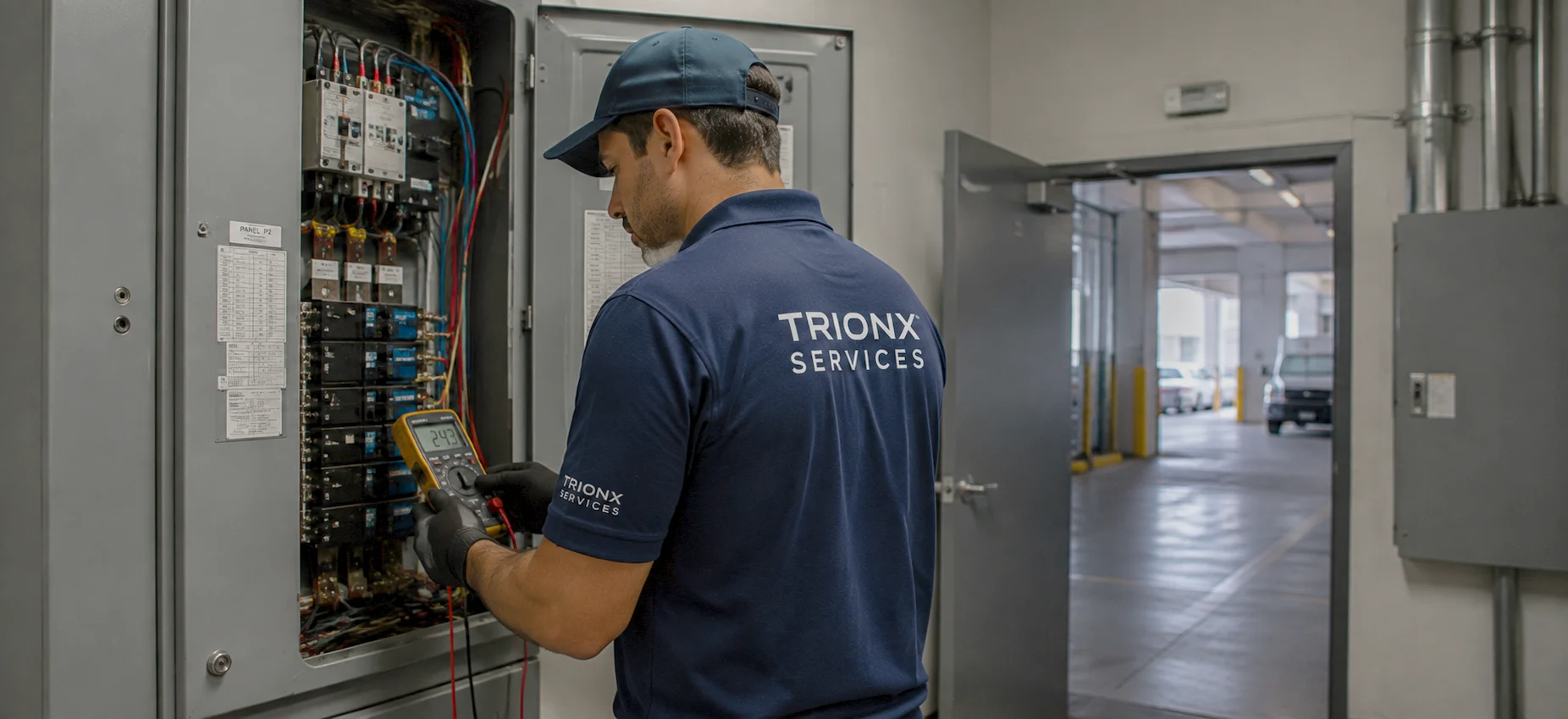
One company, whoever does the work
Our technicians handle the trades that need no state license, and licensed contractors handle the ones that do. Either way we scope it, book the visit and file the record. Tell us the property and the problem and we will come back with a window. Call out of hours and someone who works here answers.