
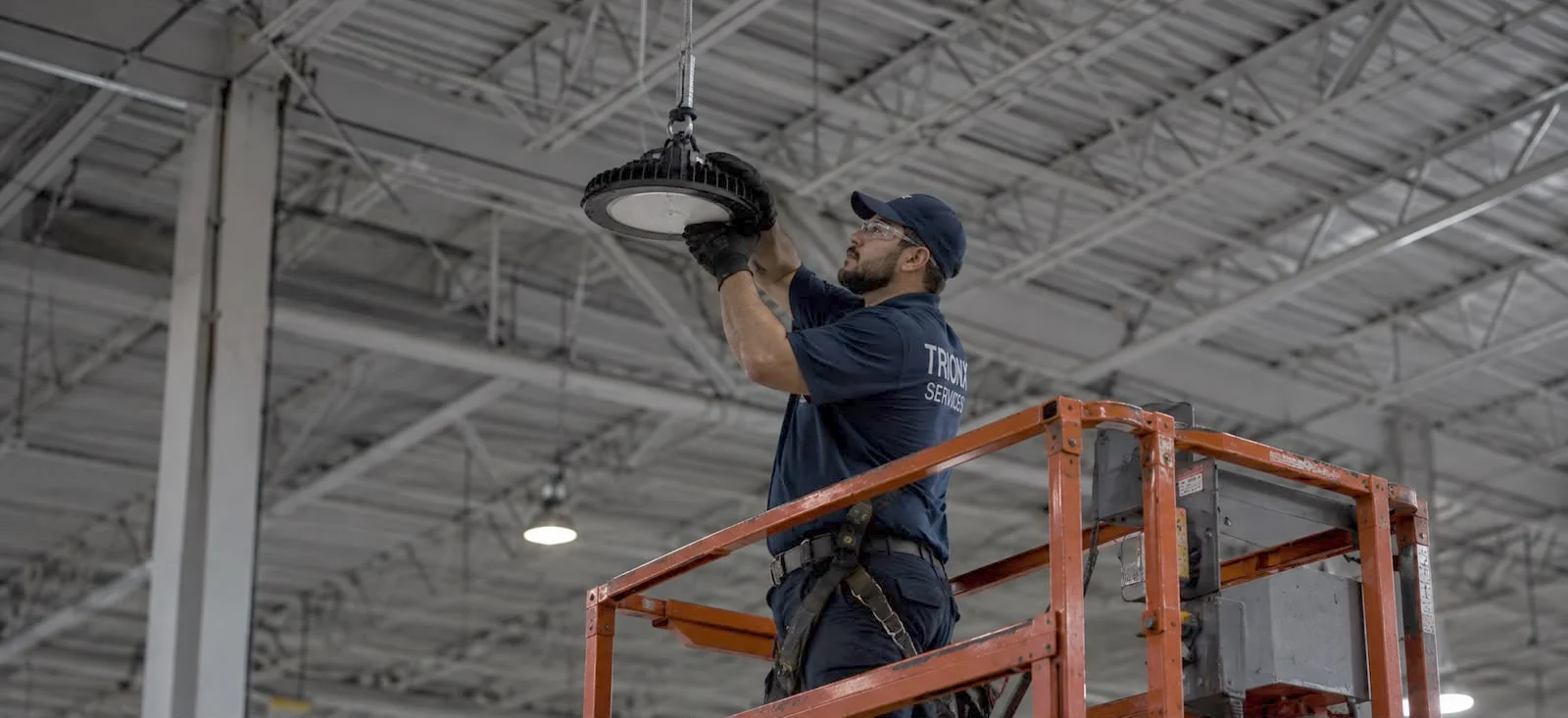
Lighting
Commercial signage: what fails and who fixes it
A sign is the one part of a building that is looked at by everybody and maintained by nobody.
Walk the frontage after dark and photograph every sign, then walk it again in daylight and photograph the same ones. Signs fail differently in each condition and almost nobody looks at both.
Everything below treats the sign as a piece of the building. Where the problem is simply that it has gone dark, our article on parking lot and sign lighting out covers diagnosing that.
The faces
Acrylic and vinyl both degrade under Florida sun. Colors shift at different rates, so a face fades unevenly in composition and evenly across its area, which is why nobody notices until it sits next to something new.
Look for yellowing, chalky surface, crazing, and vinyl lettering lifting at the edges or shrinking back from the corners. Look for cracks, which in this climate become water paths within a season.
Water inside a cabinet is the thing to catch. A cracked or badly sealed face lets rain into a box holding electrical equipment, and the visible symptom is staining, streaking or standing water at the bottom of the face long before anything stops working.
The fasteners, which is the one that matters
Salt air corrodes brackets, anchors and fasteners continuously, and all of it happens behind the sign where nobody looks.
A sign face is a large sail area. In a storm, a cabinet held by corroded anchors becomes a projectile, and that is a consequence rather than a maintenance inconvenience. It is also the part most likely to be excluded from a claim if it can be shown it was never maintained.
Check anchors into the wall as well as the sign's own hardware. Look for rust staining running down the wall below a fixing, which is the visible sign of corrosion behind it. Check that a sign has not started to move, tilt or drop at one corner.
Letters, returns and channel signs
Individually mounted letters fail one at a time, and a sign missing a letter reads as neglect more strongly than almost anything else on a frontage.
Look for letters that have loosened, rotated, or lost their spacers. Look at the returns, the sides of each letter, for corrosion and for separating seams. Water entering a channel letter finds the electrical inside it.
The permit question, before you order anything
Replacing a face in an existing cabinet is normally maintenance. Changing the sign itself, its dimensions, its structure, its illumination type or its position generally needs a permit in Miami-Dade, and permits vary by municipality within the county.
Anything requiring a permit is licensed work whatever the trade, which overrides the split described below. Establish this before ordering, because a fabricated sign that cannot be installed is an expensive object.
Worth checking your lease as well. Signage is commonly controlled by a landlord or an association, and approval there is separate from the permit.
Establish who owns the sign before it needs anything. On leased premises the cabinet is frequently the landlord's and the face the tenant's, and on plenty of frontages the whole thing belongs to an occupier who left years ago and never removed it. That question takes a minute at the start of a tenancy and becomes slow and awkward once something has failed.
Removal is worth planning too. A sign taken down at the end of a tenancy leaves fixing holes, a shadow where the wall behind it has not weathered with the rest, and often a redundant power supply. Making that good is part of the exit and it is routinely forgotten until a final inspection raises it.
Which half we do
Mounting, remounting, fasteners, anchors, brackets, face replacement in an existing cabinet, cleaning, sealing, and the making good on the wall behind are performed directly by our own technicians. So is removing a sign and repairing the frontage afterward, which comes up on every tenant change.
The illumination is electrical: wiring, power supplies, modules, transformers, photocells, timeclocks and the circuit feeding the sign. Florida requires a licensed electrical contractor for that at any job size, and it is coordinated and documented by us. Our article on relamping against retrofit covers where a lamp change stops being a lamp change, which applies to signage as much as to interior lighting.
Doing it on a schedule rather than on a complaint
Signage sits in a gap. Nobody internally owns it, nothing schedules it, and every customer looks at it before they look at anything else.
Put a night walk and a daylight walk of the frontage on the quarterly property walk, photograph from the same positions each time, and check the fasteners annually before the season. Where a repaint is coming up, our article on how often a South Florida exterior needs repainting covers timing, and doing signage in the same visit avoids paying twice for the same access equipment.
Common questions
Questions we get asked about this
Why do signs fade and yellow so fast here?
Ultraviolet exposure. Acrylic and vinyl faces both degrade under Florida sun, and colors shift at different rates, so reds and blues go first. A face that has yellowed is doing it evenly, which is why it goes unnoticed until it is photographed next to a new one.
Is the fixing really the risk?
On a coastal building, yes. Salt air corrodes anchors and brackets behind the sign where nobody sees them, and a sign face is a large sail area in a storm. It is the failure with real consequences rather than a cosmetic one.
Do I need a permit to change a sign?
Replacing a face in an existing cabinet is usually maintenance. Changing the sign, its size, its structure or its location generally needs a permit in Miami-Dade, and permitted work is licensed work whatever the trade. Check before ordering anything.
Who fixes the illumination?
That half is electrical. Anything on the wiring, the power supply, the modules or the circuit needs a licensed electrical contractor in Florida at any job size. Faces, fasteners, mounting and cleaning are performed by our own technicians.
Keep reading
Related field notes
Relamping against retrofit: what a technician can and cannot touch
Graffiti and storefront damage: back to trading condition

How often a South Florida commercial exterior needs repainting
A light is out and the bulb is not the problem
Floor tile is lifting, cracked or loose
One area is too hot or too cold
One company, whoever does the work
Our technicians handle the trades that need no state license, and licensed contractors handle the ones that do. Either way we scope it, book the visit and file the record. Tell us the property and the problem and we will come back with a window. Call out of hours and someone who works here answers.