
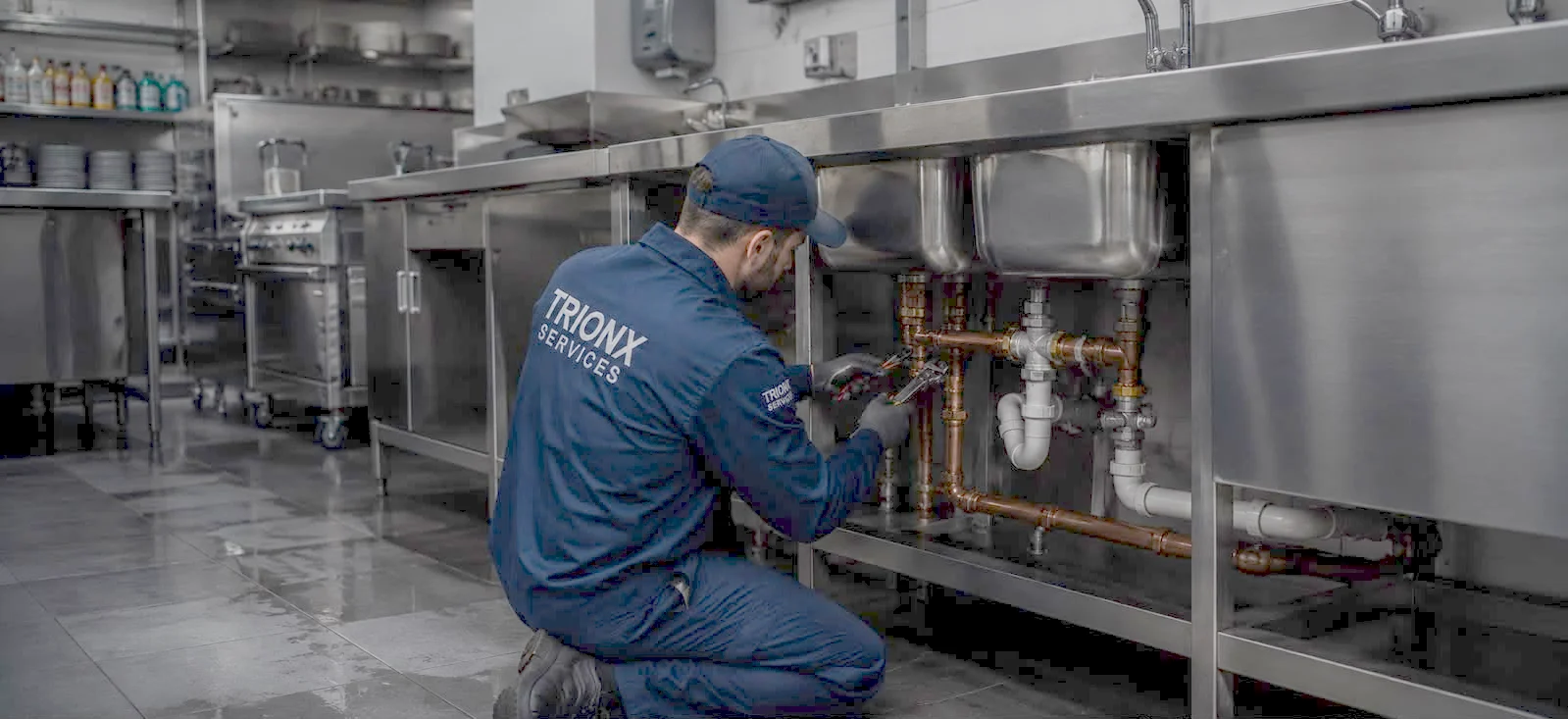
Plumbing
A toilet is running, or the water bill has jumped
A commercial water bill that has jumped with no change in occupancy is usually a leak that has been running quietly for weeks.
Someone who works here answers, out of hours included. (786) 628-9227
Do the overnight meter test before assuming anything. Read the meter when the building is empty and everything is shut off, read it again before the first person arrives, and see whether the number moved.
A meter that advances with nothing running is proof of a leak, and it converts an argument about the bill into a search with a known answer.
Start with the toilets
A continuously running toilet is the most common cause of a commercial bill jumping, and it is easy to miss in a building with several restrooms nobody visits at quiet times.
Walk every restroom and listen. A faint hiss or trickle from a pan that nobody has just used is water running to drain. Look for a ripple on the surface of the water in the bowl, which is the giveaway on a slow leak from the tank or flush valve.
Check urinal flush controls too. A sensor that has failed on, or a timed flush set far too frequently, will run all night and every weekend without anybody noticing.
Then the places nobody walks
Irrigation is the most commonly missed cause on commercial property. It runs at night by design, a failed valve or a broken head can run for months, and nobody sees it because it happens when the site is empty. If your meter moves overnight, isolate the irrigation and repeat the test.
Equipment that takes make-up water, including cooling towers, ice machines and some kitchen equipment. Outside faucets, particularly ones with a hose left connected. Underground supply between the meter and the building, which shows as a wet patch, unusually green grass, or nothing at all.
Water heaters and their relief valves, which can discharge to a drain continuously without any visible sign.
Narrowing it down
Isolate one part of the site at a time and repeat the overnight test. Irrigation first, since it is both the most likely and the easiest to shut off.
If the meter still moves with the building isolated at its main stop, the leak is between the meter and that valve, which is underground and a different job.
Compare the bill against the same period last year rather than against last month, so seasonal irrigation and occupancy changes are not mistaken for a fault. Note whether the increase was a step or a climb, because a step points at something that failed on a date and a climb points at something degrading.
Read the bill itself before searching the building. Commercial water charges usually include a sewer element calculated from metered supply, so a leak that never reaches a drain is billed twice, once as water and once as sewer. That is also the argument for raising it with the utility once the leak is found, because some authorities will consider an adjustment where the repair can be evidenced with a dated invoice.
Check whether the meter has been changed recently. A replaced meter reading from zero against an estimated previous bill produces exactly the step change people attribute to a leak, and it is worth eliminating before anybody starts digging.
The other reason this matters
Water that leaves the system is also water arriving somewhere. A supply leak inside a wall or above a ceiling will produce a stain, a smell or damage long before anybody connects it to the bill.
Where you have both a raised bill and a mark on a ceiling, treat them as the same problem until proven otherwise. Our articles on water coming through a ceiling and reading a stained ceiling tile cover that side of it.
Who is allowed to do the work
Plumbing in Florida requires a licensed plumbing contractor, at any job size. Working on a toilet, a flush valve, a tank, a faucet, a water heater, irrigation piping or any supply line where connections are made and broken all sit on that side, and a routine fixture repair needs a license exactly as much as a large one.
TrionX coordinates that contractor and documents the work. Our own technicians handle everything around it: the making good, the drywall, the ceiling, the painting, the doors and any access that has to be opened up and closed again.
Keeping it from repeating
Read the meter monthly and write the number down, which is the cheapest leak detection available and needs no equipment. A building with twelve months of readings notices a step change immediately.
Put restroom checks and an irrigation check on the quarterly property walk. Both are quick, and both catch the failures that otherwise run unnoticed until a bill arrives.
Common questions
Questions we get asked about this
How do I confirm there is a leak rather than higher usage?
Run an overnight meter test. Take a reading when the building is empty and everything is off, take another before anybody arrives, and note whether the meter moved. Movement with nothing running means water is going somewhere it should not.
How much water does a running toilet actually waste?
Enough to show on a commercial bill, because it runs continuously rather than intermittently and often does so unnoticed for weeks. Several running at once in a building with public restrooms is a common cause of a bill jumping with no other explanation.
Can a maintenance technician fix a running toilet?
Work on the fixture where supply or waste lines are made and broken is plumbing, and Florida requires a licensed plumbing contractor for it at any job size. We coordinate that and document it rather than performing it.
Nothing is visibly leaking. Where else should we look?
Irrigation, which runs at night and is the most commonly missed cause. Cooling tower and equipment make-up water. Underground supply between the meter and the building. Any of those can run for months without appearing anywhere a person walks.
Keep reading
Related field notes
One company, whoever does the work
Our technicians handle the trades that need no state license, and licensed contractors handle the ones that do. Either way we scope it, book the visit and file the record. Tell us the property and the problem and we will come back with a window. Call out of hours and someone who works here answers.