
Electrical
An outlet or a circuit has stopped working
A dead outlet has a reset device behind it more often than it has a fault, and the device is rarely in the room you are standing in.
Before assuming a fault, hunt for a reset device. A tripped GFCI protects several outlets downstream of it, and the button is frequently in a room nobody associates with the dead outlet.
Check restrooms, janitor closets, outside walls, behind counters, in store rooms and near sinks. That single check resolves a large share of dead outlet calls.
Map what is actually dead
Test more than the one outlet somebody reported. Walk the area with something small you can plug in and note every outlet that works and every one that does not.
The pattern is the diagnosis. One outlet dead with everything else live is usually the outlet itself or a reset device. A run of outlets dead along one wall is a circuit. Outlets dead but the lighting still on is normal, because they are usually separate circuits, and it points at one tripped circuit rather than a supply problem. A whole area dead is covered in our article on part of the building losing power.
Check the appliance too, on an outlet you know works. Equipment fails more often than wiring does, and an appliance with an internal fault is also the thing most likely to have tripped the circuit in the first place.
The breaker rule
Resetting a tripped breaker once is reasonable and it is often the end of it.
Resetting one that trips straight back is not. The breaker exists to disconnect a circuit that has a problem, and the second trip is confirmation the problem is still connected. Holding the handle, taping it, or working it repeatedly defeats the protection on a circuit that has already declared a fault.
Leave it off, put a label on it so nobody helpfully resets it, and get a licensed electrician to trace the cause.
What to do before that call
Unplug everything on the affected circuit. Where a faulty appliance caused the trip, the circuit will usually hold once it is disconnected, and knowing which appliance did it is worth more than any other piece of information you can gather.
Note what was running at the moment it went. Note whether it has happened before and how recently. Note whether there has been any water near the area, which is worth saying plainly because it changes the risk.
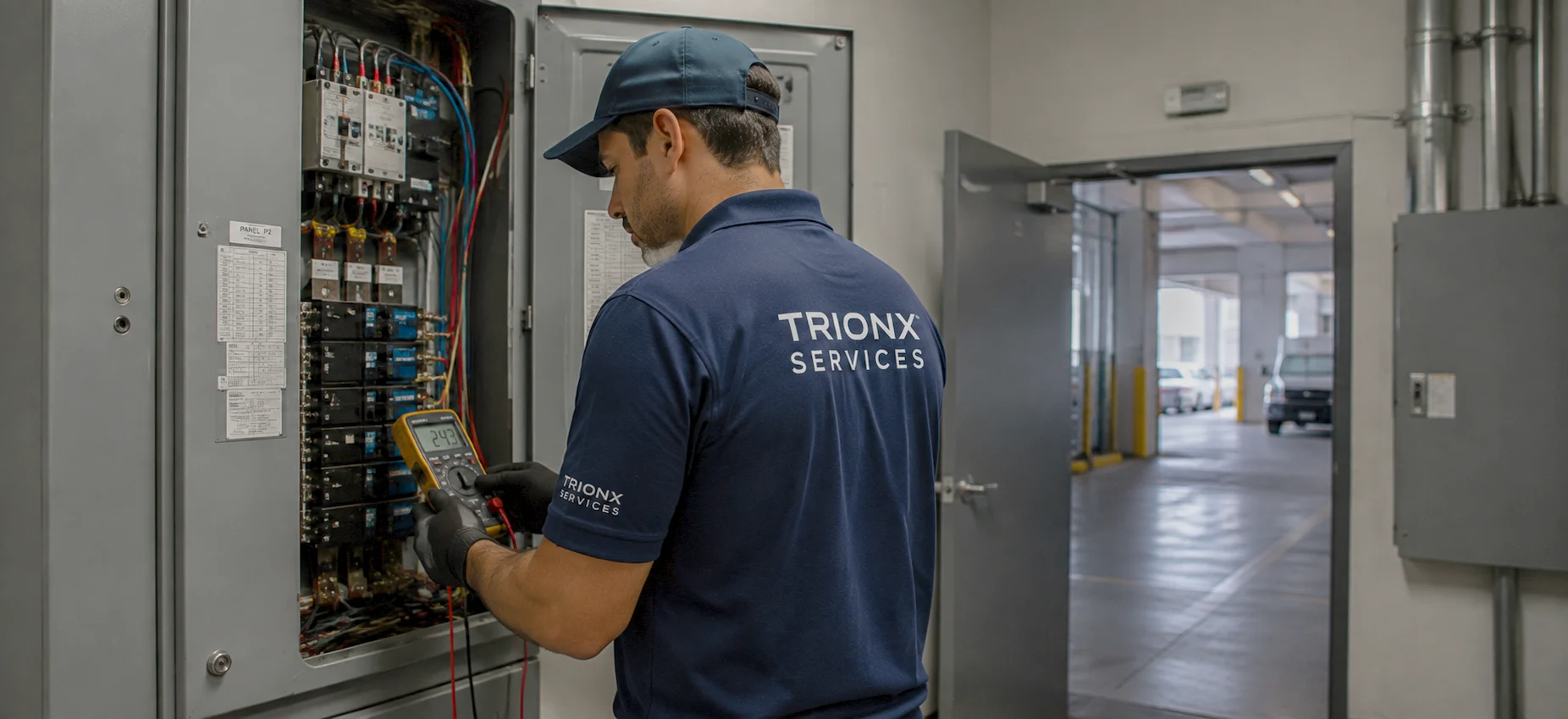
Photograph the front of the distribution panel with the labels visible and the tripped breaker in position. Reading the outside of a board is safe and useful. Opening it is not.
What not to do
Do not remove a panel cover. There are live parts behind it that are not obvious and not insulated, and opening it is qualified work whatever the intention.
Do not replace an outlet yourself, however routine it looks. Do not daisy-chain extension leads to work around a dead circuit. Do not ignore an outlet that is warm, discolored, scorched, or that sparks when something is plugged in, because those are covered by a different and more urgent article.
One thing worth doing while somebody is on site for this: get the distribution panel labeled properly. Most commercial boards carry labels written during the original build-out and invalidated by twenty years of changes since, and an unlabeled board turns a ten minute fault into an hour of switching things off to find out what they feed. It is among the cheapest improvements available to a building of any age.
Who is allowed to work on it
This is licensed work. Replacing an outlet or a switch, tracing a circuit fault, working in a panel and anything on the supply side all require a licensed electrical contractor in Florida, at any job size. Our article on what legally needs a licensed electrician sets out how wide that scope is, and it is wider than most property managers expect.
TrionX coordinates the contractor, attends and documents the job. Our own technicians handle the part with no wiring involved: relamping, mounting equipment, and making good afterward.
When it cannot wait
Right away if the dead circuit takes refrigeration, security, powered doors, access control or emergency lighting with it, or if a breaker has tripped more than once. A power loss frequently arrives as three separate complaints that turn out to be one fault.
Anything warm, scorched or smelling of hot plastic is immediate, and our article on a burning smell with nothing visible covers what to do about it.
A single dead outlet in an area with others available can be scheduled. Take it out of service properly with a label rather than leaving it to be rediscovered, because an outlet that half works gets used.
Common questions
Questions we get asked about this
Why would one outlet be dead when the others work?
Most often a GFCI device upstream has tripped, and it is frequently in another room: a restroom, a cleaner’s cupboard, an outside wall or behind a counter. One device protects several outlets, so the dead one and the reset button are often nowhere near each other.
The breaker trips again as soon as I reset it. What do I do?
Leave it off, label it, and get a licensed electrician. The breaker is protecting the circuit and the second trip is telling you the fault is still there. Repeatedly forcing it back is the most common dangerous thing done during an electrical problem.
Can I use an extension lead until it is fixed?
For a light load, briefly, run safely and not through a doorway. It is a poor answer for anything that draws real current, and running a heater, a compressor or kitchen equipment off a lead borrowed from another circuit is how the next circuit gets overloaded.
Is replacing an outlet really licensed work?
Yes. Replacing outlets, switches, fixtures and ceiling fans is electrical work in Florida and needs a licensed electrical contractor at any job size. There is no exemption for small or routine jobs.
Keep reading
Related field notes
What legally needs a licensed electrician in Florida
Lights are flickering in part of the building
There is a burning smell and nothing visible
Office churn: moving teams without wrecking the finishes
Grocery and convenience: what actually keeps the doors open
Trim and door frames: repairing rather than replacing
One company, whoever does the work
Our technicians handle the trades that need no state license, and licensed contractors handle the ones that do. Either way we scope it, book the visit and file the record. Tell us the property and the problem and we will come back with a window. Call out of hours and someone who works here answers.