
Carpentry
There is a hole in a commercial wall: repairing it fast
A hole in a wall looks like a ten-minute job until the cutting starts and something is behind it.
Someone who works here answers, out of hours included. (786) 628-9227
Look behind it before you cut anything. Shine a flashlight into the hole and check what is running through the wall, because an impact that went through the board may already have bruised a cable or a pipe, and a saw will finish the job.
If the cavity is clear, the repair depends on the size of the hole. A door-handle punch-through is a small patch. A cart or equipment strike takes out a larger piece and often the framing behind it. A removed shelf or television bracket leaves a group of holes that can be filled together. All of them can be paint-ready quickly if the method matches the damage.
Checking behind the wall
Commercial walls carry more than residential ones. Cable, data lines, conduit, sprinkler and water supply, and drain lines can all sit inside a partition, and a hole beside a switch, a sink or a column is more likely to have something close to it.
With a flashlight and a phone camera you can see most of it. Look for cable that has been stripped or crushed, conduit that has been dented, and any sign of damp on the back of the board. If something is exposed, stop there. Keep people away from the area and do not push the cable back into the wall to make it tidy.
Anything that turns out to be wiring or plumbing is licensed work in Florida, however small the damage looks. Electrical and plumbing faults found behind a wall are coordinated through licensed contractors, with TrionX arranging the visit and recording what was found. The wall is closed once they have finished, and the closing is the part our own technicians do.
Check the fire rating
Corridor walls, stair enclosures, walls between tenancies and walls around mechanical rooms are often fire rated. The rating comes from the board type, the number of layers and the way the joints are made. A patch that uses one thin layer of ordinary board in a two-layer rated wall leaves a weak spot that an inspector will find.
Look at the edge of the hole. Count the layers and note the board thickness, then match it. Where you cannot tell whether a wall is rated, treat it as if it is until the drawings say otherwise. A patch that matches the existing wall removes the question.
Choosing the patch by size
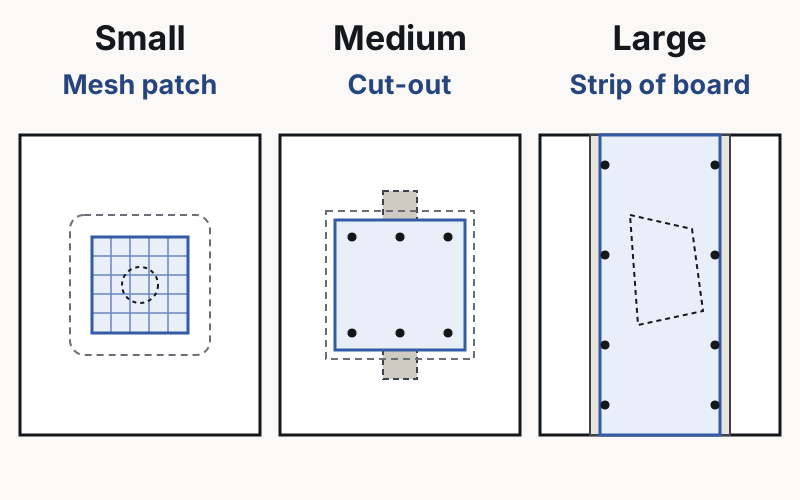
Small holes, up to the size of a fist, can take a self-adhesive mesh patch. Bed it in compound and feather it out over two or three passes. This suits door-handle damage and old anchor holes.
Medium holes need a cut-out. Square the opening with a straight edge, fix a piece of backing across the gap if the framing is not close enough, and screw a new piece of board of the same thickness into place. Tape the joints and finish in compound. A cut-out holds better than a mesh patch on a wall that people brush against every day.
Large damage, or holes that reach a stud or the corner of a bay, may need a strip of board replaced to the nearest framing line. Taking the repair to a natural break, a corner or a door frame, gives a cleaner result than a large patch in the middle of a flat wall. Metal corner bead that has been struck has to be replaced as well, because a bent bead shows through any paint.
Block and concrete walls are different. A hole in masonry is filled with repair mortar, and a hole in a block wall painted over needs the surface matched, or it shows as a smooth patch in a textured wall.
Getting it paint-ready
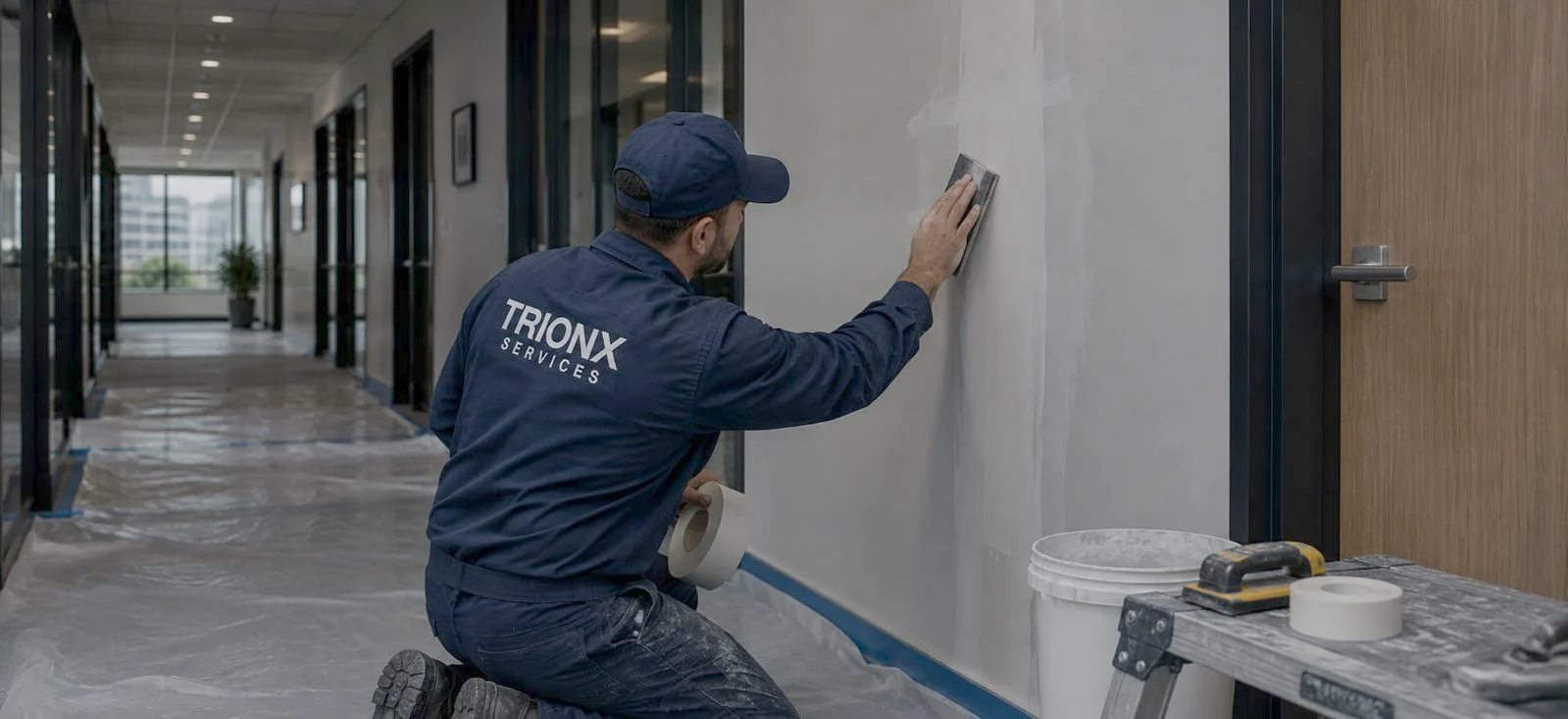
A fast repair keeps every step and gets the sequence right. Set the patch, apply the first coat of compound, let it set, sand and apply the second. Fast-setting compounds shorten the wait between coats, and a heater or a dehumidifier helps in a closed room with no air movement.
The standard of finish depends on how the wall will be seen. A wall in a back corridor can take a lower finish than a reception wall under strong light, and our article on drywall finish levels explains how the levels differ and which one to ask for. A flat wall lit from the side shows every ridge, so sand with a light held at an angle to check.
Prime the whole patch before painting. Compound and paper absorb paint at a different rate from the wall around them, and without primer the repair shows as a dull square. After priming, the question is the finish coat, and matching paint over a repair has its own problems, which are covered in matching paint over a repair. Painting the whole wall from corner to corner is often the only way to make it invisible.
Is it a hole or a symptom?
Impact damage is simple to explain. A wall that has cracked, bulged or been stained is a different matter, and a hole with a damp edge or a rust stain around it points to water. Our piece on a crack that has appeared in a wall covers how to tell movement from surface damage. If the board is soft around the hole, the cause needs finding before anyone patches over it.
A hole that keeps coming back in the same place usually has a cause that is not the wall. A door with no stop behind it, a handle with no wall protector and a corner on a cart route will all do it again. Fit a door stop or a corner guard when the patch is done, so the same wall is not hit again.
Who carries this out
Patching, drywall repair, backing, taping, finishing, priming and painting are carpentry and finish work, performed directly by our own technicians. TrionX carries general liability and workers' compensation on that work, and none of it requires a Florida contractor license. Photographs are taken before the cut, with the cavity open and when the wall is finished.
Fire-rated walls are still carpentry when the repair is a patch to match, but a repair that needs a permit is coordinated rather than carried out directly. Any wiring or piping found behind the board is handled by a licensed contractor, as above.
When it needs doing today
Do it right away where the hole exposes wiring or a pipe, where it sits in a rated wall that a tenant or inspector is about to see, or where it opens a gap into a secure room, a stockroom or a cash area. Holes in an occupied space with sharp edges or exposed screws are a hazard to staff and customers.
A hole in a back-of-house wall can wait for a visit and be batched with other work. If a turnover or a reopening is close, put it on the tenant turnover punch list with a photograph, so that it is not found at the final walk with no time left to cure compound and paint.
Common questions
Questions we get asked about this
How big a hole can be patched without cutting a new piece of board?
Small holes from a door handle or a removed anchor can be filled with a mesh patch and compound. Anything larger than a hand needs the damaged area cut back to a clean opening and a new piece of board fixed in, usually onto backing.
Do I need to check behind the wall before patching?
Yes, before anything is cut. Pipes, cables and conduit run through commercial walls in places that are not obvious, and a hole made by an impact can already have exposed something. Look first, and stop if you find wiring or a pipe.
What if there is a cable or a pipe inside the hole?
Leave it alone and keep the area clear. Damaged wiring and plumbing are licensed work in Florida at any size. We coordinate a licensed contractor to deal with it and document it, and the wall is closed up once that is signed off.
Does the wall have a fire rating that the patch must keep?
Some do, particularly corridor walls, stair enclosures and walls between tenancies. A patch in a rated wall has to use the same board type and layers as the wall around it. If you are unsure, check the drawings or ask before closing it.
How soon can the wall be painted?
Once the compound is dry and sanded, which depends on the product and the humidity. Fast-setting compounds shorten it. A visible repair needs a primer coat over it before the finish paint or it will show through.
Keep reading
Related field notes
One company, whoever does the work
Our technicians handle the trades that need no state license, and licensed contractors handle the ones that do. Either way we scope it, book the visit and file the record. Tell us the property and the problem and we will come back with a window. Call out of hours and someone who works here answers.