
Glass
A window is leaking around the glass when it rains
Water at the edge of a window in the rain usually comes through the sealant, the gasket or the glazing bead, but it can also be arriving from somewhere above and only showing up at the glass.

Start by finding out where the water enters, and do it while it is raining or straight afterward. Mark the wet spot on the sill, then look upwards: trace the water along the frame to the highest point where it is wet. Water runs downhill inside a frame, so the place it drips is rarely the place it came in.
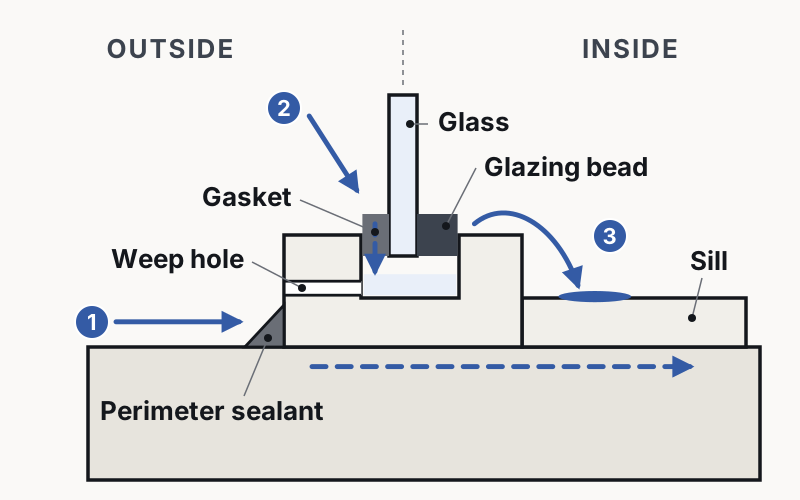
Most leaks around the glass come from one of three places: the perimeter sealant between the frame and the wall, the glazing sealant or gasket between the frame and the glass, or the weep holes at the bottom of the frame that have blocked up. Condensation, a leaking wall and a roof defect can all produce the same wet sill, so rule those out before you pay for a reseal.
Check the obvious causes first
Look at the sealant on the outside. Sealant that has split, shrunk away from one side of the joint, gone hard and chalky or lifted at a corner is a failed seal. Joints at the corners and at the bottom of the frame fail first because they take the most water and the most movement.
Look at the gasket if the glass is held by one. A rubber gasket that has shrunk will pull away at the corners and leave a visible gap. Run a finger along it and a gasket that has gone brittle will feel hard and may crack.
Then look at the weep holes, the small slots along the bottom edge of the outer frame. They let water that gets into the frame drain out again, and they clog with dirt, paint and old sealant. A frame with blocked weep holes fills like a tray and overflows at the sill, which looks like a leak through the glass when the glass is fine.
Rule out condensation
Condensation is common in a humid city with strong air conditioning. It forms on a cold surface, so it appears on the inside of the glass or the frame, and it happens on dry days as well as wet ones. A leak follows the rain. If the sill is damp on a dry, muggy morning, the glazing is probably intact.
Moisture trapped between the two panes of a double-pane unit is a separate problem with a separate repair, and our piece on sealed unit fogging covers how to recognize it.
A simple hose test
If the cause is unclear, test it rather than guessing. Two people are needed, one outside and one inside with a flashlight and a dry cloth.
Start at the bottom of the window and work upwards. Run a gentle stream of water, not a pressure jet, along one section of the perimeter for several minutes, and then move up to the next. The person inside watches for the first sign of water. Starting low matters: if you wet the top first, you cannot tell which section the water came through.
When water appears, you have the entry point. If you wet the glass joints and the frame for a full cycle and nothing appears inside, the cause is probably above the window, in the wall or the roof, and the test should move there.
Protect the area while you wait
Put a towel or absorbent sheet along the sill, move stock and electronics away from the wall, and lift any floor covering that is soaking up water. Water that stays under flooring or inside a wall cavity causes far more damage than the leak does.
A temporary seal of waterproof tape or a bead of temporary sealant on the outside of an identified gap will buy time until the repair. Do not seal the weep holes. Where water is entering faster than that can manage, or the glass is cracked or loose, ask for an emergency board-up so the opening is closed and secured.
What gets repaired
When the failure is in the sealant, the repair is to cut out the old material completely, clean and dry the joint, fit backing rod where the joint is deep and apply new sealant that suits the surfaces on either side. Our article on commercial caulking and sealing explains why the joint preparation matters more than the product.
Where the gasket or glazing bead has failed, or the glass has moved in its frame, the fix is to take the glass out and set it again with new gaskets and sealant. That is re-glazing, and our piece on what re-glazing involves goes through the steps. Clearing blocked weep holes is part of either job.
When the water comes from somewhere else
If the hose test shows nothing at the glass, look above. A failed roof flashing, a blocked scupper, a cracked parapet or a crack in the wall face can all send water down into the head of a window and out at the sill. The same applies if the leak appears in heavy rain only or wind-driven rain from one direction.
Check the ceiling and wall around the window for staining that runs up past the frame. Our article on water through a commercial ceiling covers tracing a leak back to its source.
If the test points above the window, our technician records that finding with photographs. Roofing and structural repairs need a licensed contractor in Florida, so those are coordinated through licensed contractors, with TrionX managing the job and documenting it. Re-sealing the window in the meantime is wasted money if the roof is the cause.
Who carries it out
Re-sealing, re-glazing an existing opening, gasket and bead replacement, clearing weep holes and temporary protection are performed directly by our own technicians. None of that needs a Florida contractor license, and TrionX carries general liability and workers' compensation on the work. A full storefront or window replacement that needs a permit is coordinated rather than done directly. See glass and glazing for the scope.
Report a leak as soon as you see it. Water entering at the frame rots the wall behind it and the damage is hidden until the plaster or drywall goes soft.
Common questions
Questions we get asked about this
Can I seal it myself with a tube of silicone from the hardware store?
You can, and it often makes things worse. New sealant laid over old, dirty sealant does not bond, and a bead that closes off the weep holes at the bottom of the frame traps water inside it. Remove the failed material, clean the joint and use a sealant suited to the substrate.
How do I tell condensation from a leak?
Condensation appears on a surface that is cold relative to the room, and it shows up on dry, humid mornings as well as in rain. A leak follows the weather and usually starts at the same point each time. Wiping the area dry and watching where the water reappears settles most cases.
Does a leak mean the glass needs replacing?
Usually it does not. Most leaks are in the sealant or gasket around the glass, and the glass itself is fine. Re-sealing or re-glazing the existing opening is the usual repair. The glass is replaced when it is cracked, or when the sealed unit has failed and fogged.
What if the water is coming from the wall or the roof above?
Then re-sealing the window will not stop it. A hose test that wets the whole perimeter and shows nothing at the glass points the search upwards. Roofing and structural repairs are coordinated through licensed contractors, with TrionX documenting the findings and managing the job.
Is the window repair something you do directly?
Yes. Re-sealing, re-glazing an existing opening, gasket and bead replacement and temporary protection are performed by our own technicians. A full storefront replacement that needs a permit is coordinated instead.
Keep reading
Related field notes





One company, whoever does the work
Our technicians handle the trades that need no state license, and licensed contractors handle the ones that do. Either way we scope it, book the visit and file the record. Tell us the property and the problem and we will come back with a window. Call out of hours and someone who works here answers.