

Glass
A sealed glass unit has fogged: why, and what fixes it
Condensation on the inside face wipes off. Condensation between the panes does not, and that difference is the whole diagnosis.
Try to wipe it. If the misting is on the room side or the weather side it will clear, and the answer is humidity and ventilation. If it sits between the two panes where nothing can reach it, the seal around the cavity has failed.
That test takes a second and settles the question completely.
What a sealed unit actually is
Two panes of glass separated by a spacer bar around the perimeter, with the cavity sealed and dried. The spacer holds a desiccant, which absorbs the small amount of moisture trapped at manufacture and keeps the cavity clear. Some units are filled with an inert gas to improve the insulation.
Everything depends on that perimeter seal staying intact. It is doing two jobs at once: keeping outside air and moisture out, and keeping any gas fill in.
Why it fails
The cavity heats through the day and cools at night, and the air inside expands and contracts with it. The seal flexes on every cycle. Ultraviolet degrades the sealant. Heat accelerates all of it.
Once the seal is breached, humid outside air moves in and out with the same daily cycle. The desiccant absorbs the moisture until it is saturated, which is why a unit can be failed for months before anything shows. After that, every cool night condenses moisture on the inside faces and you see it.
Installation plays a part too. A unit resting on the frame rather than on setting blocks is stressed at the edge, and edge stress is where seals go first. Our article on what re-glazing involves covers why the blocks matter.
Why it gets worse rather than staying still
Fogging is usually the second visible stage rather than the first. Before it appears there is often a faint film or a residue on the cavity faces, left by the sealant breaking down and depositing on the glass.
Once moisture is cycling in the cavity it also etches the glass over time, leaving permanent marks that would still be there if the seal could somehow be restored. A unit that has been fogged for a long season is not the same unit it was.
What defogging does and does not do
The procedure drills the unit, dries the cavity and fits a small vent. It clears the appearance and it can be a reasonable holding measure on an awkward or very expensive unit.
It does not restore the seal, does not replace saturated desiccant, and permanently opens the cavity to outside air. Any gas fill is gone, the insulation value drops, and the unit continues to admit humidity from then on. In this climate that is a short reprieve rather than a repair, and it is worth being told that before agreeing to it.
What the actual fix is
The sealed unit is replaced. The frame, the sill, the surround and the opening all stay exactly as they are, and the new unit goes in the way any re-glazing does: rabbet cleaned, setting blocks positioned, pane centered, gaskets or sealant reinstated.
Getting the specification right matters more here than on a single pane. Overall thickness, the individual pane thicknesses, the spacer depth, whether either pane is tempered or laminated, and whether there is a low emissivity coating and which face it is on. A replacement that matches the hole but not the build-up performs differently from the units either side of it, and on a storefront that shows.
Worth checking the neighbors
Units installed at the same time tend to fail within the same few years, because they have had the same exposure and the same number of thermal cycles. Where one has gone, walk the elevation early on a cool morning and look at the rest before deciding what to order.
Doing several at once while the access is already in place is the cheaper outcome than returning for each one as it announces itself.
Check the date before you order
Most sealed units carry a date stamp on the spacer bar, visible through the glass at the edge if you look along the perimeter in good light. It tells you how old the unit is, which tells you whether the rest of the elevation is likely to follow.
It is also worth knowing before you buy a replacement, because sealed units are commonly supplied with a manufacturer warranty against seal failure and a unit that has failed early may still be inside it. That is a conversation with whoever supplied the original glazing rather than with us, and it is worth having before ordering a new one.
Who carries this out
Replacing a sealed unit in an existing frame is performed directly by our own technicians, and TrionX carries general liability and workers' compensation on that work. Where the opening needs the framing system replaced, or the work needs a permit and an NOA submittal, that is coordinated through licensed contractors.
Common questions
Questions we get asked about this
How do I know the seal has failed rather than the room being humid?
Try to wipe it. Condensation on the room side or the outside face wipes away. Misting between the two panes cannot be reached from either side, and that is conclusive: the cavity is no longer sealed.
Does defogging work?
Drilling a unit to vent and dry it clears the appearance for a while. It does not restore the seal or the desiccant, the cavity is now open to outside air, and any gas fill and much of the thermal performance are gone. It treats the symptom and shortens the life of the unit.
Does the whole window have to come out?
No. The sealed unit is replaced and the frame stays. That is re-glazing an existing opening, which is normally unpermitted work, so the framing, the sill and the surround are untouched.
Why do they fail faster here?
Heat, ultraviolet and humidity. The cavity heats and cools daily, the seal flexes with it, and the desiccant inside has a finite capacity for moisture. South Florida works every one of those harder than a temperate climate does.
Keep reading
Related field notes
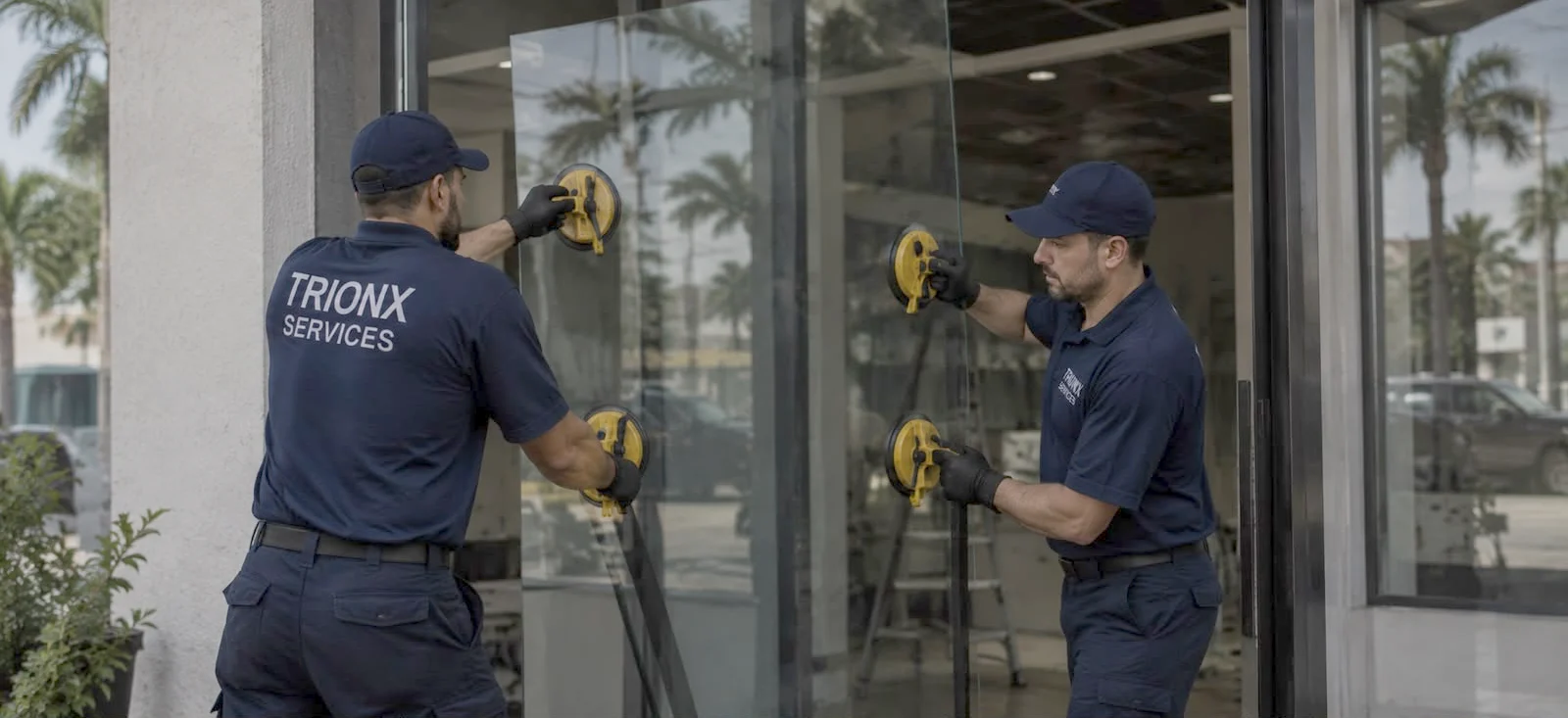
What re-glazing an existing opening actually involves
Glass has cracked but not fallen: how long can it wait?
Caulking and joint sealing: the maintenance nobody schedules
A tempered glass door has shattered
A window is leaking around the glass when it rains
Arranging storefront board-up before hurricane season
One company, whoever does the work
Our technicians handle the trades that need no state license, and licensed contractors handle the ones that do. Either way we scope it, book the visit and file the record. Tell us the property and the problem and we will come back with a window. Call out of hours and someone who works here answers.