
Glass
A glass storefront door drags or will not lock
A glass door that drags or will not meet its lock has usually dropped on its pivots or fittings, and the glass itself is often fine.
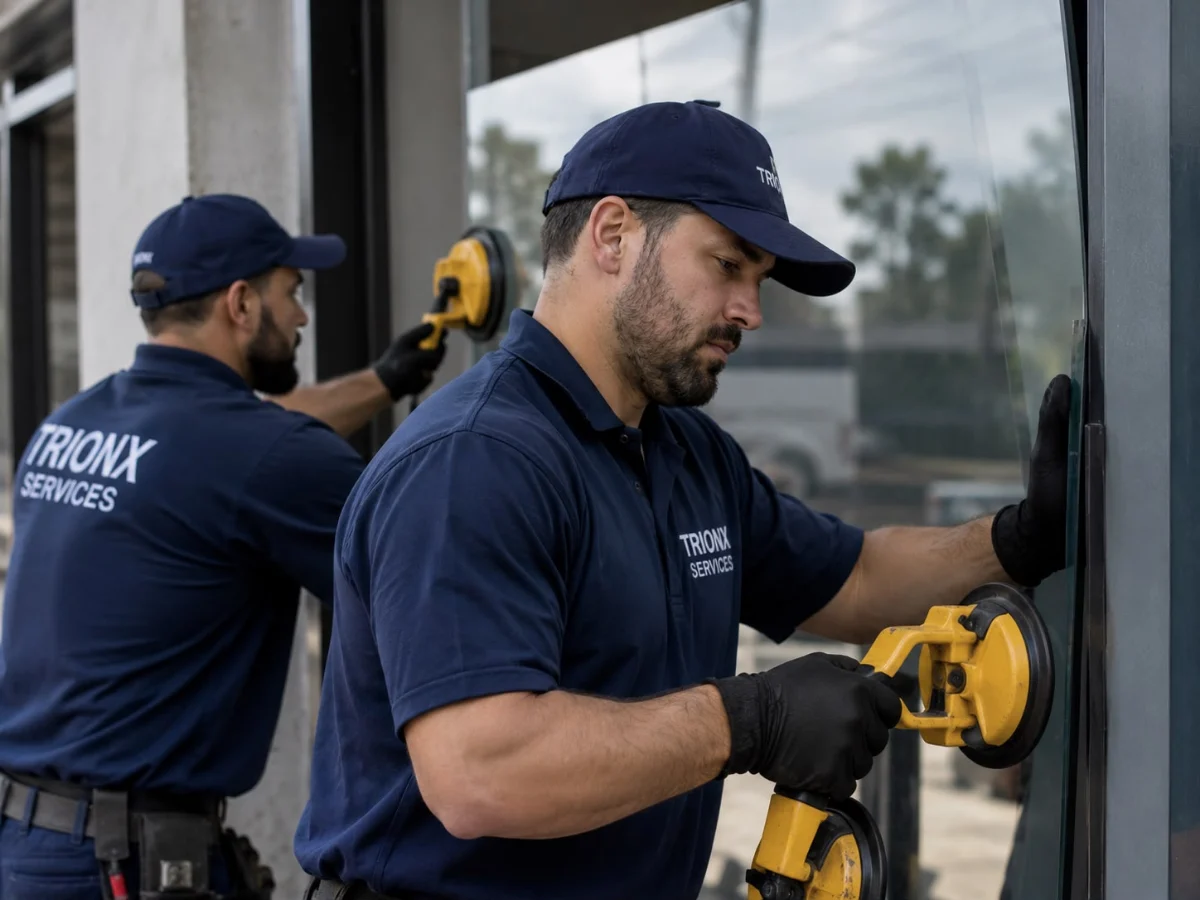
A glass door that scrapes the floor or will not line up with its lock has nearly always moved on its hardware. The glass is heavy, it hangs from a small number of fittings, and when a pivot wears or a fitting loosens the whole leaf sags a few millimeters. That is enough to catch the threshold and to miss the strike.
Stop leaning on the door and do not force the lock. Forcing a dropped leaf against a latch loads the glass at the fitting, which is the one place you do not want load, and it can turn a hardware repair into a broken door.
Find where the door has dropped
Stand square to the door, closed, and look at the gap around it. On a leaf that has sagged, the gap at the top corner on the lock side is wide and the gap at the bottom on the same side is tight or touching. The scrape marks on the floor or the threshold show where it lands.
Open the door slowly and watch how it swings. A leaf that lifts or wobbles as it passes the halfway point points at the floor pivot or the closer spindle. A leaf that swings cleanly but hangs low is more likely a loose patch fitting at the top or bottom corner.
The hardware that carries the glass
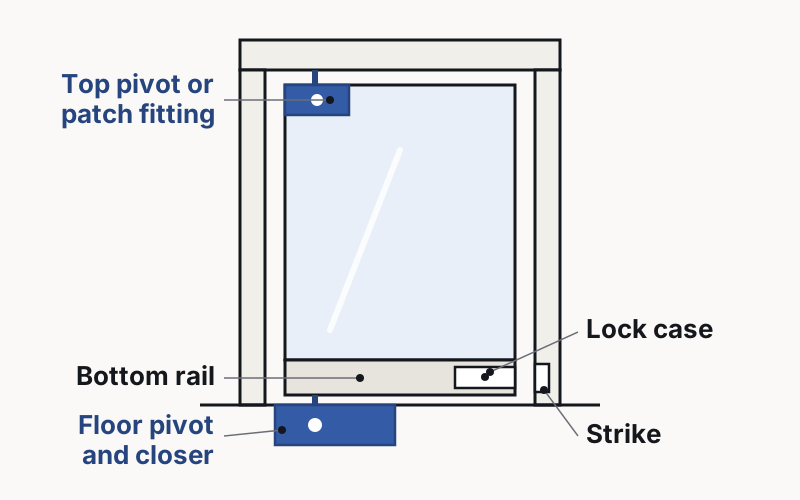
Frameless and storefront glass doors are carried by a handful of parts, and each one fails in its own way.
- Floor pivots and floor closers wear at the spindle and the bearing, and a worn one lets the leaf sink and swing out of line. A closer that has lost oil also lets the door slam, which loosens everything else.
- Top pivots and header patch fittings can back off, and the clamp that grips the glass can loosen as the gasket compresses.
- Bottom rails on a framed leaf fix the glass to its lower edge. Screws work loose in the rail, and the glass can shift inside it.
- Strikes and lock cases on a glass leaf sit against a very small tolerance, so a few millimeters of sag is enough to miss them.
Our piece on commercial door alignment covers solid and framed leaves, where the fix is usually at the hinge and the frame. A glass leaf has fewer places to adjust, and the pivot is the one that matters most.
Hardware or glass
This is the question most managers cannot answer from the front of the shop, and it decides what the job is. Look at the glass itself before anyone touches the fittings.
Check the edges and corners for chips, shells and hairline cracks, especially where a fitting clamps the glass. Look for a crack that starts at a fixing hole or a corner and runs inward. Check whether the glass has slipped in its rail, which shows as an uneven gap on one side of the bottom edge. A leaf that is cracked, or that has a damaged edge at a clamp, cannot be re-hung on new hardware and trusted. Tempered glass does not tolerate a flaw at a load point.
If the glass is sound, the repair is hardware: replacing the pivot or closer, tightening and re-seating the fittings, resetting the bottom rail, and re-aligning the strike. If the glass is damaged, the job moves to the glass, and our article on broken storefront glass covers how to secure the opening in the meantime.
When the door will not lock
If the lock will not engage but the door otherwise swings, the cause is usually the strike or the sag, and occasionally the lock itself. Lift the leaf slightly by hand while turning the key. If it now locks, the door has dropped and the lock is fine. Fitting a new lock to a dropped door fixes nothing and the new one will fail to engage the same way.
Where the lock is genuinely worn, or the door has to be secured tonight, our piece on a commercial door that will not lock sets out what to check and how to hold the premises in the meantime. A glass leaf that cannot be locked is an open storefront after hours, so treat it with the same priority as a broken pane.
Re-glazing an existing opening
Sometimes the glass is the fault. A cracked leaf or a damaged panel beside the door has to be replaced, and replacing glass in an existing opening is a defined job with its own steps for removal, setting blocks, gaskets and sealant. Our article on what re-glazing involves walks through it.
Glass replaced in an existing opening, like for like, is direct work. A change that needs a permit is different. A new storefront system, a change of glass type that triggers a product approval, or a replacement requiring a Notice of Acceptance submittal in a high-velocity hurricane zone is coordinated through licensed contractors, with TrionX handling the paperwork and the record. It is worth asking early which one applies, because it decides the timeline.
Who carries this out
Pivots, patch fittings, floor closers, bottom rails, locks, strikes, weatherstripping and alignment on an existing glass door are performed directly by our own technicians. None of it requires a Florida contractor license. We carry general liability and workers' compensation on that work, and every job is photographed before and after.
An automatic or powered entrance has an electrical side, covering the operator supply, control wiring and sensor circuits. That is carried out by licensed, insured contractors, coordinated and documented by TrionX, because Florida requires a license for electrical work at any size.
When it cannot wait
A door that will not lock, a leaf that has shifted in its frame, a visible crack at a fitting or a leaf that is hanging loose is an urgent call. A door that is only dragging and still closes and locks can be booked in, though a leaf that touches the floor is wearing its own pivot and the glass edge, and the repair gets larger each week it is left. See our glass and glazing service if you want it looked at.
Common questions
Questions we get asked about this
Can I adjust a glass door myself?
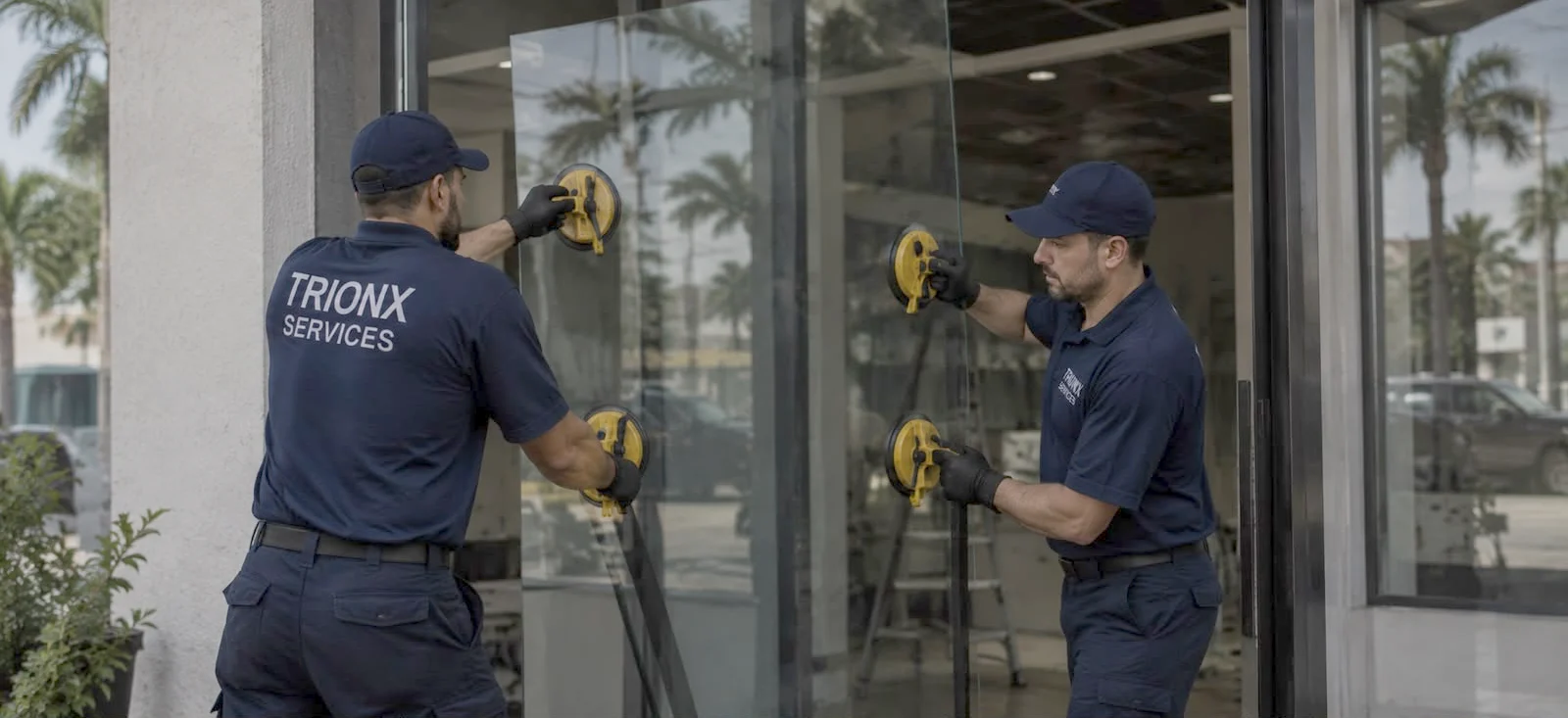
Small adjustments to a strike or a closer speed are reasonable. Anything that involves loosening the patch fittings or the pivot means taking the weight of the glass off the hardware, and a heavy tempered leaf is easy to chip at the edge when it moves. Leave that to someone with the right support and suction equipment.
The door only drags in the afternoon. Why?
Heat expands the frame and the threshold, and a door that is already a few millimeters low will touch the floor in the hottest part of the day. It is a sign the pivot has dropped, not a sign it will sort itself out.
Does a chipped edge on the glass matter?
Yes. Tempered glass fails from its edges, and a chip or shell mark at a corner that is also being clamped by a fitting is the place a door can shatter without warning. Get it looked at before the door is used heavily again.
Do you repair these or replace them?
Pivots, patch fittings, floor closers, bottom rails, locks, strikes and alignment on an existing glass door are performed directly by our own technicians, and TrionX carries general liability and workers' compensation on that work. A full replacement that needs a permit is coordinated through licensed contractors, and TrionX documents it.
Keep reading
Related field notes

One company, whoever does the work
Our technicians handle the trades that need no state license, and licensed contractors handle the ones that do. Either way we scope it, book the visit and file the record. Tell us the property and the problem and we will come back with a window. Call out of hours and someone who works here answers.