

Locks
Choosing a commercial locksmith in Miami
Pick a commercial locksmith before you need one. Whoever you call from a search result at night will hold your keys, your key codes and a way into the building.
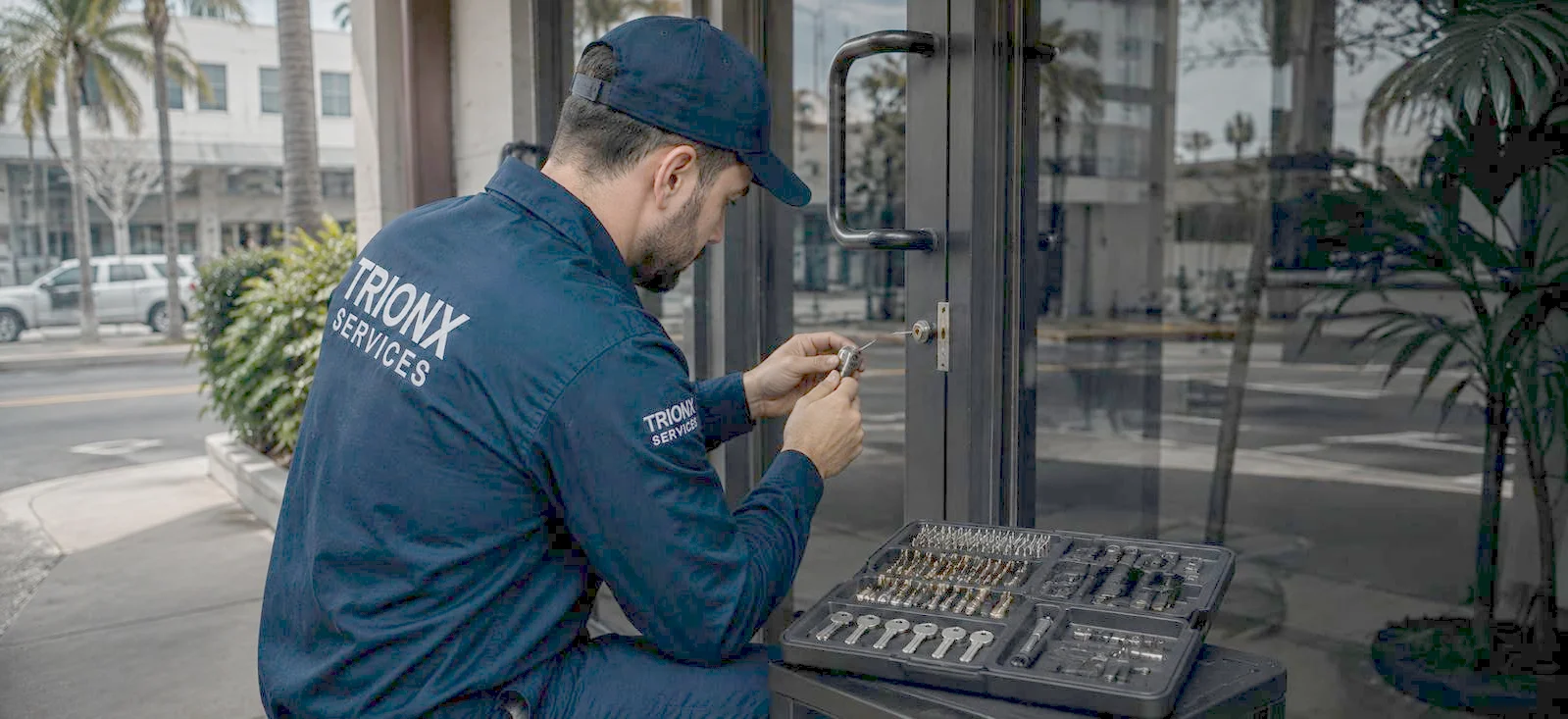
Choose on four points: who actually turns up, how they identify themselves, who keeps the record of your keys and key codes, and how the phone is answered. A locksmith who cannot give you straight answers on those four is not one to hand a building to, however quickly they can attend.
The decision usually gets made badly. A door will not open, or a tenant has left and the keys are unaccounted for, and the manager takes the first listing that shows a map pin and a local number. A lock is a security product, so the vendor who fits it knows how to get past it. That is worth some thought before the call rather than during it.
Find out who is actually coming
Ask on the phone whether the person arriving is an employee of the company you are speaking to. Some listings are a call center that sells the job and passes it to whichever self-employed locksmith is closest. Others are a real company with its own people. Both can be competent, but they are different relationships, and only one of them leaves a single business accountable if something goes wrong at your door.
Ask for the technician's name before they set out, and check it against photo ID when they arrive. Ask whether they have been background checked. Someone who will be alone in your stairwell at night, working on the hardware that protects the building, should have been. At TrionX, locks and access control are performed directly by our own technicians, who are background checked and on our payroll, and we carry general liability and workers' compensation on that work.
Ask for the company's certificate of insurance too. The vendor onboarding documents are covered in our article on the COI, W-9 and license packet, and a locksmith should be able to supply a certificate promptly when you ask.
Ask who keeps the key codes
Every master key system and most restricted keyways come with a record: the bitting codes, the key schedule and the list of doors. Whoever holds that record can cut a key that opens your building. Ask where it is stored, who in the company can see it, and what proof they need before cutting a key for someone who calls.
The right answer is that keys are cut only on a request from a person you have named. Write that list down and give it to the vendor. Without it, a former employee or a tenant who has moved out may be able to order duplicates simply by knowing the name of the building. The same thinking applies when staff leave, and our piece on key control after a termination sets out what to retrieve and what to change.
Also ask what happens to the record if you change vendors. You are entitled to your own key schedule. If a locksmith treats it as theirs, that is a reason to move before the system grows.
Listen to how the phone is answered
The first call tells you more than the website does. Is it answered by someone who works at the company, or by a service that reads from a script and promises a callback? When a door will not secure at night, that difference decides how long you stand next to it.
Ask whether attending is charged if no work follows, and ask for the rate before anyone is dispatched. Reputable vendors say so plainly. A figure that appears only once the technician is at the door, or that changes after the work starts, is a warning sign. If you want to know what a well-run call and visit looks like from the manager's side, locked out of a commercial property walks through it.
Warning signs in search listings
- No street address, or an address that is a shared mailbox or a building that is not a locksmith's premises.
- A very low advertised call-out figure, then a much larger one at the door once the lock is already out.
- A company name that differs from the one the technician gives, or an unmarked vehicle with no paperwork.
- Pressure to replace a lock that could have been picked, rekeyed or repaired.
- Reluctance to put the work, the parts and the charge on a written invoice.
Several of those come from the same source. The listing is a lead-generation service and the person who arrives is a subcontractor of a subcontractor. When you speak to the company, ask for its legal name and look it up before you agree to anything.
Match the vendor to the work
Not every lock job is a locksmith job. If the lock is fine and the door has dropped, the fault is in the door, and replacing a cylinder fixes nothing. Our article on whether you need a locksmith or a door company explains how to tell. A vendor who does both avoids a second visit.
Electrified locks, magnetic locks and access readers sit on both sides of the line. Fitting the lock body, the strike and the reader is lock work. The supply, the wiring and any fault in a circuit is electrical, and Florida requires a licensed electrical contractor for it at any job size. Ask the locksmith how they handle that boundary. A good answer is that the wiring is carried out by licensed contractors and the vendor coordinates and documents it, so you have one point of contact and one record.
Set one up before you need one
The best moment to pick a locksmith is a quiet week. Give them your site details, a list of authorized contacts, and a walk of the doors that matter. A vendor who knows your key system can deal with a lockout, a snapped key or a rekey without starting from scratch. The usual sequence on a rekey is set out in what happens on a commercial rekey, and it is worth reading before you ask for a quote so you know what a proper job includes.
Keep the contact details somewhere your front desk, your security team and the manager on duty can all reach, not in one person's phone. Review the authorized list every time someone with key authority leaves.
When you are choosing, TrionX handles locks and access control with its own technicians, and a person who works here answers the phone, out of hours included. Our locks and access control service covers rekeying, master key systems, panic hardware, keypads, card readers and lockouts for Miami commercial buildings.
Common questions
Questions we get asked about this
Does a commercial locksmith need a Florida license?
Lock and access control work such as rekeying, replacing hardware and installing keypads does not need a Florida contractor license. Electrical work on a powered lock does, so the wiring side of an electrified door goes to a licensed electrical contractor. Ask the locksmith which half of the job they carry out themselves.
Who should hold the key codes for my building?
You should. The locksmith keeps a record so that they can cut more keys, but your property manager decides who is authorized to order them. Agree in writing who may request keys, and ask how the vendor stores the codes and who inside the company can see them.
How can I tell whether the person arriving works for the company?
Ask on the phone whether the technician is an employee, and ask for their name before they arrive. Check the name against their photo ID at the door. A company that sends whoever is free tonight cannot tell you in advance.
What should I get in writing after the visit?
An invoice that lists the hardware fitted, the keys cut and the doors worked on, with photos of the finished work. For a rekey, ask for the key schedule showing which key opens which door and how many keys were issued.
Is it worth setting up a locksmith in advance?
Yes. A vendor who already has your site details, your key system and your authorized contacts can act on a lockout without a round of questions, and you will not be choosing from a search page in the middle of the night.
Keep reading
Related field notes
Card readers, keypads or keys: choosing access control
A key has snapped in a commercial lock
Choosing a facility maintenance vendor: questions worth asking
We have lost a master or building key: what now
What to ask before a vendor rekeys your building
Who is the technician with keys to your building?
One company, whoever does the work
Our technicians handle the trades that need no state license, and licensed contractors handle the ones that do. Either way we scope it, book the visit and file the record. Tell us the property and the problem and we will come back with a window. Call out of hours and someone who works here answers.