

Locks
What actually happens on a commercial rekey
A rekey changes what the lock answers to. The lock itself usually stays on the door.
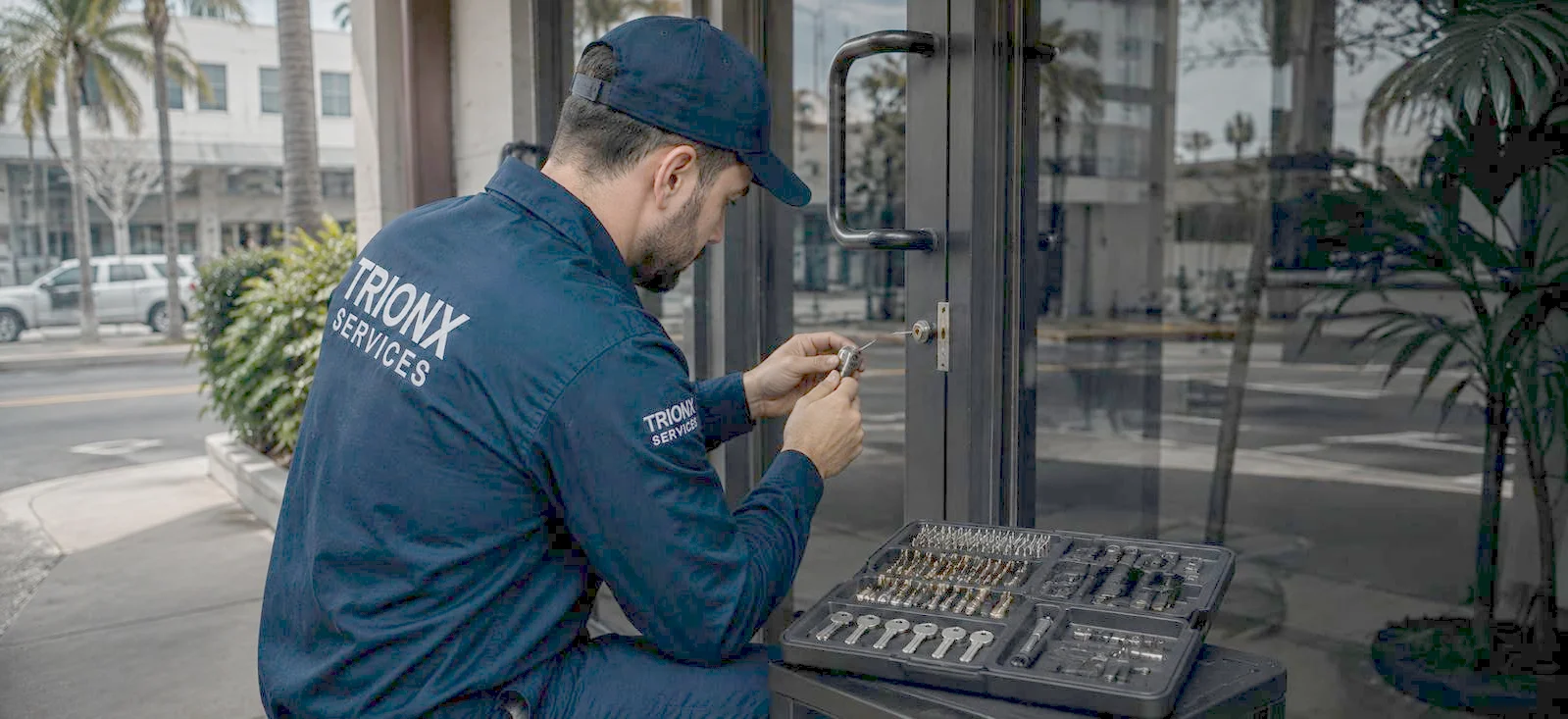
A rekey changes which key a lock answers to. On most commercial hardware the lock stays on the door, the cylinder comes out, and the inside of it is rebuilt to a different cut.
Knowing that is what makes the rest of this make sense, including why a rekey is cheap on some doors and impossible on others.
What is happening inside the cylinder
A pin tumbler cylinder holds a stack of small pins above each position along the keyway. The correct key lifts every stack to exactly the height where the split between the two halves lines up with the edge of the plug, and only then can the plug turn.
Rekeying means taking the plug out, removing the existing bottom pins and fitting a different set, so the alignment now happens at a different key cut. Nothing about the lock body, the latch, the handle or the strike changes.
That is also why a worn cylinder cannot always be saved. Once the plug and the shell have worn against each other for years, the tolerances that make the alignment work have gone, and a fresh set of pins goes into a housing that no longer holds them accurately.
Why a master keyed building is a different job
On a standalone lock there is one key and one set of pins. On a master keyed system each cylinder has to accept two keys, its own and the master, which is done by adding a second split in the pin stack at each position.
So every cylinder in a master system is part of a scheme rather than an independent lock. Rekeying one door in isolation either breaks it out of the system or has to be cut to fit the existing scheme, and getting that wrong produces cross-keying, where keys open doors nobody intended.
Say on the call whether the building is master keyed. It changes the scoping conversation completely, and our article on setting up a master key system covers how those schemes are built.
What to have ready
A door count and a list of which doors. Whether the building is master keyed. Who currently holds keys, as far as anybody knows, because the register that comes out of this starts from that list.
Access to every door on the list in one visit, which sounds obvious and is the most common reason a rekey runs over two visits instead of one. A door that is locked, blocked by stock or inside a tenant demise nobody warned us about is a door that gets done another day.
Worth deciding in advance how many keys you actually want issued. The temptation is to order plenty, and the register is only as useful as the restraint behind it.
What can turn a rekey into something else
A seized or badly worn cylinder, which becomes a replacement. Hardware of a type with no pinning kit available, which is common on older proprietary systems. A door that does not close or latch properly, because a new cylinder does nothing for a door the latch cannot reach. Our article on a door that will not latch covers that side.
A restricted keyway is the other fork, and it is a decision rather than a fault. On a standard keyway the blanks are available anywhere, so a returned key proves nothing. On a restricted keyway blanks are supplied only to the registered holder, so a future rekey can often be avoided when somebody leaves.
The register is the deliverable
New keys are the visible output. The written record of which key operates which doors, who received it and when is the part that decides whether you are in the same position again next year.
It is issued to you rather than held by us, and it gets updated on any later visit that changes a key. Our article on key control after a departure covers what that record has to contain to be worth keeping.
Who carries this out
Rekeying, master key work, cylinder replacement, restricted keyways and the register are performed directly by our own technicians. None of it requires a Florida contractor license, and TrionX carries general liability and workers' compensation on that work.
Where a door needs adjustment before a new cylinder is worth fitting, that is the same visit and the same trade. Where the opening is on access control rather than keys, the credential side is coordinated with whoever supports the system, and the door hardware remains ours.
Common questions
Questions we get asked about this
Does the lock get replaced?
Usually not. The cylinder is the part that recognizes a key, and rekeying re-pins that cylinder to a new cut. The lock body, the handle and the door hardware stay where they are, which is why rekeying is the cheaper answer where the hardware is sound.
What do you need from us before the visit?
How many doors, which ones, and whether the building runs a master key system. That last answer changes the work more than the door count does. A list of who currently holds a key is worth having too, because the register starts from it.
Can every lock be rekeyed?
Most can. A cylinder that is seized, worn past tolerance or of a type with no available pinning kit is a replacement instead, and that is normally found on the door rather than in advance. Older or proprietary hardware is where this comes up.
What do we get at the end?
New keys, and a written register recording which key opens which doors and who received it. The register is the part that keeps the rekey meaningful, because without it you are back to not knowing who holds what within a year.
Keep reading
Related field notes
One company, whoever does the work
Our technicians handle the trades that need no state license, and licensed contractors handle the ones that do. Either way we scope it, book the visit and file the record. Tell us the property and the problem and we will come back with a window. Call out of hours and someone who works here answers.