
Locks
The alarm keeps going off at night
Repeated night activations are usually a building problem being reported by an alarm that is working correctly.
Someone who works here answers, out of hours included. (786) 628-9227
Get the activation log from your monitoring company before touching anything. Date, time and zone for every activation over the last few months.
That list is the diagnosis. Repeated activations clustering on one zone point at one opening, and repeated activations across many zones point at something else entirely.
Why the door is usually the answer
A door contact reports when the door and the magnet separate. It has no opinion about why. A door that latches properly cannot separate, and a door that is resting against its frame rather than latched can move enough to break the contact under wind load or building pressure.
The fault therefore sits with the latch rather than the alarm, and replacing a contact rarely fixes it. Our article on a door that will not close or latch covers the causes, and alignment covers the repair.
Read the pattern before you walk the building
One zone repeatedly: that opening. Check it first and check it properly.
Several door zones on the same elevation: building pressure or wind, which is usually the air handling running at night or a door elsewhere that has been left open and changed the pressure across the building.
Always around the same time: something scheduled. Air conditioning starting, irrigation, a timeclock, a cleaner, a delivery, an automatic gate cycling.
Motion zones rather than door zones: something moving inside. Blinds or signage moving in front of a detector when air conditioning starts is the classic. Also balloons, hanging displays, and insects on a lens.
Scattered and increasing over months: batteries in wireless devices, which is genuinely an alarm company matter.
The checks worth doing at the door
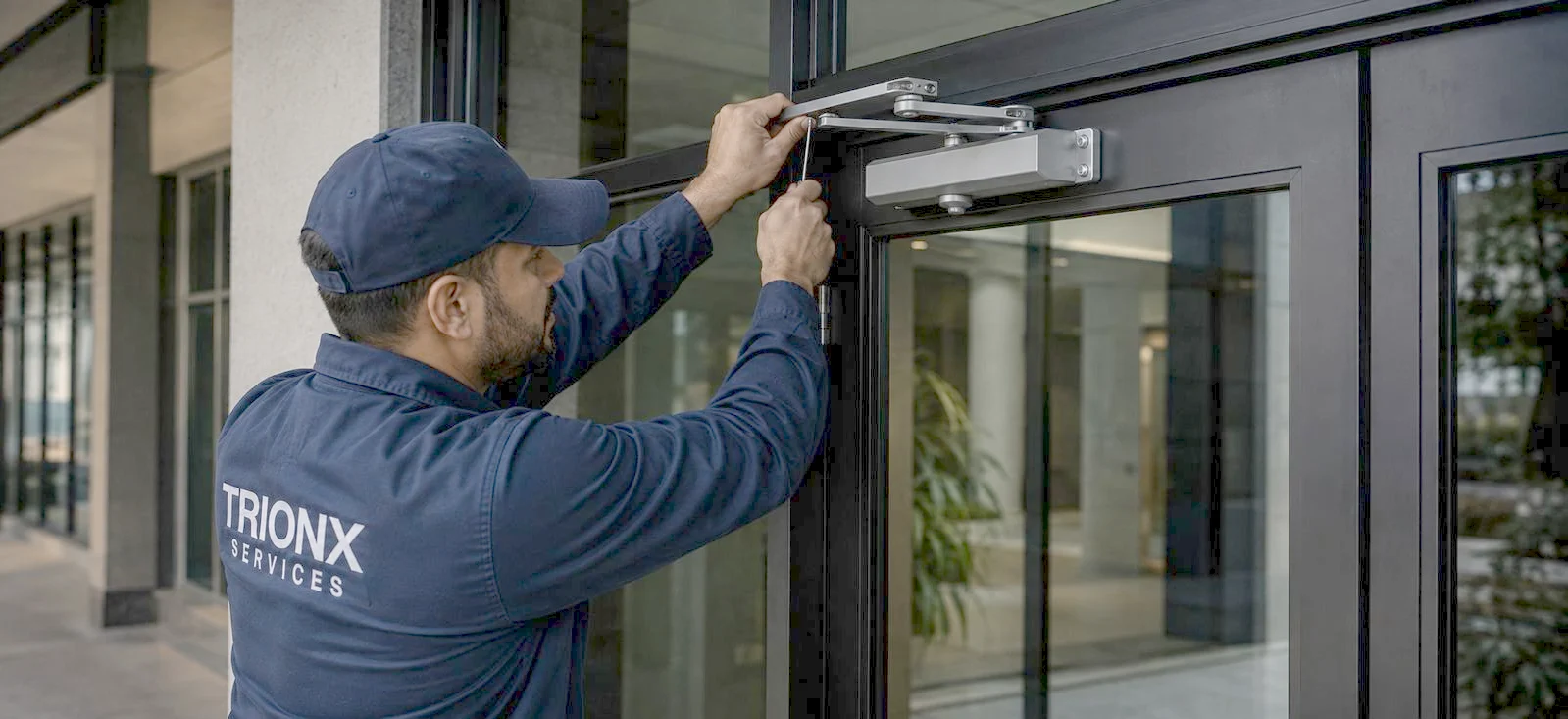
Open it halfway and let go. It has to close and latch on its own without help. A door that needs a push or a pull the last part of the way is the fault, whatever else is going on.
Look at the strike plate for a bright wear mark above or below the opening, which shows exactly how far the door has dropped. Check whether the contact and its magnet still line up, since a dropped door moves the contact as well as the latch.
Check the closer is still doing its job and has not been wound down by somebody who found the door hard to open. Check the weatherstripping has not hardened enough to hold the door off its keeper. On a gate, check the track, the rollers and whether it is seating in its latch at all.
Why this is worth fixing rather than living with
Repeated false activations carry costs that build quietly. Many jurisdictions charge for repeated police response and some withdraw it. Whoever holds the keys stops attending promptly, and after a few weeks nobody treats an activation as real.
That last one is the actual risk. A building where the alarm goes off twice a week is a building where a genuine break-in gets a delayed response from somebody who assumes it is the same door again.
The door fault is also a security fault in its own right. A door that does not latch reliably is a door that does not lock reliably, which is a separate problem the alarm happens to be reporting for you. Our article on a door that will not lock covers that side.
The split between the two vendors
The panel, the detectors, the contacts, the wiring and the monitoring belong to your alarm company. Batteries, sensitivity, zone programming and device faults are theirs and we do not work on them.
Doors, frames, strikes, closers, hinges, alignment, locks, exit devices and gates are performed directly by our own technicians. On a repeated false alarm, that is where the cause usually sits.
Neither vendor is usually given the whole picture. Send the activation log to whoever is looking at the doors, and tell your alarm company what was found at the door. Two visits that do not know about each other is how these run for months.
Closing it out
Once the door is corrected, keep watching the log for a few weeks rather than assuming. Buildings with one bad door often have two, and the second only becomes visible once the first stops dominating the report.
Add a latch check to the closing routine, which takes seconds per door and catches this before the alarm does. Our closing checklist covers what that looks like in practice.
Common questions
Questions we get asked about this
Is this the alarm company or a maintenance problem?
Read the activation log first. Repeated activations on the same door zone almost always mean the door, not the detector. A door that does not latch reliably moves in the wind and the contact sees exactly what it is designed to see.
The same zone trips every time. What does that mean?
A repeat on one zone narrows the search to one opening. Check whether that door latches on its own from a half-open position, whether the magnet and contact still line up, and whether the frame has moved.
Why does it only happen on windy nights or when the AC runs?
Because both put pressure on doors. A door that is only just latching will be pulled or pushed out of its keeper by wind load or by the building going under pressure when air handling starts. It is a latching fault revealed by conditions.
Does TrionX work on the alarm system?
No. The panel, the detectors and the monitoring are your alarm company. Doors, strikes, closers, alignment, locks and gates are ours, and that is where the cause usually is. The two halves have to talk to each other, which is the part that tends not to happen.
Keep reading
Related field notes
Why commercial doors drop, and what alignment actually involves
Commercial door will not lock: what to do tonight
Closing checklist for a retail storefront: locks, glass and lighting
Self-storage: hundreds of latches and one gate
There was a break-in overnight: securing the property and the record
A tenant is moving out this week: what to secure before they go
One company, whoever does the work
Our technicians handle the trades that need no state license, and licensed contractors handle the ones that do. Either way we scope it, book the visit and file the record. Tell us the property and the problem and we will come back with a window. Call out of hours and someone who works here answers.