
Locks
Locked out of a commercial property: what happens when you call
A commercial lockout is a different job from a domestic one, mostly because of who is allowed to authorize it.
Call the number and say the property address, which door, and whether anyone is inside. Those three facts decide the priority before anything else is discussed. Emergency dispatch runs around the clock.
What we ask, and why
A commercial lockout is not a domestic one, and the difference is authority. Opening a business premises for somebody with no right to be there is the worst thing a locksmith can do, so the questions come before the van moves.
Expect to be asked to show entitlement on arrival: a lease, a business license in your name at that address, a recent utility bill, a work order from the property manager, or a manager on site who can vouch for you. A photo ID matching one of those settles it. A locksmith who does not ask is telling you how they would treat your building if somebody else called.
In a managed building there is a second layer. Building management frequently has to authorize access to a suite, and in a tower that is often the real constraint rather than the lock.
What the answer usually is
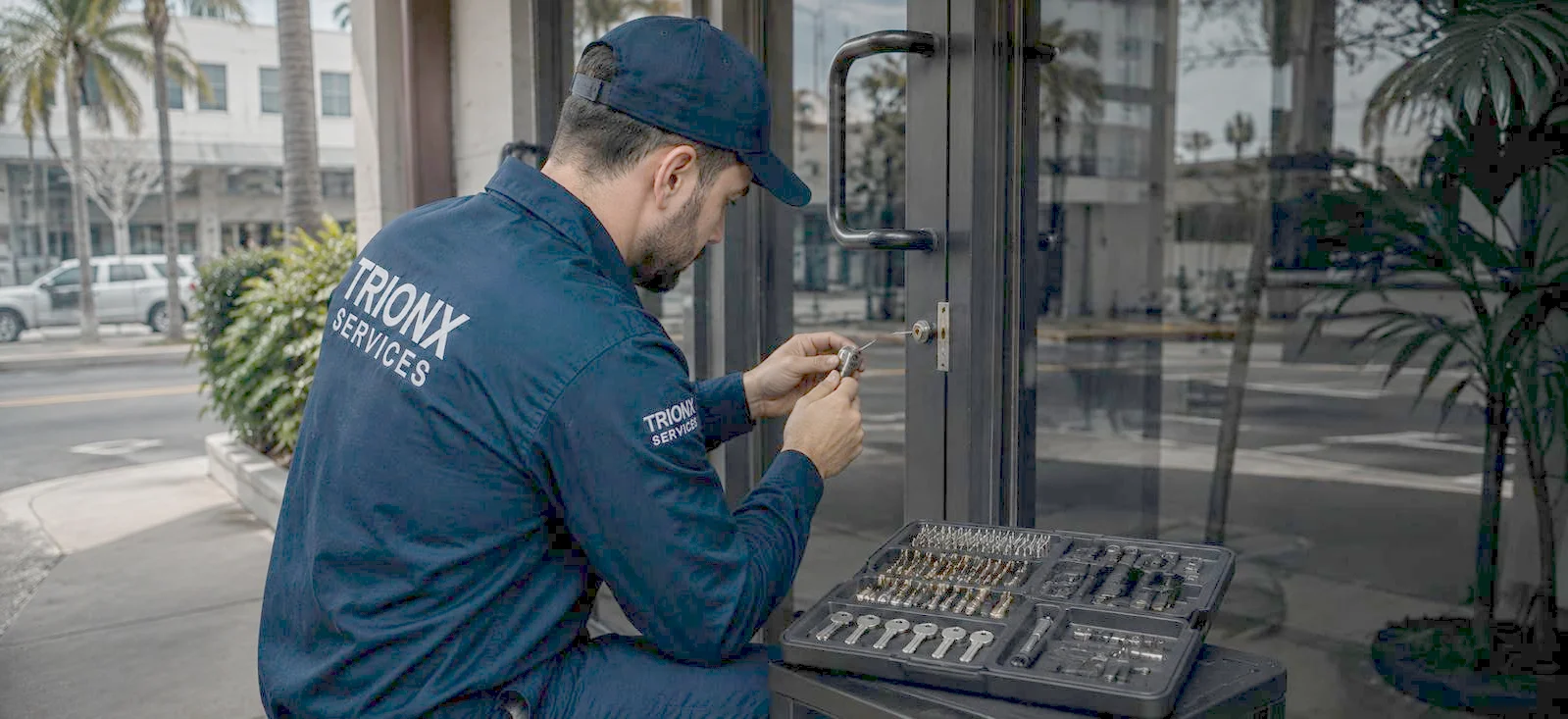
Most commercial cylinders can be opened without damage. The technique depends on the lock and the door, and none of it is worth describing on a public page, but the outcome is that the door opens and the lock still works afterward.
Drilling is a last resort. It converts a lockout into a lock replacement, which costs more and takes longer. Where a lock is high security, already damaged, or has been attacked, drilling may be the only route, and you will be told that before it happens rather than after.
The information that speeds it up
- Which door, described the way the building signs it rather than from a plan.
- Deadbolted or latched. A door that has simply closed behind somebody is a different job from one that has been locked properly.
- Whether anyone is inside. This changes the priority immediately.
- Whether the key is lost or inside. It decides whether a rekey should follow.
- Building access after hours, including whether a security desk or an elevator fob is involved.
Whether to rekey afterward
A key locked inside an office is not a security event. A key that has gone missing is, because it is an unknown number of copies in circulation and no way to establish where it is.
On a standard keyway, collecting or recovering a key proves nothing, since blanks can be cut at any counter. If key control genuinely matters on that door, a restricted keyway is the change worth making, because blanks are then supplied only to the registered holder and duplication needs your authorization.
The doors that get forgotten
A lockout usually prompts a look at the rest of the property, and the openings that never make a list are the same ones every time: stockrooms, roof access, risers, electrical rooms, cages, gate padlocks and the key cabinet itself. If the key that went missing opened any of those, the honest scope is larger than one door.
What makes it more urgent than a locked door
Two situations change the priority immediately. Somebody inside who cannot get out, which is a safety matter rather than a lockout. And a business that cannot trade, where every hour closed is the actual cost rather than the call-out.
A third is quieter and worth naming: refrigeration or equipment behind the door that needs attention. A locked door in front of a walk-in that is drifting warm is a stock loss with a clock on it, and it is worth saying so on the call.
If none of those apply and the building is secure, a lockout at midnight is frequently better handled first thing. We will tell you that rather than dispatching, because the alternative is charging you out-of-hours rates for something that would have cost less at eight in the morning.
Who carries this out
Lockouts, lock opening, rekeying and lock replacement require no Florida contractor license. TrionX performs this work with its own employees, background-checked before they attend, and carries general liability and workers compensation covering it. Anything involving the wiring or power supply behind an access control system is electrical work under Florida law, and a licensed electrician handles that part.
Common questions
Questions we get asked about this
What do I need to prove to get a commercial door opened?
That you are entitled to be there. A lease, a business license in your name at that address, a utility bill, a work order from the property manager, or a manager on site who can vouch for you. A locksmith who opens a commercial door without asking is one you should not want.
Will the lock be drilled?
Usually not. Most commercial cylinders can be opened without damage, and drilling is a last resort because it turns a lockout into a lock replacement. Where a lock is high security or already damaged, drilling may be the only route and you will be told before it happens.
Can you open a door if the key is inside?
Yes, and it is one of the more common calls. Tell us on the phone whether the door is deadbolted or only latched, because it changes the method and how long it takes.
Should we rekey after a lockout?
Only if the lockout was caused by a key going missing rather than being left inside. A lost key is an unknown in circulation and rekeying is the only way to close it. A key locked in an office is not.
Keep reading
Related field notes

A key has snapped in a commercial lock
Rekey or replace: what to do with commercial locks after a tenant leaves
A tenant is moving out this week: what to secure before they go
Keypad or card reader has stopped working
Closing checklist for a retail storefront: locks, glass and lighting
We have lost a master or building key: what now
One company, whoever does the work
Our technicians handle the trades that need no state license, and licensed contractors handle the ones that do. Either way we scope it, book the visit and file the record. Tell us the property and the problem and we will come back with a window. Call out of hours and someone who works here answers.