

Locks
We have lost a master or building key: what now
A missing master key is a risk that grows with the number of doors it opens, so the first job is to find out exactly which doors those are.
Find out which doors the missing key opens before you decide anything else. A master key that opens one suite is a small problem. A great grand master that opens every door in the building is a security event, and the response is different.
Then work out when it was last seen and who could have had it. You will not always get a name, and the plan does not depend on getting one. If you cannot rule out a stranger holding it, treat it as held by one.
Work out what the key opens
Start with the key schedule, the document that records how the system was set up. It lists each key level and the cylinders that respond to it. If you have a copy, the answer takes a few minutes. If the original installer kept it, ask for it now.
Without a schedule, look at your key log. Keys are usually stamped with a code or a number, and the log should say which level that stamp represents. A key stamped GM or GGM is near the top of the hierarchy. A key stamped with a floor or tenant name probably is not.
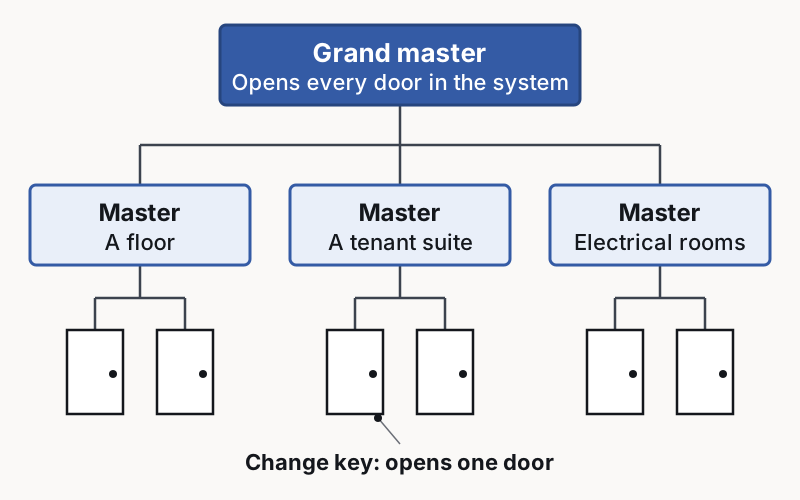
With neither, a technician can test the system door by door. It is slow, but it produces a written map of which keys work where, and you will want that map regardless of what happens next. Our piece on how master key systems are built explains the levels if the terms are unfamiliar.
Establish the window of exposure
Write down the last time anyone is certain they saw the key. Then list everyone who had access to wherever it was kept: staff, cleaners, contractors, previous tenants, the former management company. Include any copies. Master keys are often duplicated informally, and the key you lost may be one of several.
Check the doors for signs of use. Look at alarm logs, access control events and camera footage for entries at odd hours. Nothing found is reassuring but proves nothing, since a mechanical key leaves no electronic trace. Your insurer may also have requirements about notification, so read the policy before you decide how to describe the incident.
If a specific person left and the key may have gone with them, the steps in key control after someone leaves apply. The difference here is that you are working without a name.
Rekey the affected doors or re-pin the whole system
There are two realistic responses, and which one you need depends on the answer to the first question.
If the key opens a limited set of doors, rekey those cylinders. The technician changes the pins so the lost key no longer turns, and cuts new keys for the people who need them. Hardware stays in place and the work is quick.
If the key sits at the top of the hierarchy, a partial fix leaves every other key in the system at risk, because a higher-level key is the one that was compromised. In that case re-pin the whole system and reissue every key. This is a larger job, and it is also the moment to correct problems the old system carried: undocumented copies, too many people at the top level, or a layout that no longer matches how the building is used.
Sometimes the cylinders themselves are the issue. Worn, mismatched or low-grade hardware can be replaced during the same visit rather than rekeyed. Our article on rekeying or replacing commercial locks sets out how to decide, and the one on lock grades covers what to specify if you replace.
What to do until the work is done
Rekeying rarely happens the same hour you discover the loss, so tighten control in the interim.
- Prioritize doors that protect cash, records, stock, server rooms and anything a tenant would hold you responsible for.
- Add a deadbolt or a padlocked hasp to the most sensitive doors, keyed outside the master system.
- Ask staff to report doors found unlocked, and walk the building at close each day.
- Check that camera coverage and alarm schedules are working on the exposed areas.
- Stop issuing or duplicating any key from the affected system.
If a tenant space is on the affected system, tell the tenant. They may have their own obligations, and they will not thank you for finding out later.
Fix the control, not only the locks
A rekeyed system with the same habits will be back in this position in a few years. Keep a key register that records every key by stamp, holder and date issued. Restrict top-level keys to as few people as the building needs. Use a restricted keyway so copies can only be cut with authorization, and keep spare cut keys in a locked cabinet with a sign-out sheet.
Where several doors share one master, consider whether card readers or keypads on the most critical ones would let you remove a person's access without touching a cylinder. Mechanical master keys are efficient and hard to audit. Electronic access is easier to audit and easier to revoke.
Who carries this out
Rekeying, re-pinning, cylinder replacement, new master key systems, restricted keyways, keypads and card readers are performed directly by our own technicians. None of it needs a Florida contractor license, and TrionX carries general liability and workers' compensation on the work. Our locks and access control service covers the full scope.
Where an electric strike or a magnetic lock needs new power or control wiring, that part is electrical and goes to a licensed contractor, coordinated and documented by TrionX alongside the lock work.
When it cannot wait
If the key opens the whole building, if there has been any sign of unexplained entry, or if the key went missing alongside a break-in, do not wait for the next convenient slot. Secure the sensitive areas first and arrange the re-pin as soon as a technician can attend.
A key that opens one storeroom can be dealt with in the normal week. Either way, write down what you know now: what was lost, when it was last seen, who might have held it and which doors it opens. The technician will use that record, and so will your insurer.
Common questions
Questions we get asked about this
Can a locksmith copy a master key we no longer have?
Only with the key, the key code or the system records. Stamped keys and the original key schedule are the usual sources. If none of that exists, the cylinders can be read and the system documented, but it takes longer than working from records.
Do I have to change every lock if one master key is missing?
Not always. If the missing key sits low in the hierarchy it may open only one floor or one tenant space, and only those cylinders need attention. A key at the top of the system opens everything and usually means the whole system is re-pinned.
Should I wait a few days in case the key turns up?
A short wait to search is reasonable if you tighten control in the meantime. Set a date, search properly, and then act. A key that has been missing for weeks with no trace should be treated as lost.
Is this work you carry out yourselves?
Yes. Rekeying, re-pinning, master key systems, cylinder replacement and key control records are performed directly by our own technicians. TrionX carries general liability and workers' compensation, and none of this work needs a Florida contractor license.
Keep reading
Related field notes
Rekey or replace: what to do with commercial locks after a tenant leaves
Setting up a master key system without losing control of it
Lock grades: what Grade 1, 2 and 3 actually mean
There was a break-in overnight: securing the property and the record
A tenant is moving out this week: what to secure before they go
Locked out of a commercial property: what happens when you call
One company, whoever does the work
Our technicians handle the trades that need no state license, and licensed contractors handle the ones that do. Either way we scope it, book the visit and file the record. Tell us the property and the problem and we will come back with a window. Call out of hours and someone who works here answers.