
Locks
Who is the technician with keys to your building?
A vendor's paperwork describes the company. Your tenants and your insurer care about the person who walks through the door, and the two are not the same document.

A technician who enters secured or occupied space should be an employee of the company you hired, screened as an individual, and identifiable on arrival. Get the answer to each of those in writing before the first visit, not after the first incident.
Company paperwork does not give you that. Our article on the vendor onboarding packet covers the insurance certificate, the tax form and the license. It tells you about the business. It says nothing about the individual who will be standing in a tenant's suite at seven in the evening with a master key.
Employee or subcontractor
This is the first question and it changes the others. An employee is on the vendor's payroll, covered by the vendor's workers' compensation, supervised by the vendor and accountable to the vendor for conduct. A subcontractor is another firm's employee, or a sole trader, sent under the vendor's name.
Neither is automatically wrong. A subcontractor is the normal route for work that needs a state license. You need to know which one is coming, and the screening you were promised applies to that person and not only to the company that sent them.
Ask the vendor to state it plainly for each trade they offer. The answer should read something like this: the locks, doors, glass, finish and general maintenance work is done by our own employees, and the electrical, plumbing, HVAC and refrigeration work is carried out by licensed contractors that we coordinate. If a vendor cannot say which trades fall on which side, they probably do not track it.
What a background check should cover
Ask what was checked, when and by whom. A criminal record search, an identity verification and a check that the person is entitled to work are the usual elements. Some leases and insurers specify more, such as a sex offender registry search or a driving record where a vehicle is involved.
Do not ask for the results. A vendor should not hand over an individual's file, and you do not want to hold it. Ask for a written statement that every technician sent to your property has passed the screening, and ask when it was last repeated. A check done once at hiring and never again is a weaker assurance than one with a stated interval.
Our technicians on the direct trades are background checked, and the company carries general liability and workers' compensation. That statement is what a property manager can put in a file and hand to a tenant's risk lead.
Identification on arrival
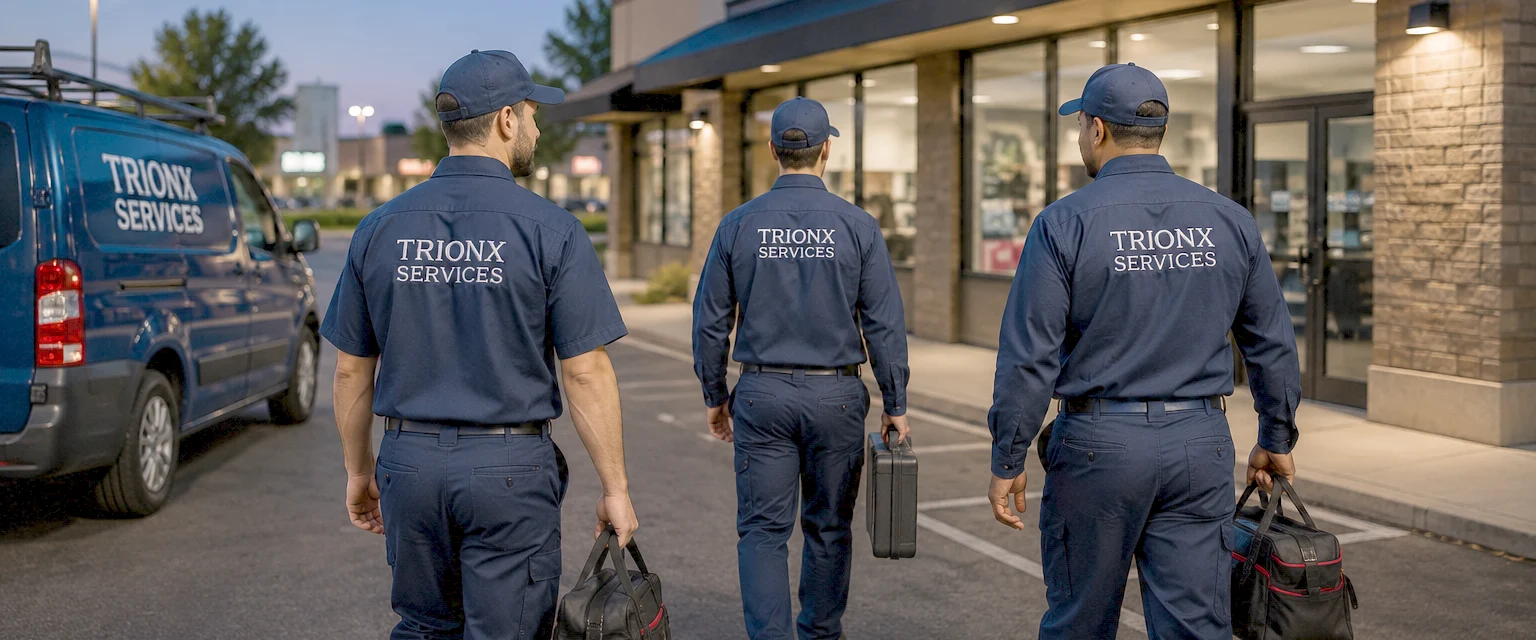
Screening only helps if the person at the door is the person who was screened. The control is simple. The vendor sends the technician's name with the work order, the technician shows photo identification, and the front desk or security matches the two before anyone is let in.
On sites with a manned desk this adds very little to the visit. On sites without one, the property manager can ask for a text or email at arrival and again at departure. The point is a record that somebody was expected, somebody arrived and the two agreed.
Watch for substitution. If the name on the work order is not the person who turns up, the visit waits until someone confirms with the vendor. Vendors who take this seriously do not mind being asked.
Sign-in, escorts and areas
Decide the rules before the vendor asks, and write them down in one page. Which areas need an escort. Which need one only after hours. Which are closed to outside staff entirely. Tenant suites, cash and records rooms, server closets and the roof usually appear on the list.
A sign-in log is worth keeping even where nobody has asked for one. It should show the name, company, time in, time out, the areas entered and the work order number. When a tenant reports something missing or a door found unlocked, that page is the first thing anyone wants to see.
Banks and similar sites run this tighter than most, and the routine is worth borrowing. Our piece on maintenance at a bank branch describes how access is arranged around opening hours, vault areas and alarm states.
Keys and credentials
A technician who can open a door has, for the length of the visit, the same access as the person who owns it. Ask how keys and credentials are handled. They should be signed out, kept on the person and returned at the end of the visit, with any master key or access card never leaving the site with a vendor unless you have agreed it.
Think also about the end of the relationship. When a technician leaves the vendor, or the vendor leaves you, the keys and cards they held need to be accounted for and the codes changed where they were shared. The process in key control after someone leaves applies to a vendor's staff as much as your own.
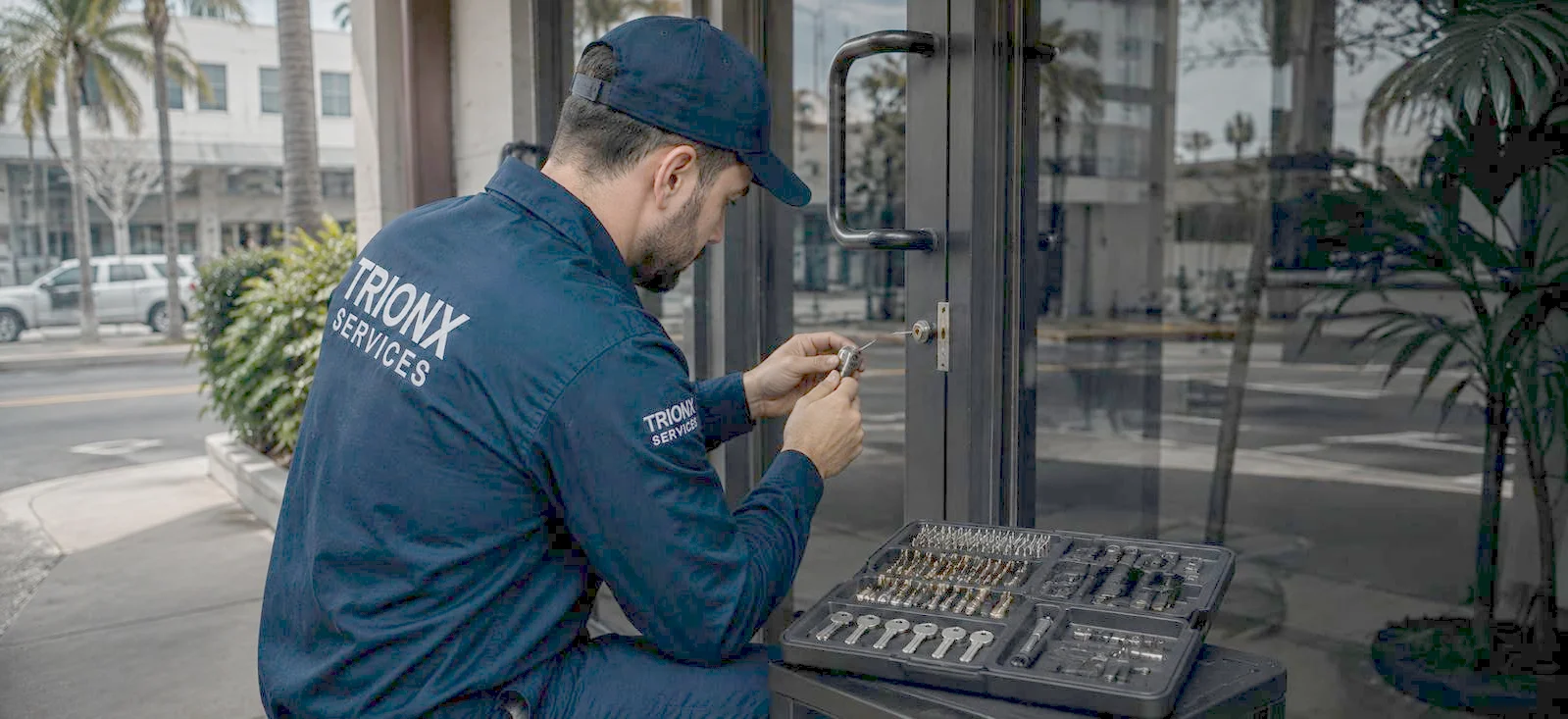
If your building runs a key system or card readers, the access rights given to a vendor should be a named, time-limited credential rather than a shared code. Rekeying, master key systems and reader programming are part of our locks and access control work, performed by our own technicians.
What to ask for in writing
When a lease or an insurer requires vetted staff, the request to the vendor can be short.
- Whether each technician who will attend is an employee of the vendor, or of a subcontractor
- A statement that each has passed a background check, and the interval at which it is repeated
- The identification the technician will carry and how the name is sent ahead
- Proof of general liability and workers' compensation cover, with the certificate holder named
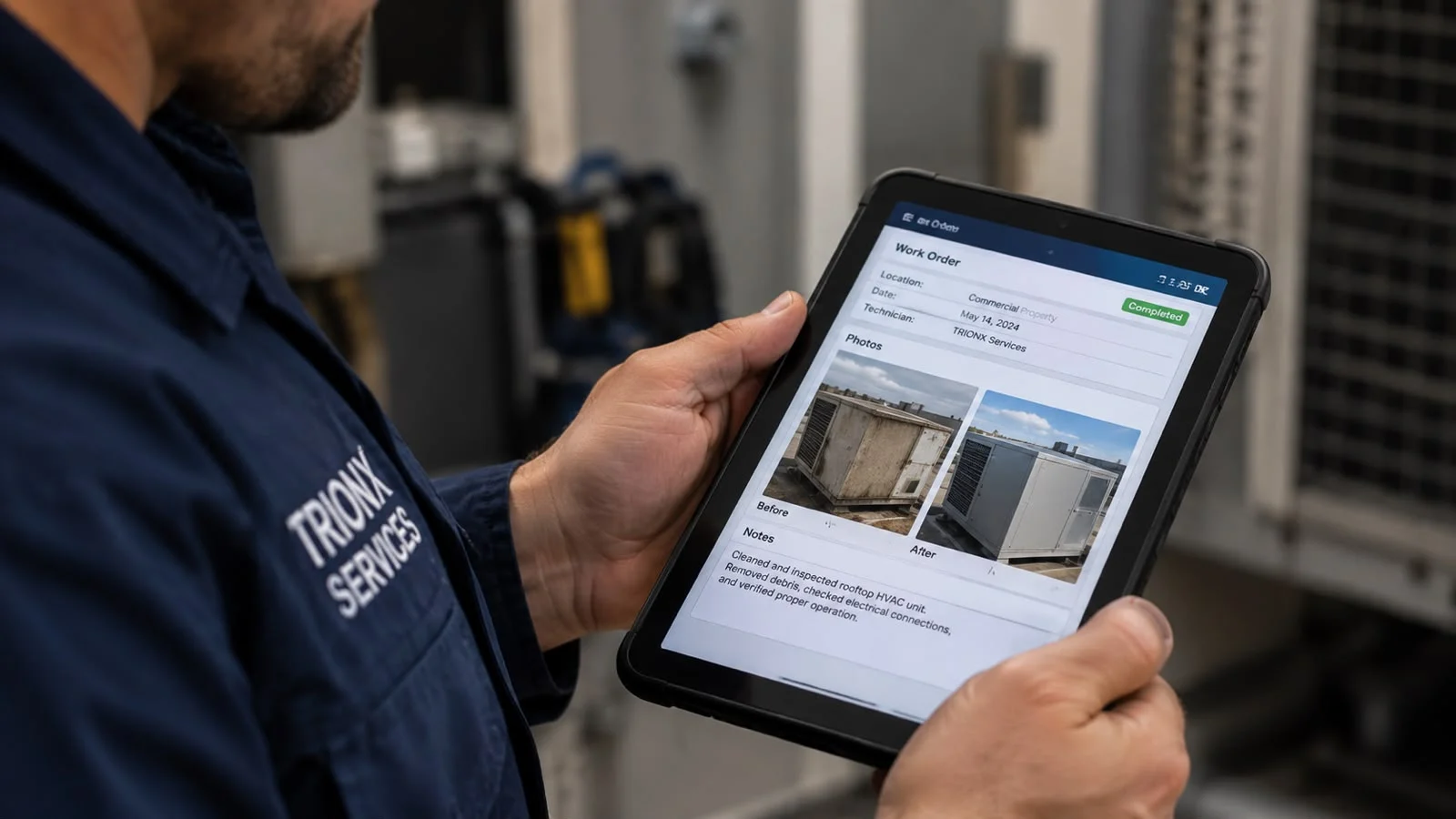
- A written record of each visit: who attended, when, which areas and what was done
The last item is the one most often missed. A photograph record and a close-out report at the end of each job give the property a file that answers questions months later, and the layout of one is in our article on the work order close-out report.
Where licensed trades fit
Florida requires a license for electrical, plumbing, HVAC and refrigeration work, so those jobs are carried out by licensed contractors, with TrionX coordinating and documenting them. Hold those contractors to the same standard. Ask for the technician's name in advance, identification on arrival and the same visit record.
Where one company coordinates the visit, you get one point of contact and one written record covering both kinds of worker, which makes the file much easier to hand over when a tenant or insurer asks for it.
Locks and access control in Miami
Common questions
Questions we get asked about this
Does a background check on the company cover the technician?
No. A company can hold insurance and tax paperwork and still send someone nobody has screened. Ask whether the person attending is on the vendor's payroll and whether that individual has been background checked, and ask for the answer in writing.
What should a technician show on arrival?
Photo identification that matches the name on the work order, and a company identifier if the vendor issues one. Many sites also want the name sent ahead, so the front desk or security can match the person to the job before they reach the door.
When does a technician need an escort?
The site decides. Common triggers are tenant suites, records or cash areas, server rooms and anywhere after hours. Decide the rule once, write it into the access procedure and give it to the vendor, so it is applied the same way every visit.
What if the work is electrical, plumbing or HVAC?
Those trades are carried out by licensed contractors, coordinated and documented by TrionX. Ask the same screening questions about the contractor's people, and ask for the answer to come back through the coordinating company so there is one written record.
How long should visit records be kept?
Keep them for as long as the lease or the insurer's requirement says, and at least as long as the access arrangement itself. A dated record of who attended, when, and which areas they entered is the document that answers a later question.
Keep reading
Related field notes

An insurance loss control survey found deficiencies
What a proper work-order closeout should contain
Card readers, keypads or keys: choosing access control

Annual door closer and hinge service for a building
Servicing roller shutters and gates before they stick
A restroom stall door will not latch or lock
One company, whoever does the work
Our technicians handle the trades that need no state license, and licensed contractors handle the ones that do. Either way we scope it, book the visit and file the record. Tell us the property and the problem and we will come back with a window. Call out of hours and someone who works here answers.