
Facilities
Gyms: humidity, heavy doors and unattended hours
The changing rooms age the building faster than the gym floor does.
A gym is three maintenance problems in one building: a humid wet area, a set of doors doing more work than they look like they do, and a site that is frequently open with nobody watching it.
The gym floor itself is the easy part.
The wet side ages everything
Changing rooms, showers and anything near a pool hold moisture continuously, and the salt in sweat accelerates corrosion on everything people touch. Hinges seize, closers weep, latches stiffen and fasteners rust out of walls that looked sound a year ago.
Ceilings tell you first. Mineral fiber takes moisture out of the air, so a persistently humid room produces a whole ceiling bowing gently with no leak to find. Replacing the tiles without fixing the humidity puts it back within a season, and our article on replacing ceiling tile covers matching them properly when you do.
A musty smell with nothing visible is the other early signal, and it usually means the air conditioning is not running long enough to dehumidify rather than that anything is leaking. Our article on a musty smell with no visible water covers separating the two.
Doors are doing more than they look
Gym doors are heavy, used constantly, and frequently pushed with a shoulder by somebody carrying a bag. Closers weaken, doors drop, and latches stop meeting their strikes on exactly the doors that matter most.
Where a site trades unattended, the entrance hardware and the reader are the entire security arrangement. A door that no longer latches reliably is not an inconvenience in that context, it is the building standing open with members inside it.
Worth knowing what your doors do in a power cut before you find out. Fail-safe hardware releases and fail-secure stays locked, and which one belongs on which door is a decision rather than an accident. Our article on fail-safe or fail-secure covers it, and on an unattended site it is worth being certain.
Access control is the operational core
Members join and leave constantly, and a reader that has stopped responding is the difference between a site that trades overnight and one that does not. Our article on a reader that has stopped working covers narrowing it down before anybody attends.
Tailgating is the quieter problem, and it is a hardware question as much as a policy one: a door that closes slowly enough for two people to walk through on one credential is a closer adjustment rather than a member education campaign.
Surfaces take a specific kind of beating
Mirrors get knocked and their fasteners corrode in humid rooms, which is worth checking rather than waiting for. Wall finishes behind equipment take repeated impact at a fixed height. Flooring lifts at seams where heavy equipment is dragged rather than lifted.
Lockers, benches and anything fixed to a changing room wall are in the worst environment in the building and are usually fixed to the wall that has been wettest for longest.
Finding the quiet window
A site open around the clock still has a genuine trough, and it is worth establishing rather than assuming there is no window at all. Work that takes a changing room or an entrance out of use gets planned around that, and everything else fits into ordinary hours.
Where a room has to come out of use, saying so in advance to members is a different job from doing the work, and it goes better when the two are planned together.
Equipment is not ours, and what is around it is
Worth drawing the line before it comes up. Treadmills, resistance machines and anything with a service contract belong to whoever supplies them, and we do not work on them.
We handle everything the equipment sits in and on. Flooring under heavy plate, which lifts at the seams where machines are dragged rather than lifted. Wall finishes behind racks, which take repeated impact at a fixed height. Mirrors and their fasteners, which is worth specific attention in a humid room because the fasteners corrode out of sight behind the glass.
Anything bolted to a wall or a floor is a fasteners question rather than an equipment one, and in a gym the loads are dynamic rather than static, which is a different calculation. Our article on what actually holds covers why.
Who carries this out
Doors and hardware, locks and access hardware, glass and mirrors, carpentry, flooring, ceiling, painting and general maintenance are performed directly by our own technicians, who are background checked and on our payroll. TrionX carries general liability and workers' compensation on that work.
Electrical, plumbing and HVAC are coordinated through licensed contractors, because Florida requires a license for those at any job size. In a gym the HVAC is usually the answer to the humidity, which makes it the coordinated half of the most common problem here.
Common questions
Questions we get asked about this
Why does hardware corrode so fast in a gym?
Humidity and chlorides. Changing rooms, showers and pool areas hold moisture continuously, and salt from sweat accelerates it on anything handled constantly. Hinges, closers, latches and fasteners in those rooms have a much shorter life than the same parts elsewhere in the building.
What happens to the doors during unattended hours?
They carry the security. Where members enter on a credential with nobody on the desk, the entrance hardware and the reader are the whole control, so a door that no longer latches is not a maintenance item, it is the building standing open.
The ceiling tiles keep sagging. Why?
Mineral fiber absorbs moisture out of the air, so a humid room produces a whole ceiling bowing gently with no leak anywhere. Replacing the tiles without addressing the humidity puts the same problem back within a season.
When can work happen in a 24-hour site?
There is usually a genuine quiet window rather than a closed one, and it is worth identifying rather than assuming. Anything that takes a changing room or an entrance out of use is planned around that window, not around opening hours that do not exist.
Keep reading
Related field notes
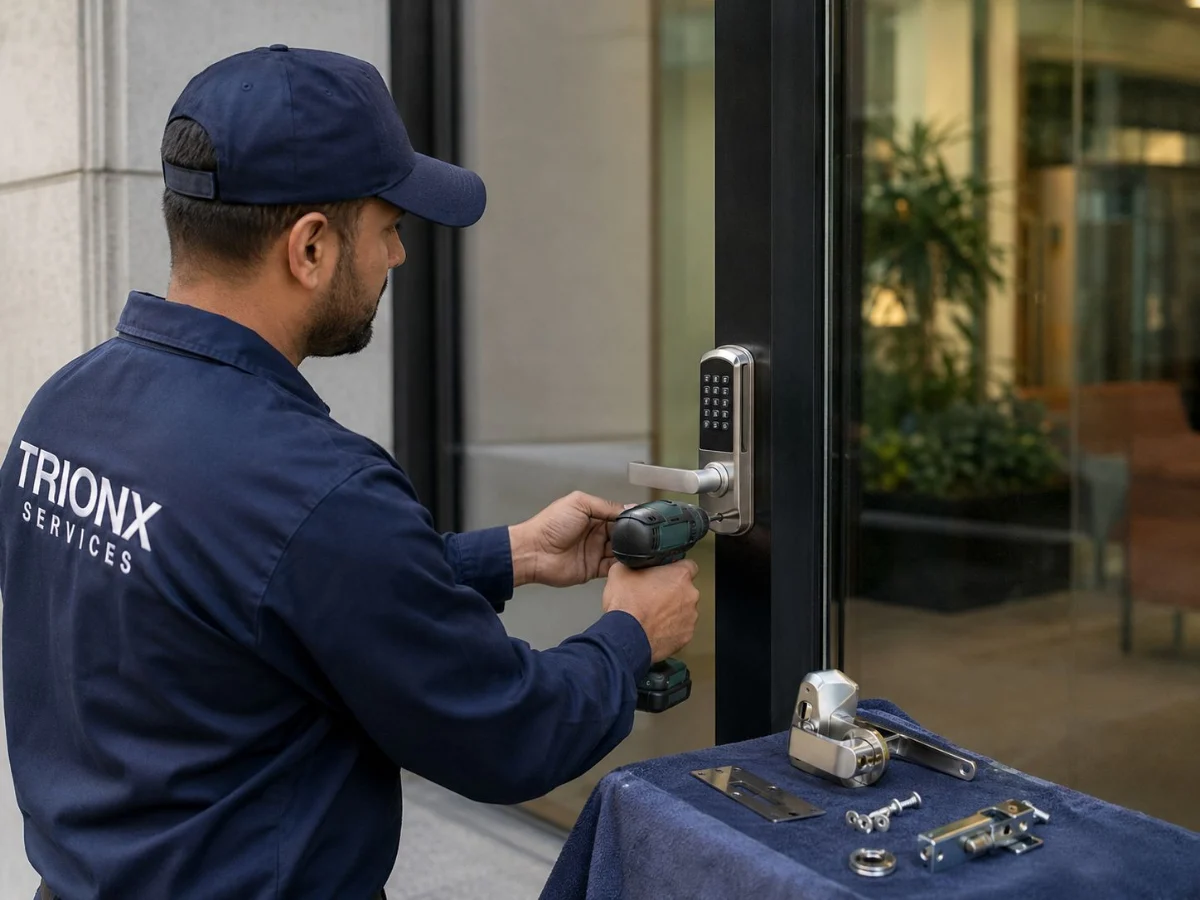
Fail-safe or fail-secure: what your electric strike does in a power cut
Replacing ceiling tile without wrecking the rest of the grid
Keypad or card reader has stopped working

Hotel back of house: maintenance around a building that never closes
Medical and dental suites: maintenance around patients
Taking over a restaurant space: what to check before signing
One company, whoever does the work
Our technicians handle the trades that need no state license, and licensed contractors handle the ones that do. Either way we scope it, book the visit and file the record. Tell us the property and the problem and we will come back with a window. Call out of hours and someone who works here answers.