
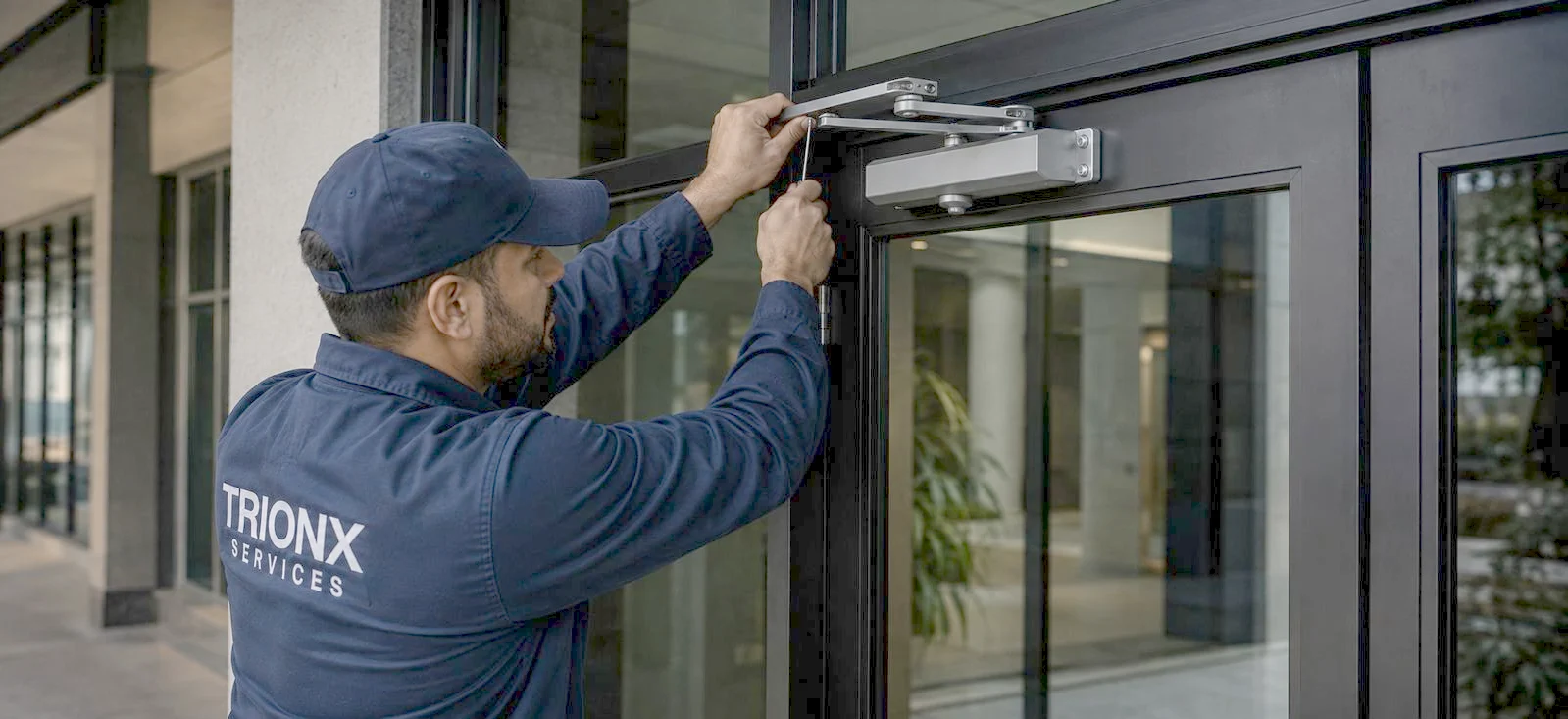
Doors
Schools and childcare: working around term time and access
The holidays are the maintenance window, and everything that needs one has to be booked against it.
A school runs on a calendar nobody can move. That single fact shapes the maintenance program more than the building does, because the work that needs a room, a route or quiet has one window and it is the holidays.
What the holidays are for
Anything noisy, dusty, or that closes a corridor. Flooring, ceilings, painting, anything structural, and any sequence that runs over more than a day.
That window is short and every school in the district wants it, so the list is built during term and booked early rather than assembled when the holidays start. A repair identified in October and scoped in November gets done at the break. One identified at the break waits for the next one.
More can happen in term time than people assume: a single door, hardware replacement, a lock change, a contained repair in a room that is free that period. It needs a timetable rather than a free hand, and it needs somebody on site who can say which room is empty when.
Door hardware dominates the list
A school has a great many doors, operated hard, by a great many people, all at the same moments of the day. Hardware wears at a rate that surprises anybody used to an office.
Most of those doors are on escape routes, which changes what a fault means. An exit device that needs a second push, a door that no longer latches, or a closer that has given up are all compliance findings rather than annoyances. Our articles on what an inspector checks on exit devices and fire door inspection cover the standard they are held to.
Classroom function hardware is its own category. It has to secure a room from inside without a key, and it has to be operable by somebody with full hands. Hardware that satisfies one and not the other gets fitted regularly and discovered late.
The things added for a practical reason
Every school accumulates them. A wedge under a fire door because the corridor gets hot. A chain on a gate because somebody was getting in at night. An exit device dogged so a route works during an event and never undogged afterward.
All of them are added by people solving a real problem, and all of them are findings. The durable answer is usually to fix the reason: a door that will not stay open has a hold-open device designed for it, and a gate that is being climbed has a hardware answer that is not a chain. Our article on a door that will not latch covers the most common underlying cause.
Access and who holds what
Schools issue a lot of keys, to teaching staff, facilities staff, cleaners, caterers, contractors and out-of-hours users of the hall or the field. Few of them are recorded anywhere.
A written register and a restricted keyway are worth more here than in most buildings, because the turnover is real and the consequence of an unaccounted key is not merely commercial.
Where out-of-hours rentals happen, the access arrangement for those is worth reviewing separately. It is usually the least controlled part of the whole system.
Accessibility gets tested constantly
A school entrance is used by parents, visitors and pupils with a wide range of needs, and a door that has stiffened as its closer aged becomes a genuine barrier rather than a heavy door. Measuring it rather than judging it by hand is the only way to know, and our article on opening force covers how.
Build the holiday list during term
The window is short and every school in the district is competing for the same contractors in it. A list assembled when the holidays start is a list that gets partly done.
The practical habit is a running log through term: what was noticed, where, and whether it can wait. A walk once a half term turns that into something schedulable rather than a set of recollections, and it also catches the things nobody reports because they are not anybody's job.
Our article on the quarterly property walk covers a repeatable version, and on a school calendar it maps naturally onto the breaks.
What the record is for
Escape routes and fire doors carry inspection obligations with dates attached, and those records get asked for. Keeping them with the maintenance file rather than in a folder somebody inherited is the difference between answering the question and reconstructing it.
Who carries this out
Doors and hardware, exit devices, closers, locks and access hardware, glass, carpentry, flooring, ceiling, painting and general maintenance are performed directly by our own technicians, who are background checked and on our payroll. TrionX carries general liability and workers' compensation on that work.
Electrical, plumbing, HVAC and roofing are coordinated through licensed contractors, because Florida requires a license for those at any job size.
Common questions
Questions we get asked about this
What actually has to wait for a holiday?
Anything noisy, dusty, or that takes a route or a room out of use. That is most substantial work. Repairs to a single door, hardware replacement and anything contained can usually happen in term time around the timetable.
Do your technicians work around children?
Our technicians are employees on our payroll and background checked rather than whoever a subcontractor had available. Where a school has its own screening or supervision requirements on top of that, those are met before anybody attends.
What gets missed most often?
Exit hardware that has been made easier to live with. A propped exit, a chained gate or a device that has been dogged when it should not be are all added for a practical reason and all of them are findings.
Keep reading
Related field notes
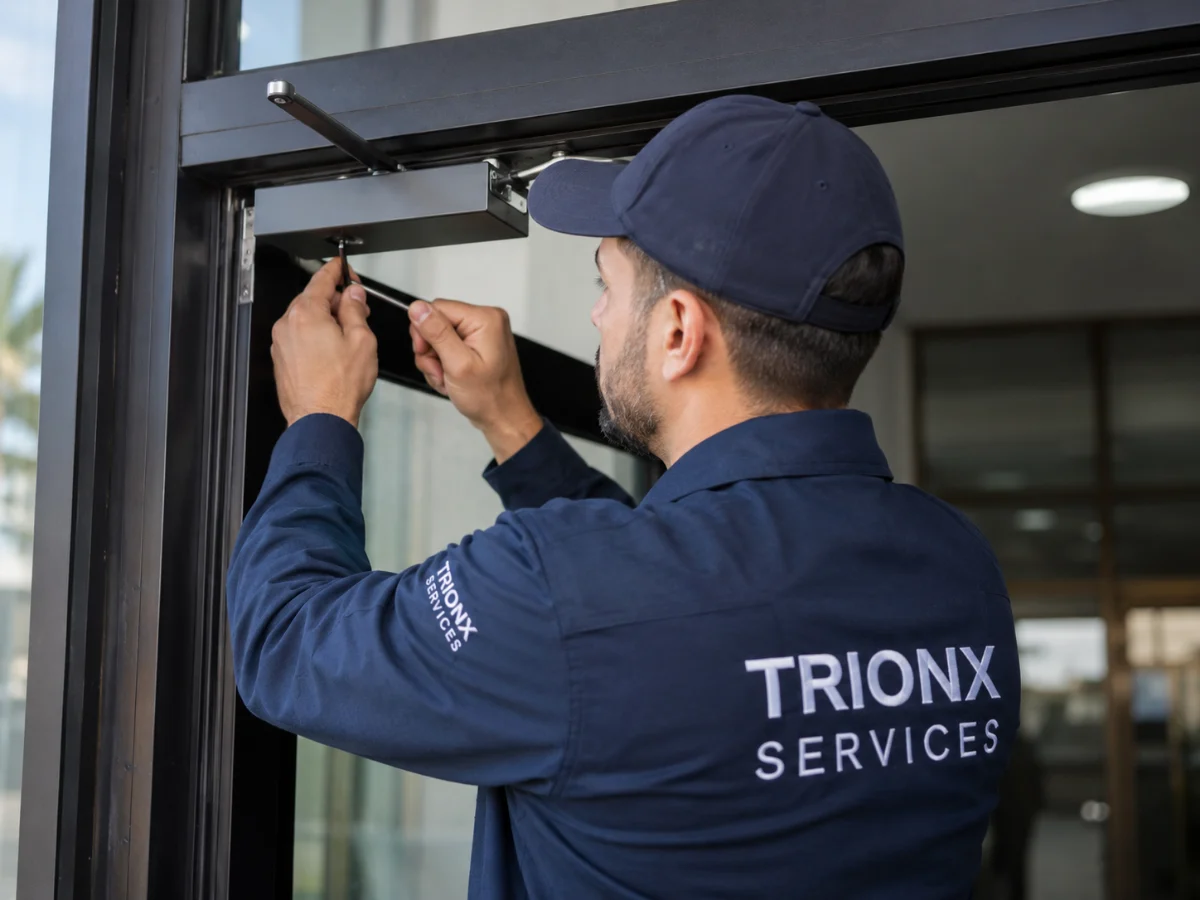
Fire door inspection: the annual requirement and the paperwork
A commercial door that will not close or latch
ADA opening force: the limit, and how doors fail it
A sliding door is hard to slide or off its track
Annual door closer and hinge service for a building
Servicing roller shutters and gates before they stick
One company, whoever does the work
Our technicians handle the trades that need no state license, and licensed contractors handle the ones that do. Either way we scope it, book the visit and file the record. Tell us the property and the problem and we will come back with a window. Call out of hours and someone who works here answers.