
Facilities
A vacant unit: what to check while it sits empty
An empty unit deteriorates faster than an occupied one, and almost all of it is preventable by turning up.

Set the air conditioning back rather than switching it off. In this climate that single decision does more to protect an empty unit than everything else on the list combined.
Then isolate the water supply at the stop, leaving anything feeding a sprinkler system alone, because a leak with nobody there is what turns an empty unit into a claim.
Humidity is the real enemy
An unconditioned commercial space through a Miami summer will grow mold in the drywall, the ceiling tile, the carpet and anything soft left behind. It happens quietly, it happens everywhere at once rather than in one spot, and the remediation is far more expensive than the electricity saved.
Set the thermostat back rather than off, so the system still runs and still dehumidifies. Where the unit has been left off and there is already a smell, our article on a musty smell with no visible water covers what to look for.
Change the filter before the vacancy starts, so the system is not running for months on a dirty one.
Water, in both directions
Isolate the supply so nothing can leak while nobody is watching. A failed flexible connector in an occupied building is a bad morning; the same failure in an empty unit runs for weeks.
Then handle the opposite problem. Drain traps dry out and let sewer gas in, so pour water down every drain on each visit. It takes minutes and it is the reason so many empty units smell.
If the unit has a water heater, decide deliberately whether it stays on. Left on it continues to cycle and its relief valve continues to be a risk; switched off it may need attention before reuse.
Making it look occupied
An empty unit that looks empty attracts attention, and the sequence tends to be graffiti, then attempted entry, then entry.
Keep the exterior lighting working and on a timer or photocell, keep the frontage clean, and clear post and flyers from the door. Cut back planting that gives cover. Where glazing is papered over, use something that looks deliberate rather than something that looks abandoned.
Check every external door locks and latches properly on each visit, and check the glass. Our article on an overnight break-in covers what a forced attempt leaves behind, which is worth recognizing early on a unit nobody is watching.
What a visit should actually cover
Walk the whole unit rather than the front. Look at ceilings for new stains, floors for water, walls for cracking, and use your nose in every room.
Refill the drain traps. Confirm the air conditioning is running and at the setting you left it. Check the perimeter for pest entry, since an empty unit is where they establish. Check that nothing has been dumped against the building.
Photograph the same views each time from the same positions. That series is what tells you whether something is changing, and it is what answers questions from a landlord, an insurer or an incoming tenant later.
Decide who else has access and write it down. Vacant units accumulate keys quickly: agents showing the space, contractors quoting, a cleaner, a build-out team. Each is reasonable on its own and together they are a key list nobody is maintaining, which is far easier to sort out now than on the day it is re-let.
Keep it presentable enough to show, too. A prospective tenant walking into a space that smells, with a stained ceiling and a dark frontage, negotiates from a different position than one walking into a space that looks maintained. That difference usually exceeds what the visits cost.
The paperwork side
Policies commonly attach conditions once a property has been unoccupied for a set period, sometimes including how often it must be inspected and what must be isolated. Read yours rather than assuming, because those conditions surface at claim time rather than before.
Where a loss control survey has already been carried out, its recommendations usually get stricter on a vacant property. Our article on a loss control survey that found deficiencies covers responding to one with evidence.
Who carries this out
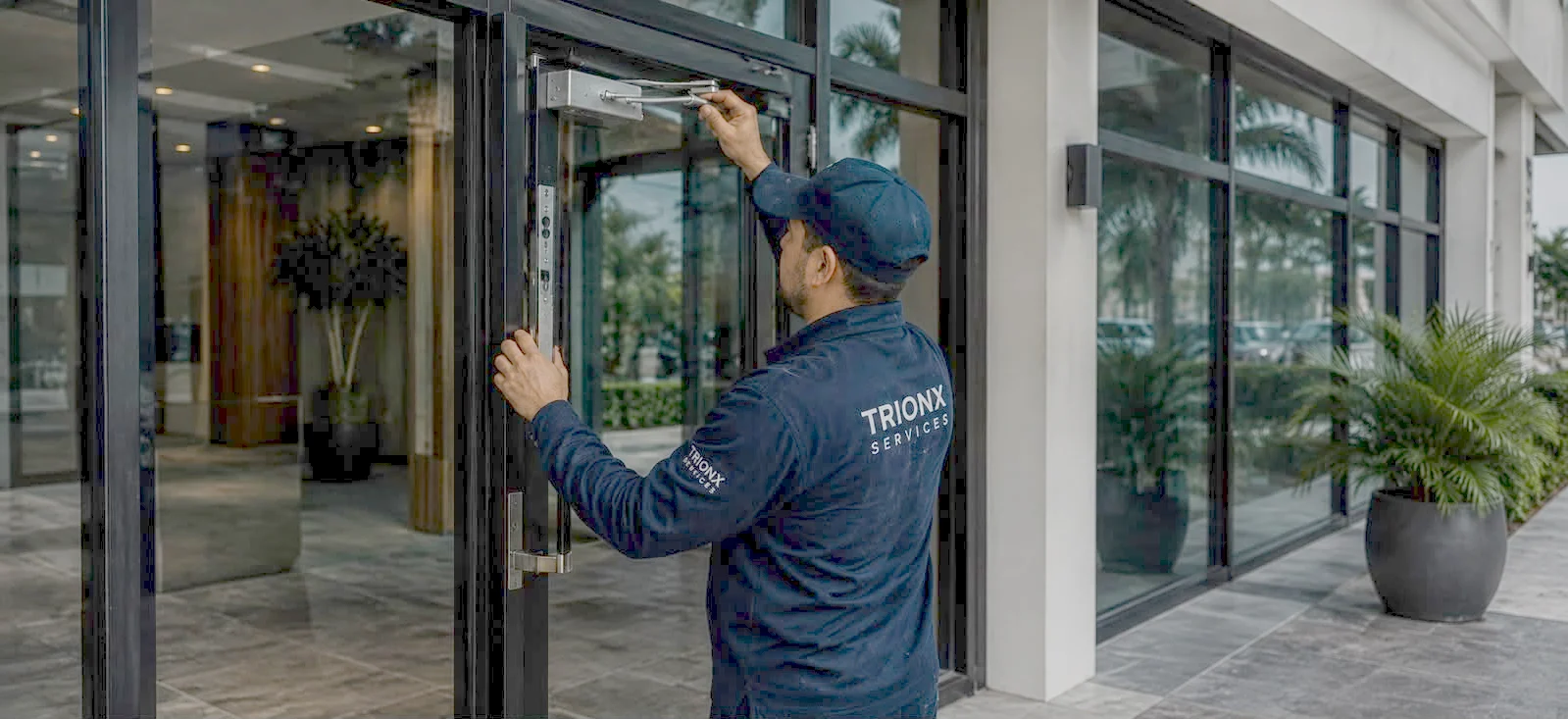
Doors, locks, glass, boarding, carpentry, painting, ceiling, sealing and general maintenance on a vacant unit are performed directly by our own technicians, and the visit itself comes back with photographs as standard.
Plumbing, electrical, HVAC and refrigeration are coordinated through licensed contractors, because Florida requires a license for those at any job size.
When it comes back into use
Start a week before the date rather than on it. Our article on reopening a space that has been closed covers the restart, and a unit that was visited properly while empty is a considerably shorter version of that list.
Common questions
Questions we get asked about this
Should I switch the air conditioning off to save money?
Not completely, and this is the expensive mistake in this climate. A unit left unconditioned through a Miami summer grows mold in the fabric and the ceiling, and the remediation costs far more than the running cost saved. Set it back rather than off.
Should the water be isolated?
Isolating the supply at the stop removes the leak risk, which is the main thing that damages an empty unit. Do not isolate anything feeding a fire sprinkler system. Refill the drain traps on each visit, because they will dry out.
Does vacancy affect insurance?
Policies commonly carry conditions once a property has been unoccupied for a set period, sometimes including inspection intervals. Check yours rather than assuming, because those conditions are exactly the sort that get discovered at claim time.
How often should somebody attend?
Often enough that a leak is found in days rather than months, and often enough that the unit does not look abandoned. Your policy may set a minimum. Record each visit instead of relying on memory.
Keep reading
Related field notes
Reopening a space that has been closed for months
An insurance loss control survey found deficiencies
There was a break-in overnight: securing the property and the record
Taking over a restaurant space: what to check before signing
Annual agreement or call by call
Pests are getting in: finding the entry points
One company, whoever does the work
Our technicians handle the trades that need no state license, and licensed contractors handle the ones that do. Either way we scope it, book the visit and file the record. Tell us the property and the problem and we will come back with a window. Call out of hours and someone who works here answers.