
Doors
Adjusting a door closer: the valves and what each one does
Three small valves control almost everything a closer does, and turning the wrong one is how a door stops latching.
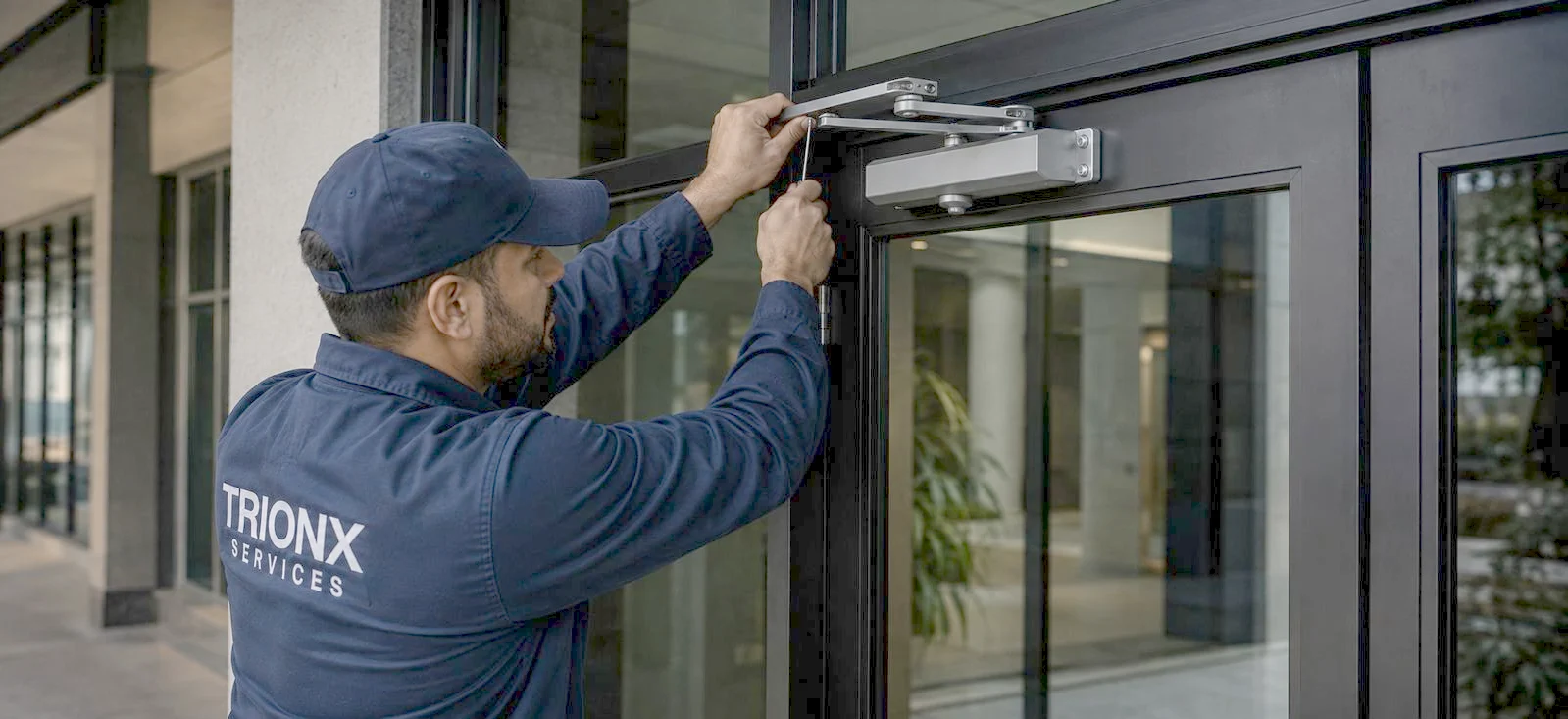
A commercial closer has a spring that pushes the door shut and a hydraulic circuit that controls how fast it travels. The valves meter the fluid. The spring is set separately, and mixing those two up is behind most closers that have been adjusted into a worse state than they started in.
The three valves
Sweep governs the main arc, from wide open down to roughly the last ten degrees. It is the speed people notice and the one usually meant when somebody says a door slams.
Latch governs those final few inches into the frame. It has to carry enough speed to drive the latch bolt into the strike against the seals and whatever pressure the building is under, while not being so fast that the door cracks into the frame.
Backcheck resists the door near the end of its opening arc, so it cannot be flung into a wall or a person. It is a cushion rather than a stop, and it should not be used to take the place of a door stop.
Some closers add a delayed action valve, which holds the door open a while before the sweep starts. It is genuinely useful on an accessible entrance or anywhere people move through slowly with carts.
How the adjustment actually goes
Small increments, an eighth to a quarter turn, then watch a complete cycle before touching anything. These valves have a short working range and the difference between right and wrong is often less than half a turn.
Never wind a valve fully closed. The fluid has to go somewhere and forcing it past a seal is how a closer starts weeping oil down the door, which our article on what a failing closer is telling you covers as a symptom.
Set sweep first and latch second, because latch is judged by whether the door actually latches, and that is easier to see once the approach speed is settled.
The mistake worth naming
A door feels heavy, so somebody winds the spring power down until it is easy to open. The door now opens nicely and no longer latches.
That trade is the wrong way round, and on a fire door it swaps a comfort problem for a life safety one. Where a door genuinely has to be both easier to open and reliably latching, the answer is usually elsewhere: a dropped door binding on the frame, seals compressed harder than they were meant to be, or building pressure working against the opening. Our article on opening force covers measuring it properly before anybody reaches for the spring.
The arm matters as much as the valves
Regular arm mounts on the pull side and gives the most mechanical advantage, so it closes the most reliably and projects the furthest into the opening.
Parallel arm mounts on the push side and tucks against the door, which is tidier and more resistant to being vandalized, at the cost of some efficiency. Top jamb mounts on the frame face where the door has no room for the others.
A closer fitted in the wrong configuration for its opening cannot be adjusted into behaving, and that is worth checking before spending time on the valves.
When the closer is not the problem
If the door binds at one point in its travel, that is alignment rather than hydraulics. If several doors on the same elevation misbehave together, that is building pressure. If the latch catches on the edge of the strike, the strike or the door position needs correcting first.
Our article on why commercial doors drop covers the diagnosis, and adjusting a closer on a door that has dropped is effort spent on the wrong component.
Size is not the same as adjustment
Closers are made in sizes, conventionally numbered, and the size is matched to the width and weight of the door. A wide or heavy leaf needs more spring than a light internal door, and no amount of valve adjustment compensates for a unit that is simply too small for the opening.
Many commercial closers are adjustable across a range of sizes, which is genuinely useful and is also how the wrong setting survives for years. A door that will not close the last few inches in any weather, or one that needs a shove on a windy day, is usually undersized rather than badly valved.
Exterior doors want sizing toward the upper end of the range, because wind and building pressure both work against closing. A closer set indoors in still air behaves quite differently once the air conditioning starts, for the same reason.
Who carries this out
Closers, arms, adjustment, replacement and the alignment work around them are performed directly by our own technicians. None of it requires a Florida contractor license, and TrionX carries general liability and workers' compensation on that work.
On a fire rated assembly the closer has to be a rated unit and the door has to close and latch from any position, which is checked as part of the work rather than assumed.
Common questions
Questions we get asked about this
What are the valves on a door closer?
Usually three. Sweep controls the speed across most of the arc, latch controls the last few inches into the frame, and backcheck resists the door being flung open into a wall. Some closers add delayed action, which holds the door open longer before the sweep begins.
Is spring power the same as closing speed?
No, and confusing the two causes most bad adjustments. Spring power is how hard the closer pushes, set separately by a size adjustment. The valves meter hydraulic fluid and control how fast it moves. Winding spring power down to make a door easier to open changes the force, not the speed.
How much should a valve be turned?
Small amounts, an eighth to a quarter turn, then watch a full cycle before touching it again. These valves have a narrow working range and closing one fully can force fluid past a seal, which is how a closer starts leaking.
Why does the door have to latch?
Because a door resting against the frame is not closed. It is a security exposure overnight, it defeats access control on the opening, and on a fire door it is a life safety failure and the finding inspectors record most often.
Keep reading
Related field notes
Why commercial doors drop, and what alignment actually involves
ADA opening force: the limit, and how doors fail it
Thresholds, sweeps and weatherstripping: the parts that wear first
Schools and childcare: working around term time and access
A sliding door is hard to slide or off its track
The fire inspector wrote us up: closing the findings out
One company, whoever does the work
Our technicians handle the trades that need no state license, and licensed contractors handle the ones that do. Either way we scope it, book the visit and file the record. Tell us the property and the problem and we will come back with a window. Call out of hours and someone who works here answers.