
Doors
Repair or replace a commercial door
The frame decides this more often than the door does, and it is the half nobody looks at.
Close the door and look at the gap around all four edges before deciding anything about the leaf. An even gap means the frame is square and everything else is fixable. A gap that tapers means the frame has moved, and no new door will cure it.
This gets the wrong answer more often than any other question about doors, because the leaf is what people look at and the frame is what decides.
What is repairable, which is more than most people assume
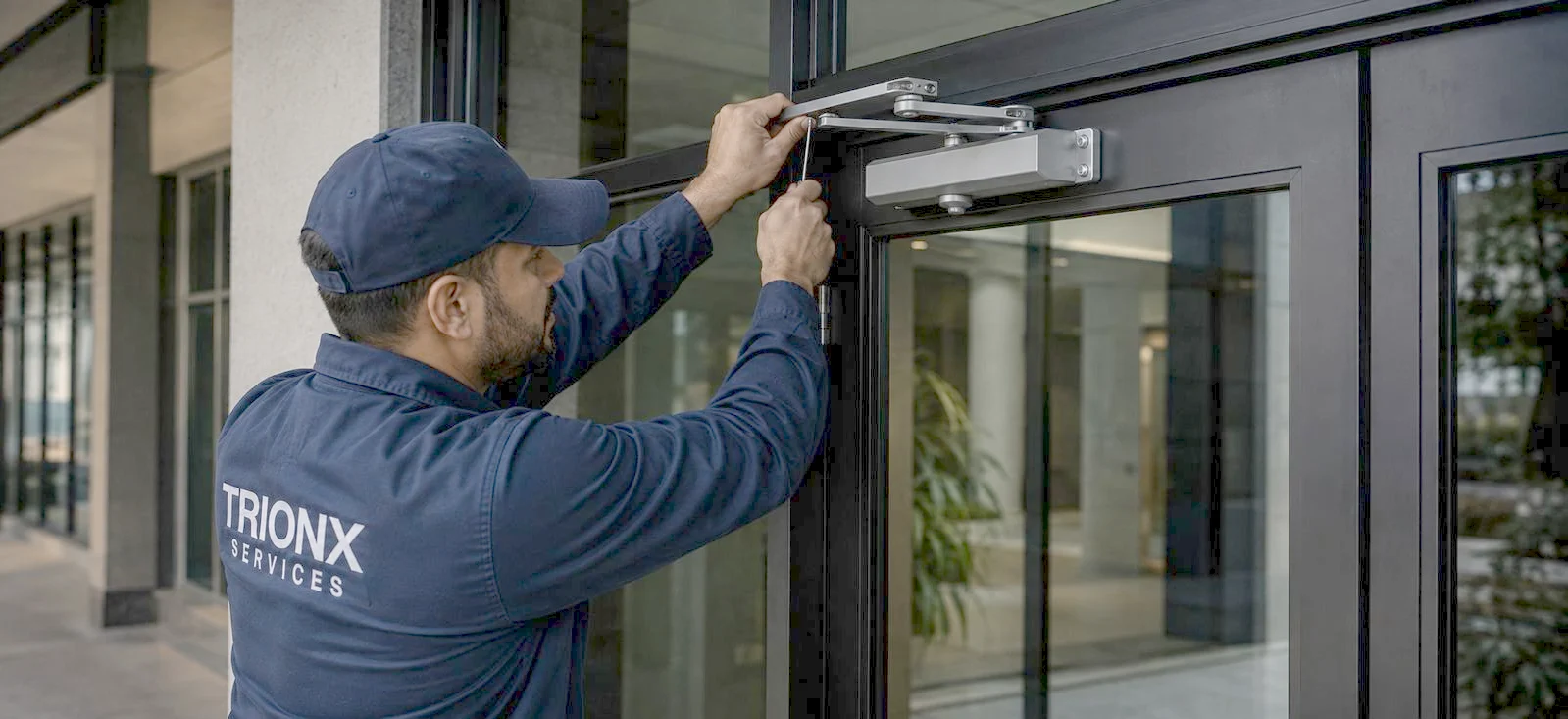
Almost all hardware. Closers, hinges, exit devices, locks, handles, thresholds and weatherstripping are replaceable individually on a sound door, and a door with every piece of hardware renewed is effectively a new door at a fraction of the cost.
Alignment. A dropped door, worn hinges and a strike out of position are adjustment work, and they account for a large share of doors that people had written off. Our article on why commercial doors drop covers what that involves.
Surface damage, dents and finish. Local corrosion that has not gone through. Glazing in a vision panel. A closer of the wrong size for the leaf is also a repair: the closer is swapped and the door stays.
What makes replacement unavoidable
Corrosion through the leaf, particularly at the bottom rail of a hollow metal door. Water sits inside the leaf and works outward, so what is visible understates it. Once section is lost around hinge or lock reinforcement, there is nothing left to fix to.
A delaminated or swollen leaf, where the skin has separated or a timber core has taken water. It will not hold hardware reliably again.
A frame that is out of square beyond what packing and adjustment can take, or one whose fasteners have lost their grip in the wall. Replacing the frame is the larger job and it is sometimes the only honest answer.
A rated assembly that has been compromised past what its listing allows: cut through, drilled through for cables, or fitted with components that are not rated. Our article on fire door inspection covers what a rated assembly has to satisfy.
Hardware that is obsolete with no parts available, which is common on older aluminum storefront and on proprietary systems.
The rated door rule, stated plainly
A fire rated door is an assembly and every part of it has to carry a rating: the leaf, the frame, the hinges, the closer, the latch, the seals and the glazing. Making good a rated door with unrated parts produces something that looks correct and is not.
That constrains repair in a way it does not on an ordinary door, and it is worth establishing whether a door is rated before scoping anything. On a rated door the answer is more often replacement than it would otherwise be.
Lead time belongs in the decision
Hardware is largely stocked. Doors are not. A replacement leaf is ordered, and a rated door, a hurricane rated door or anything non-standard in size takes longer still.
So the question is rarely repair against replacement in the abstract. It is whether the opening can be left in its current state for as long as a replacement takes. Where it cannot, a repair that restores security and function while the replacement is on order is the right first move even when replacement is the eventual answer.
Establishing that on day one, rather than after a survey, is what keeps a door from standing unusable for weeks.
The repeat repair test
A door that has needed attention three times in two years is telling you something the individual visits did not. Look at the pattern rather than the last fault.
Usually the underlying cause is the frame, the building pressure, or traffic the door was never specified for. A door in a delivery route taking cart impacts daily is not a maintenance problem, it is a specification one, and the answer is a door built for that rather than another repair.
Where the same door keeps wearing out locks, our article on locksmith or door company covers why that happens and why it produces two invoices.
Who carries this out
Repairs, hardware replacement, alignment, frame adjustment and full door and frame replacement on an existing opening are all performed directly by our own technicians. None of it requires a Florida contractor license, and TrionX carries general liability and workers' compensation on that work.
Altering an opening, structural work around it, and anything requiring a permit are coordinated through licensed contractors. On an exterior opening in Miami-Dade a replacement may bring a product approval submittal with it, which makes it permitted work whatever the trade.
Common questions
Questions we get asked about this
How do I know whether the frame is the problem?
Close the door and look at the gap all the way round. An even gap means the frame is square and the door is the variable. A gap that tapers means the frame has moved, and fitting a new leaf into it produces the same fault in a month.
Is a door with a rusted bottom rail repairable?
Sometimes, and it depends how far it has gone. Corrosion at the bottom of a hollow metal door usually means water has been sitting in the leaf, so the inside is worse than the outside. Once it has lost section around the hardware, it is a replacement.
Can a fire rated door be repaired?
Within limits, and every part used has to carry a rating. A rated assembly cannot be made good with unrated components, holes cannot simply be filled, and once a leaf or frame is compromised beyond what the listing allows it is a replacement.
Why does lead time matter to the decision?
Because a replacement door is ordered, and a rated or hurricane rated one takes longer. Where an opening cannot stand open for that period, a repair that buys time is the right first move even when replacement is the eventual answer.
Keep reading
Related field notes

What a failing door closer is telling you
Do I need a locksmith or a door company?
Fire door inspection: the annual requirement and the paperwork
Giving a vendor access: keys, codes and sign-in rules
Annual door closer and hinge service for a building
Servicing roller shutters and gates before they stick
One company, whoever does the work
Our technicians handle the trades that need no state license, and licensed contractors handle the ones that do. Either way we scope it, book the visit and file the record. Tell us the property and the problem and we will come back with a window. Call out of hours and someone who works here answers.